Temperature18 – 24 °C
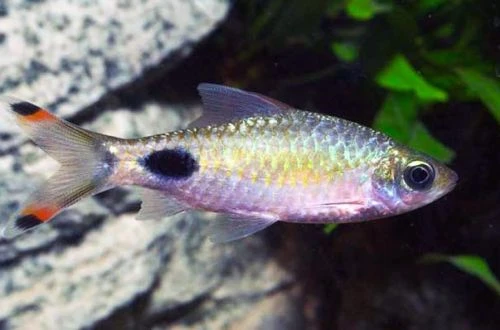
The fish known as Mahecola Barb (scientific name Puntius mahecola) is classified within the family Cyprinidae. It is very popular in Asian countries, especially India, but outside of this region, in Europe and America, it is extremely rare. This species of aquarium fish is considered undemanding and easy to keep, coexisting perfectly with various freshwater neighbors.
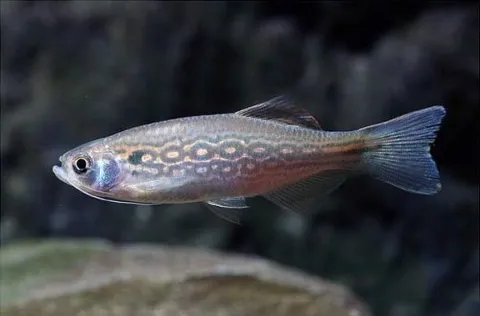
Adults typically reach a length of about 7 cm. It should be noted that sexual dimorphism is quite weak, making it almost impossible to distinguish males from females. Their coloration is characterized by silvery tones with prominent large scales that can acquire greenish or bluish hues depending on the lighting. Their fins are translucent, with a reddish tint, and the tips of the caudal fin are adorned with a red and black pattern. One of the most striking and recognizable features is a large black spot located at the base of the caudal fin.
The natural habitat of this species covers India, including the states of Karnataka, Tamil Nadu, and Kerala. The Mahecola Barb inhabits river systems that originate in the Western Ghats mountain range and flow into the Laccadive Sea. Preferred habitats are shallow sections of rivers (up to 2 meters) with moderate currents, as well as lagoons and lakes. Sandy or rocky substrates dominate these waters, and aquatic vegetation is found only in small quantities.
This is a peaceful and calm fish that coexists well with other non-aggressive species of comparable size. Keeping them in a group of 8–10 individuals increases their activity, and the presence of larger neighbors does not make them overly timid. Furthermore, schooling positively affects the intensity of their coloration; males display their best colors when competing with each other for the attention of females.
For a small group of these fish, an aquarium of at least 80 liters is considered optimal. In terms of decor, the Mahecola Barb is quite undemanding and can adapt even to a minimally decorated tank. They also do not have high requirements for keeping conditions, demonstrating the ability to cope with a wide range of hydrochemical parameters. Routine aquarium care includes several standard procedures: weekly partial water changes (30% to 50% of the volume) with fresh water, systematic removal of organic waste (e.g., food debris and excrement), maintaining equipment in good working order, and monitoring and stabilizing pH and dGH parameters.
Being an omnivorous species, these fish in a home aquarium readily accept most common foods of appropriate size, including live, frozen, freeze-dried, and dry options.
As of the preparation of this information, reliable data on the successful breeding of Mahecola Barbs in home aquariums has not been recorded. The absence of such information is primarily due to the limited prevalence of this species in aquaristics outside its native India.
In a balanced aquarium ecosystem, closely matching the requirements of this species, diseases are extremely rare. Illnesses often arise due to deteriorating habitat quality, contact with already sick fish, or physical injuries.
When choosing a Mahecola Barb, it is important to consider that this species is rarely widely available and is often confused with other members of the genus. Healthy individuals should be active, show interest in their surroundings, and stay in a school if several specimens are in the aquarium. Avoid fish with signs of lethargy, scale damage, body film, or an unnaturally bloated abdomen. Before purchasing, inspect the fins for integrity and absence of white spots, which may indicate parasitic diseases. Since the species is schooling, it is recommended to acquire a group of 8–10 individuals at once, which reduces stress levels in fish during transport and adaptation to new conditions. Ensure that the keeping conditions in the store meet the basic needs of the species, and that the fish do not show signs of emaciation.
The essentials: size, tank volume, water parameters and care
An adult reaches 7 cm in length. Plan the tank around the maximum size: the fish quickly outgrows a cramped setup.
The recommended volume is 80 L. A smaller tank speeds up nitrate build-up and raises stress levels.
Temperature 18–24 °C, pH 6–7.5, hardness 1–15 dGH. Stability matters more than exact values: sudden swings are harder on the fish than a small deviation from the ideal.
Around 4 years when kept properly. Lifespan depends directly on tank volume, water quality and a varied diet.
Temperament: peaceful (regular). Keep this in mind when choosing tank mates.
Recommended setup: group (8–10 individuals). Ignoring this is a common cause of stress and disease.
Diet type: any (universal). Feed small portions that are finished within a couple of minutes — overfeeding does more harm than underfeeding.
The scientific name of the species is Puntius mahecola, family Cyprinids (Cyprinidae). It also appears in the literature as: Leuciscus mahecola.
The water suits 196 of 208 plants in the catalogue — the easiest ones are shown first.
Afzelius's AnubiasAnacharisAnubiasBrazilian PennywortDwarf CloverDwarf CloverDwarf HygrophilaDwarf SagittariaDwarf ValGuppy GrassHornwortJava FernJava MossMoneywortMud SwordNarrow Leaf AnacharisNarrow-leaf CloverStringy MossSüsswassertangTaiwan MossTape GrassTemple PlantUssuri WatermilfoilWater Wisteria
Matched by family, categories and overlapping keeping conditions
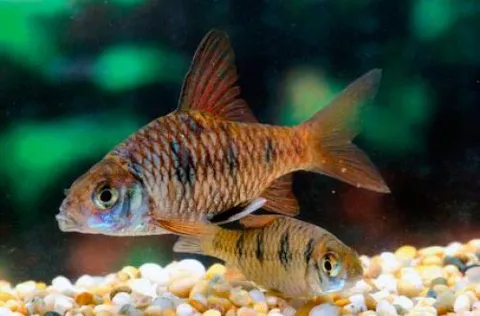
Puntius sahyadriensis
Puntius sahyadriensis, or Maharashtra Barb, is a member of the Cyprinidae family. Among various barb species, it stands out with its distinctive angular body shape, making it easily recognizable. This species is easy to…
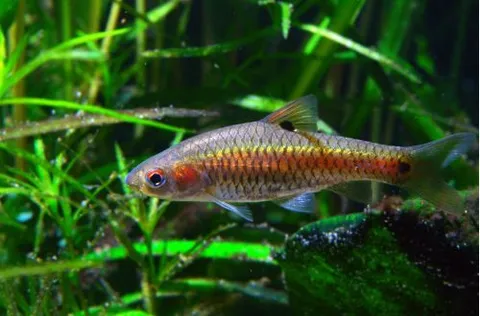
Puntius bimaculatus
Puntius bimaculatus, or the Two-Spot Barb, belongs to the family Cyprinidae. Kept in a school, these fish make a wonderful addition to almost any aquarium. They are undemanding in care, easy to breed, and compatible…
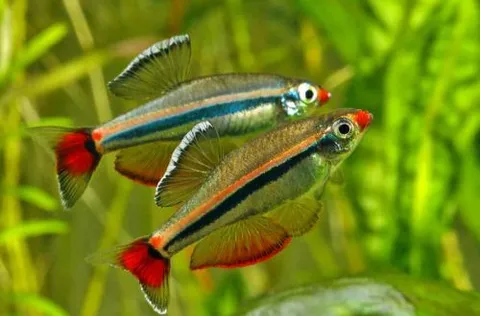
Tanichthys micagemmae
The Vietnamese Cardinal, or Tanichthys micagemmae by its scientific name, belongs to the family Cyprinidae (Carps). This fish was first discovered in 2001 and quickly found its place in home aquariums. It became a…
Danio dangila
Danio dangila, or Whiskered Danio (scientific name Danio dangila), belongs to the family Cyprinidae, known as carps. This fish stands out from other Danios due to its noticeably longer barbels. Its ease of care,…