Temperature18 – 24 °C
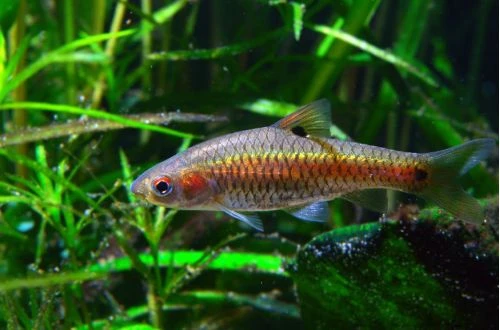
Puntius bimaculatus, or the Two-Spot Barb, belongs to the family Cyprinidae. Kept in a school, these fish make a wonderful addition to almost any aquarium. They are undemanding in care, easy to breed, and compatible with many popular species, making them an excellent choice for beginner aquarists.
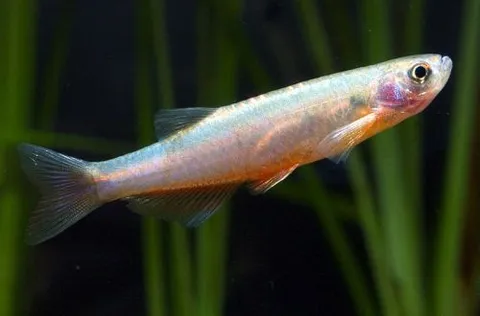
These fish are miniature species, rarely exceeding 5 cm in length. Males are distinguished by a more elegant and slender physique, while females appear fuller, especially during the breeding season. Their coloration includes a red horizontal stripe, the intensity of which varies significantly from individual to individual: in some, it is clearly visible, in others, barely discernible. A characteristic feature of their body pattern, reflected in their Latin name, is two dark spots. One is located in the middle at the base of the dorsal fin, and the other on the caudal peduncle.
The natural habitat of this species covers the southern regions of India and the island of Sri Lanka. These fish inhabit numerous rivers and streams, from shallow to medium-sized, that flow from hills and mountain slopes hidden under the dense canopy of tropical forests. They prefer areas with relatively calm currents and are not found in plains. In Sri Lanka, they can be found in mountain streams at an altitude of over 1500 meters above sea level—an unusually high mark for freshwater species. Unfortunately, wild populations have significantly declined due to human activities, including water pollution, deforestation, and intensive collection of individuals for the aquarium trade.
The Two-Spot Barb is a very peaceful and social schooling fish. Thanks to its calm temperament and undemanding nature regarding water hydrochemical parameters, it coexists well with most popular peaceful species of similar size, including other cyprinids, livebearers, and characins. It is recommended to keep these fish in groups of 6–10 individuals. This not only reduces their shyness but also contributes to a more vibrant display of coloration, which is especially noticeable in males.
For a school of Two-Spot Barbs, a relatively small aquarium, from 60 L, equipped with abundant vegetation, will be needed. Optimal conditions for these modest inhabitants will be created by dense plant thickets in a sandy or rocky substrate, supplemented with roots, snags, and other shelters. Floating plants will also be beneficial, as they help gently diffuse light. As for water parameters, the fish prefer slightly acidic pH values, close to neutral, and water with low to medium hardness. More detailed information on pH and dGH parameters, as well as methods for their correction, can be found in the “Hydrochemical Composition of Water” section. The recommended minimum set of equipment includes a filtration system, a heater, an aerator, and lighting fixtures. The latter should be set to low power, as the fish do not like bright light. Aquarium maintenance involves weekly partial water changes (20–30% of the volume) and regular cleaning of the substrate from organic deposits.
In their diet, Two-Spot Barbs prefer a wide variety of food, including both protein and plant components. For home keeping, high-quality dry or freeze-dried foods, such as flakes and granules, can be used. Live or frozen foods, such as daphnia, bloodworms, small aquatic insects, and other zooplankton, will be an excellent addition to the main diet. It is recommended to feed the fish 2–3 times a day, offering a portion they can eat within 5 minutes; any leftover food after feeding should be removed.
Under favorable conditions, the breeding period occurs several times a year. Special conditions for spawning are usually not required, as the fish successfully reproduce even in a community tank. However, given their lack of developed parental instincts and tendency to eat their own fry, it is recommended to conduct spawning in a separate tank. A volume of 15–20 L is usually sufficient for a spawning aquarium. Large pebbles (marbles) or ordinary sand covered with a fine mesh are used as substrate. This allows the eggs to fall freely into the gaps between the stones or under the mesh, remaining inaccessible to the parents. If desired, plants can be used, choosing low-growing species with small leaves that form dense thickets, such as Java moss. Such plants serve as additional cover for the eggs. Spawning aquarium equipment includes a simple sponge filter and a heater. Intense lighting is not required—dim room light will be quite sufficient. The aquarium is filled with water from the main tank. The stimulus for the onset of the breeding period is an increase in water temperature to the upper permissible limit (23–24°C) and a predominance of protein foods (live or frozen) in the diet. After some time, the females will noticeably round out, which is a signal for their transfer to a separate tank. A day later, a male or several males are added to them. After spawning, the fish are returned. Fry appear after 1–2 days, and after another 24 hours, they begin to actively swim in search of food. They should be fed microscopic foods: special store-bought foods or live foods such as Artemia nauplii, microworms, or infusoria can be used.
The Two-Spot Barb has a strong immune system when kept in appropriate water parameters. The main health problems arise from environmental imbalances, particularly the accumulation of nitrogenous compounds, which weakens the organism and leads to secondary infections. The most common diseases include bacterial skin and fin lesions, as well as ichthyophthiriasis. Prevention includes maintaining cleanliness, regular water changes, and ensuring good aeration. It is important to avoid sharp fluctuations in temperature and pH parameters, as stress is the main predisposing factor for disease development in this species.
When purchasing, choose active fish that stay in a school and display natural species-specific behavior. Healthy individuals have clean fins without signs of rot, film, or ulcers, and their scales lie flat against the body. It is recommended to avoid specimens with signs of emaciation, sunken bellies, or unnaturally bloated bodies. Before purchasing, it is important to inspect all fish in the tank, as the presence of sick individuals in a common tank indicates a risk of infection for the entire stock. During transport and adaptation to a new aquarium, fish may temporarily pale due to stress, but their coloration should recover within a few days if suitable conditions are provided.
The essentials: size, tank volume, water parameters and care
An adult reaches 5 cm in length. Plan the tank around the maximum size: the fish quickly outgrows a cramped setup.
The recommended volume is 60 L. A smaller tank speeds up nitrate build-up and raises stress levels.
Temperature 18–24 °C, pH 6–7.5, hardness 2–16 dGH. Stability matters more than exact values: sudden swings are harder on the fish than a small deviation from the ideal.
Around 5 years when kept properly. Lifespan depends directly on tank volume, water quality and a varied diet.
Temperament: peaceful (regular). Keep this in mind when choosing tank mates.
Recommended setup: schooling (usually from 5–6 individuals and more). Ignoring this is a common cause of stress and disease.
Diet type: any (universal). Feed small portions that are finished within a couple of minutes — overfeeding does more harm than underfeeding.
The scientific name of the species is Puntius bimaculatus, family Cyprinids (Cyprinidae). It also appears in the literature as: Barbus bimaculatus, Barbus puckelli, Gnathopogon bimaculatus.
The water suits 196 of 208 plants in the catalogue — the easiest ones are shown first.
Afzelius's AnubiasAnacharisAnubiasBrazilian PennywortDwarf CloverDwarf CloverDwarf HygrophilaDwarf SagittariaDwarf ValGuppy GrassHornwortJava FernJava MossMoneywortMud SwordNarrow Leaf AnacharisNarrow-leaf CloverStringy MossSüsswassertangTaiwan MossTape GrassTemple PlantUssuri WatermilfoilWater Wisteria
Matched by family, categories and overlapping keeping conditions
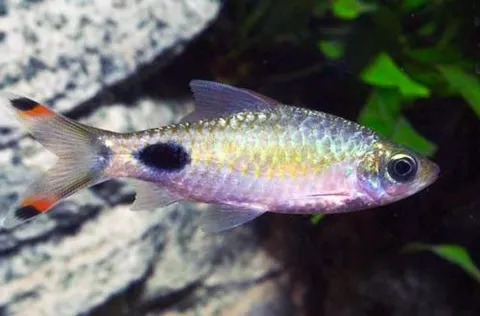
Puntius mahecola
The fish known as Mahecola Barb (scientific name Puntius mahecola) is classified within the family Cyprinidae. It is very popular in Asian countries, especially India, but outside of this region, in Europe and America,…
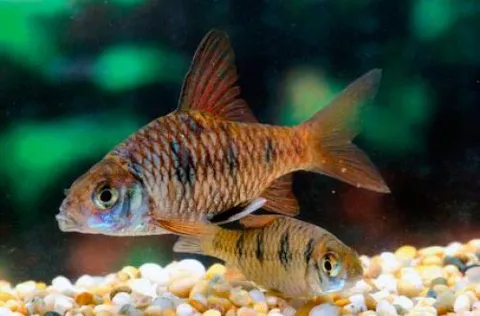
Puntius sahyadriensis
Puntius sahyadriensis, or Maharashtra Barb, is a member of the Cyprinidae family. Among various barb species, it stands out with its distinctive angular body shape, making it easily recognizable. This species is easy to…
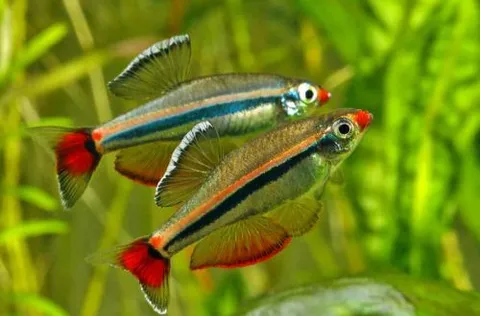
Tanichthys micagemmae
The Vietnamese Cardinal, or Tanichthys micagemmae by its scientific name, belongs to the family Cyprinidae (Carps). This fish was first discovered in 2001 and quickly found its place in home aquariums. It became a…
Danio roseus
The Rosy Danio, scientifically known as Danio roseus, belongs to the family Cyprinidae (Carps). This fish is a relatively recent addition to the aquarium hobby but has quickly gained popularity. Its care and breeding…