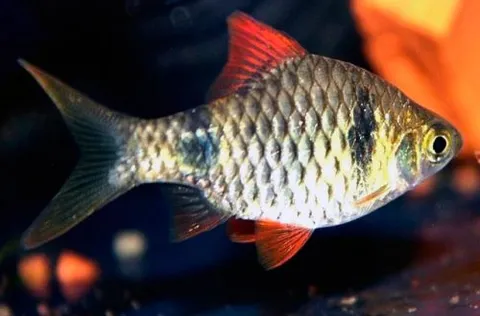
Reval Barb
Pethia reval
Pethia reval, known as the Reval Barb, belongs to the family Cyprinidae. For a long time, the species was considered only a color variant of the Cuming's Barb, and only in 2008 did it receive independent status.…
Puntius vittatus, known as the greenstripe barb, belongs to the carp family (Cyprinidae). This undemanding fish adapts readily to aquarium conditions, breeds easily, and lives peacefully with most mild-mannered tank mates. Despite these strengths, it is less common in the hobby than other barbs, possibly because of its subdued coloration.
Adult greenstripe barbs reach about 4.5 cm. Males have a grey body with a noticeable green sheen, especially above the lateral line. Females are more subdued, showing a silvery colour without pronounced green tones. Both sexes have a characteristic marking at the base of the tail and dorsal fin: a black spot or band on a red background.
This species is widespread across the Indian subcontinent and Pakistan. In the wild it inhabits lowland waters with slow current and silted bottoms. The fish live in tributaries of large rivers, oxbow lakes, various canals, swamps, and rice paddies. Some researchers suggest that this common name may cover several closely related species, which would limit the true geographic range.
This is a peaceful, adaptable species that gets along well with other similarly sized aquarium fish, especially those from Asia and Southeast Asia. It can also be kept successfully with fish from other continents, such as tetras. House these barbs in a school of at least 8–10 to keep them comfortable and encourage their natural behaviour.
A small school needs a tank of about 60 litres or more. Tank design is not critical, but dense plantings—including floating plants—and dark substrate tend to intensify their colouration. In a sparsely planted tank with bright lighting, the green sheen may fade. Care is straightforward even for beginners if you follow standard practices: weekly water changes, regular removal of decaying matter, monitoring of pH and water dH, and routine equipment maintenance. A reliable filter is essential for stable water conditions. Choose a filter that does not create strong flow, since these fish are poorly adapted to fast-moving water.
These fish are not fussy eaters. In the aquarium they thrive on quality dried foods such as flakes and granules. However, adding live or frozen treats like bloodworms or brine shrimp to the diet is beneficial and welcome.
Greenstripe barbs breed in the typical carp fashion. During spawning, females scatter hundreds of eggs in the water column, which males then fertilize. These fish show no parental care, so adults will eat both eggs and newly hatched fry after spawning. Survival in the main tank is very poor. To preserve all or most of the offspring, set up a separate spawning tank in advance with identical water parameters—temperature, pH, and water dH. Small containers such as 3-litre jars fitted with a simple sponge filter and heater work well. Room light is sufficient; extra lighting is not needed. Artificial plants, shade-loving mosses, or ferns serve as décor. After spawning, carefully move the eggs to the prepared spawning tank. Incubation takes about 24–48 hours. A day later the fry begin to swim actively. Feed them infusoria for the first few days. After about a week, expand their diet to include brine shrimp nauplii and other small foods.
In a well-balanced aquarium environment that meets this species' needs, disease is rare. Illness usually results from poor water quality, contact with sick fish, or physical injury.
When selecting greenstripe barbs, watch the activity level of the school in the tank. Healthy individuals should be active, with no visible scale damage, torn fins, or signs of ulcers or growths. Avoid fish that stay apart, breathe heavily, or show obvious weight loss. Since this species often comes from wild-caught stocks, check for external parasites. Choose fish that show interest in food and do not panic when you approach the glass. Ask the seller how long the batch has been in the shop, as recently imported fish are highly stressed.
There are no pair reviews for this species yet — check tankmates in the matcher.
All tankmatesThe water suits 197 of 208 plants in the catalogue — the easiest ones are shown first.
Afzelius's AnubiasAnacharisAnubiasBrazilian PennywortDwarf CloverDwarf CloverDwarf HygrophilaDwarf SagittariaDwarf ValGuppy GrassHornwortJava FernJava MossMoneywortMud SwordNair's LagenandraNarrow Leaf AnacharisNarrow-leaf CloverStringy MossSüsswassertangTaiwan MossTape GrassTemple PlantUssuri Watermilfoil
Matching water does not mean the plant will stay intact.
The essentials: size, tank volume, water parameters and care
An adult reaches 3.5–4.5 cm in length. Plan the tank around the maximum size: the fish quickly outgrows a cramped setup.
The recommended volume is 60 L. A smaller tank speeds up nitrate build-up and raises stress levels.
Temperature 18–26 °C, pH 6–7.5, hardness 2–12 dGH. Stability matters more than exact values: sudden swings are harder on the fish than a small deviation from the ideal.
Around 4 years when kept properly. Lifespan depends directly on tank volume, water quality and a varied diet.
Temperament: peaceful (regular). Keep this in mind when choosing tank mates.
Recommended setup: group (8–10 individuals). Ignoring this is a common cause of stress and disease.
Diet type: small / appropriate size / pieces. Feed small portions that are finished within a couple of minutes — overfeeding does more harm than underfeeding.
The scientific name of the species is Puntius vittatus, family Cyprinids (Cyprinidae). It also appears in the literature as: Barbus vittatus.
Matched by family, categories and overlapping keeping conditions
Pethia reval
Pethia reval, known as the Reval Barb, belongs to the family Cyprinidae. For a long time, the species was considered only a color variant of the Cuming's Barb, and only in 2008 did it receive independent status.…
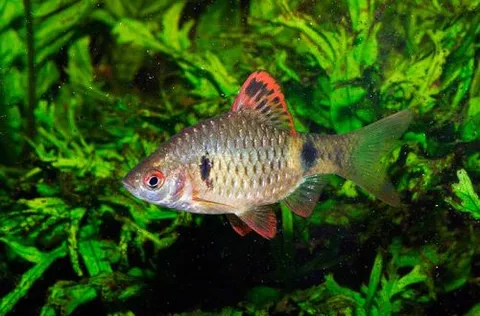
Pethia stoliczkana
Pethia stoliczkana, known as Stoliczka's Barb, belongs to the carp family (Cyprinidae). The species is named after the zoologist Ferdinand Stoliczka (1838–1874) from Moravia (now the Czech Republic), who dedicated many…
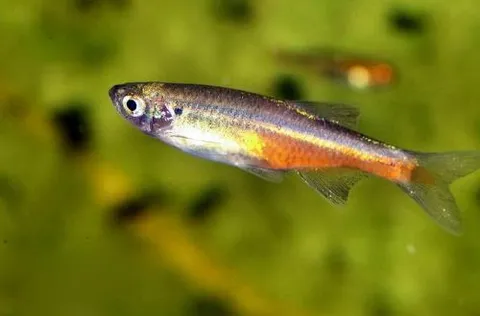
Devario sondhii
The fish, known scientifically as Devario sondhii, belongs to the Cyprinidae family and is commonly called Devario sondhii. These aquarium inhabitants became available to hobbyists in the early 2000s. Initially, there…
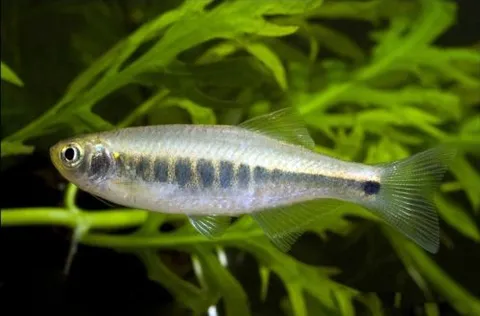
Danio absconditus
Danio absconditus, known as the Hidden Danio, belongs to the family Cyprinidae. This species was discovered relatively recently, in 2015. The intriguing name "Hidden" does not describe the fish's behavior but is related…