Temperature18 – 26 °C
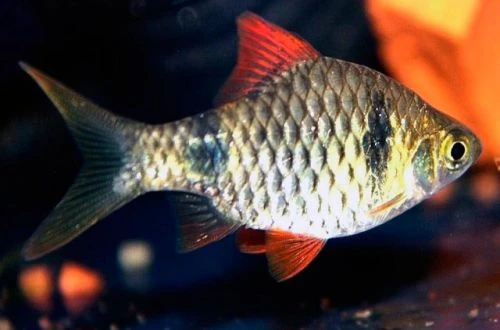
Pethia reval, known as the Reval Barb, belongs to the family Cyprinidae. For a long time, the species was considered only a color variant of the Cuming's Barb, and only in 2008 did it receive independent status. Nevertheless, its presence in aquaristics dates back many years. This fish is easy to keep and breed, coexisting perfectly with many other peaceful species, which makes it recommendable even for beginner aquarists.
Adults grow up to 3 cm in length. Outwardly, they are very similar to the aforementioned Cuming's Barb: the body has a silvery-yellow coloration, and characteristic black markings are located behind the gill cover and at the base of the tail. However, the Reval Barb is distinguished by the red coloration of its dorsal and pelvic fins. Sexual dimorphism is weakly expressed, but males are usually slightly smaller and brighter than females.
This species is endemic to the island of Sri Lanka, located near the coast of India. Its natural habitat includes shallow bodies of water and tributaries of large rivers in the western part of the island. In the south of the range natural hybrids with a closely related species occur, while the population in the Mahaweli River in the north-east of the island appears to have been introduced artificially. Apparently, they appeared as a result of cross-breeding with related species released into the wild from home aquariums.
This is an active schooling fish, highly compatible with many other species of similar size. However, it should be noted that the high activity of Reval Barbs may be excessive for some slow-moving fish, such as Goldfish, Labyrinth fish, or Killifish.
For a small group of these fish, the optimal aquarium volume starts from 60 liters. The choice of decor is not critical; the main thing is to provide enough space for the fish to swim freely. Therefore, excessive overgrowth of aquatic plants, if used, is undesirable. It is sometimes stated that dark substrate and subdued lighting can help enhance the brightness of the fish's coloration. Successful keeping largely depends on maintaining stable water conditions within the recommended range of hydrochemical parameters. Essential care procedures include: weekly partial water changes, regular cleaning of the substrate and decor elements from organic debris (such as excrement and uneaten food), equipment maintenance, and constant monitoring of basic water parameters (pH, dGH, concentration of nitrogen compounds, etc.).
These fish readily accept most popular foods. These can be dry flakes, granules, live or frozen bloodworms, as well as brine shrimp. In a home aquarium, they can easily subsist solely on dry products.
The breeding process is quite simple. Spawning occurs regularly if conditions are favorable, but fry survival in a community tank will be extremely low. They will become easy prey for adult fish and will lack appropriate food. Since parental instincts are not developed in these fish, adults are not averse to feasting on their own offspring. To preserve the young, a separate spawning tank is usually used, equipped with a simple air-driven sponge filter and a heater. An additional lighting system is not required — ambient room light will be sufficient. Artificial plants or undemanding shade-loving mosses and ferns can be used as decor elements. During the breeding period, the fish scatter their eggs throughout the water column. Since the incubation period lasts only 24–36 hours, it is important to carefully transfer the eggs to a separate tank before they are eaten or the fry hatch. In the spawning tank, the young will be safe; it will only remain to take care of special food for fry, for example, in the form of powdered products or Artemia nauplii.
In a balanced aquarium ecosystem, closely matching the requirements of this species, diseases are extremely rare. Illnesses often arise due to deteriorating habitat quality, contact with already sick fish, or physical injuries.
When choosing Pethia reval, pay attention to the overall activity of the individuals in the tank: healthy fish should swim energetically, showing no signs of apathy or a constant desire to hide in shelters. It is important that there are no specimens in the same tank with obvious damage, body film, white spots, or signs of emaciation. Avoid purchasing if there is high mortality in the store or if the fish look lethargic and refuse the offered food. — Inspect the fins: they should be intact, without signs of rot, bruising, or torn edges. — Check the condition of the eyes and scales: the eyes should be clear, without cloudiness, and the scales should lie flat against the body, without swelling or missing patches. — Ensure there are no breathing anomalies: a healthy fish breathes rhythmically, without frequent gasping for air at the water surface. — Evaluate behavior: a healthy fish should show curiosity and react to a person's approach, rather than hiding in corners or lying on the bottom. Since this species is schooling, it is recommended to acquire a group of 6–10 individuals to reduce stress levels and improve adaptation. The coloration of the fish should be bright and vibrant, which is especially noticeable in males under good keeping conditions.
The essentials: size, tank volume, water parameters and care
An adult reaches 3 cm in length. Plan the tank around the maximum size: the fish quickly outgrows a cramped setup.
The recommended volume is 60 L. A smaller tank speeds up nitrate build-up and raises stress levels.
Temperature 18–26 °C, pH 6–7.5, hardness 2–12 dGH. Stability matters more than exact values: sudden swings are harder on the fish than a small deviation from the ideal.
Around 5 years when kept properly. Lifespan depends directly on tank volume, water quality and a varied diet.
Temperament: peaceful (regular). Keep this in mind when choosing tank mates.
Recommended setup: group (8–10 individuals). Ignoring this is a common cause of stress and disease.
Diet type: small / appropriate size / pieces. Feed small portions that are finished within a couple of minutes — overfeeding does more harm than underfeeding.
The scientific name of the species is Pethia reval, family Cyprinids (Cyprinidae). It also appears in the literature as: Puntius reval.
The water suits 197 of 208 plants in the catalogue — the easiest ones are shown first.
Afzelius's AnubiasAnacharisAnubiasBrazilian PennywortDwarf CloverDwarf CloverDwarf HygrophilaDwarf SagittariaDwarf ValGuppy GrassHornwortJava FernJava MossMoneywortMud SwordNair's LagenandraNarrow Leaf AnacharisNarrow-leaf CloverStringy MossSüsswassertangTaiwan MossTape GrassTemple PlantUssuri Watermilfoil
Matched by family, categories and overlapping keeping conditions
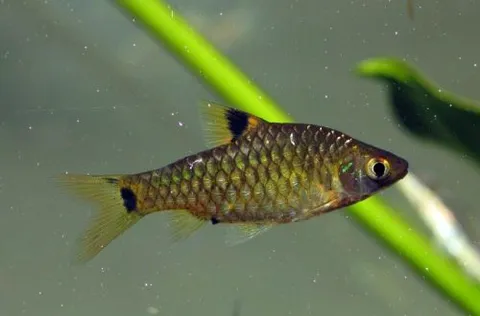
Puntius vittatus
Puntius vittatus, known as the Greenstripe Barb, belongs to the carp family (Cyprinidae). This unpretentious fish adapts well to aquarium conditions, breeds easily, and coexists harmoniously with most peaceful tank…
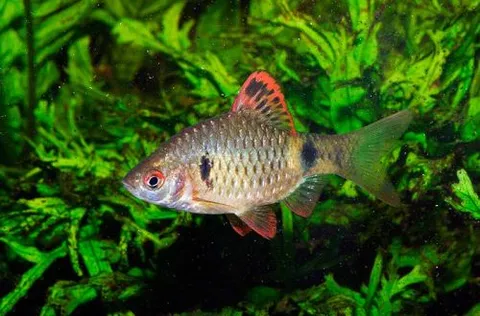
Pethia stoliczkana
Pethia stoliczkana, known as Stoliczka's Barb, belongs to the carp family (Cyprinidae). The species is named after the zoologist Ferdinand Stoliczka (1838–1874) from Moravia (now the Czech Republic), who dedicated many…
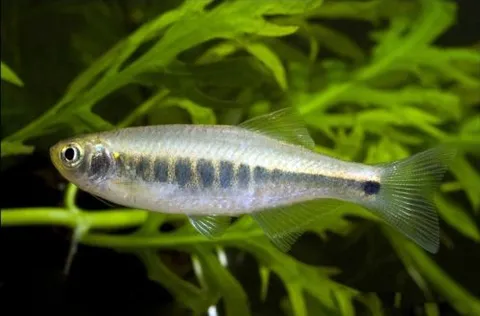
Danio absconditus
Danio absconditus, known as the Hidden Danio, belongs to the family Cyprinidae. This species was discovered relatively recently, in 2015. The intriguing name "Hidden" does not describe the fish's behavior but is related…
Microdevario kubotai
Microdevario kubotai, officially known as Microdevario kubotai, belongs to the family Cyprinidae. Its name honors the Thai biologist Katsuma Kubota. In the aquarium hobby, it is also known as Green Neon Rasbora or…