Temperature20 – 25 °C
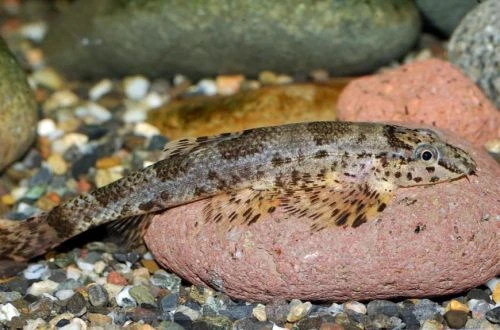
Homalopteroides tweediei, or Homaloptera tweediei, belongs to the family Balitoridae, known as river loaches. This fish was named after the naturalist and archaeologist Michael Tweedie (1907–1993), Assistant Curator of the Raffles Museum in Singapore, who assisted in collecting the type specimens of this species.
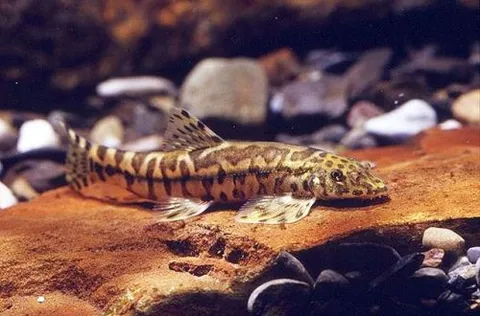
Outwardly, Homaloptera tweediei resembles Homaloptera smithi, its close relative, but is distinguished by its smaller size — adults grow up to 4 cm. A distinctive feature is the fish's elongated body. Large paired fins are shifted towards the belly and positioned horizontally, allowing the fish to firmly cling to the surface of stones or snags, successfully resisting strong currents. Its coloration is gray, adorned with four dark, irregularly shaped spots. Sexual dimorphism is weakly expressed, and there are no obvious external differences between males and females.
The natural range of this species covers Southeast Asia, covering Peninsular Malaysia, where the species was described, the mainland regions of Thailand, Laos, Cambodia and Vietnam, and the Indonesian part of Borneo. These fish prefer to inhabit the headwaters of rivers, choosing shallow areas with rocky bottoms and moderate to strong currents.
This peaceful and calm fish prefers to be in a group of its own kind. It coexists perfectly with many non-aggressive species of comparable size for which similar living conditions are suitable.
For keeping a group of 5–6 Homaloptera tweediei individuals, aquariums from 40 liters are recommended. A key condition for their well-being is the presence of clean, flowing, oxygen-rich water. It is also important to ensure a sufficiently strong current that will mimic the natural conditions of a mountain stream. A powerful internal filter can not only provide water purification but also create the necessary water movement. It should be remembered that to maintain a stable biological balance, regular aquarium maintenance activities are necessary, such as weekly partial water changes with fresh water and timely removal of organic waste. The aquarium's decor should take into account the turbulent nature of the external environment; any light decorative elements are likely to be carried away by the current. An ideal choice would be a rocky substrate with boulder formations, snags of various sizes, and unpretentious artificial or live plants.
Belonging to carnivorous species, in their natural environment, these fish feed on small crustaceans, insect larvae, and other invertebrates. In aquarium conditions, their diet should consist of high-protein food, including dry, frozen, and live foods of appropriate size.
At the time of preparing this material, the authors found no reliable data on the successful breeding of this species in home aquarium conditions.
Health problems in these fish arise only in the presence of injuries or keeping in unsuitable conditions, which leads to a weakening of the immune system and the subsequent occurrence of various diseases. At the first signs of illness, it is necessary first to check the water parameters for exceeding permissible values or the presence of toxic substances (such as nitrites, nitrates, ammonia). If deviations are found, all indicators should be normalized, and then treatment should begin.
When purchasing, caution should be exercised, as this species often goes on sale in an emaciated state that can be difficult to correct. A healthy individual should have a rounded, not sunken abdomen, clean fins without signs of erosion or white plaque, and clear eyes. Avoid fish that appear sluggish, constantly lie on their side, or have visible skin damage. — Assess the fish's plumpness: a sunken belly is a critical sign of prolonged starvation. — Observe behavior: a healthy fish should show interest in its surroundings and cling to surfaces using its fins. — Ensure the absence of external parasites and spots on the body, which may indicate stress or diseases due to poor keeping conditions in the store.
The essentials: size, tank volume, water parameters and care
An adult reaches 3.5–4 cm in length. Plan the tank around the maximum size: the fish quickly outgrows a cramped setup.
The recommended volume is 40 L. A smaller tank speeds up nitrate build-up and raises stress levels.
Temperature 20–25 °C, pH 6–7.5, hardness 2–12 dGH. Stability matters more than exact values: sudden swings are harder on the fish than a small deviation from the ideal.
Around 5 years when kept properly. Lifespan depends directly on tank volume, water quality and a varied diet.
Temperament: peaceful (regular). Keep this in mind when choosing tank mates.
Recommended setup: small group (5–6 individuals). Ignoring this is a common cause of stress and disease.
Diet type: sinking (any). Feed small portions that are finished within a couple of minutes — overfeeding does more harm than underfeeding.
The scientific name of the species is Homalopteroides tweediei, family River Loaches (Balitoridae). It also appears in the literature as: Homaloptera tweediei.
The water suits 196 of 208 plants in the catalogue — the easiest ones are shown first.
Afzelius's AnubiasAnacharisAnubiasBrazilian PennywortDwarf CloverDwarf CloverDwarf HygrophilaDwarf SagittariaDwarf ValGuppy GrassHornwortJava FernJava MossMoneywortMud SwordNarrow Leaf AnacharisNarrow-leaf CloverStringy MossSüsswassertangTaiwan MossTape GrassTemple PlantUssuri WatermilfoilWater Wisteria
Matched by family, categories and overlapping keeping conditions
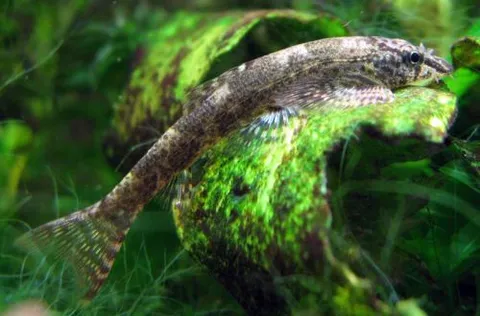
Homalopteroides smithi
Homalopteroides smithi, known as Smith's Homaloptera, belongs to the family Balitoridae, or river loaches. This fish was named after the ichthyologist Hugh Smith (1865–1941), who discovered many tropical fish in Siam,…
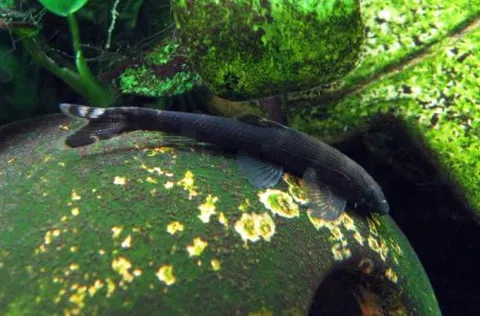
Balitoropsis zollingeri
The fish known as Zollinger's Balitorid, or Balitoropsis zollingeri by its scientific name, belongs to the family Balitoridae, which includes river loaches. It was named in honor of the Swiss botanist Heinrich Zollinger…
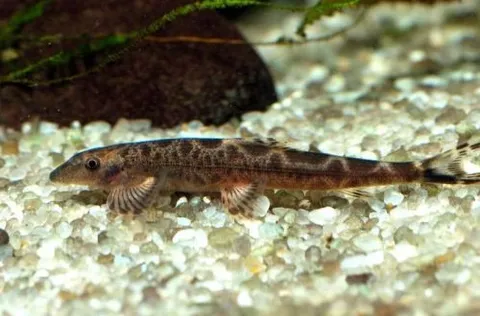
Pseudohomaloptera leonardi
The fish, scientifically known as Pseudohomaloptera leonardi, belongs to the family Balitoridae, or river loaches. It was named in honor of Mr. G. R. Leonard, who, during the reign of King George V in colonial Malaysia,…
Formosania lacustris
Formosania lacustris, also known as the Brushmouth Loach, belongs to the family Balitoridae, known as river loaches. The fish owes its name to its body structure: it is elongated and slender, but has a rather large…