Temperature24 – 27 °C
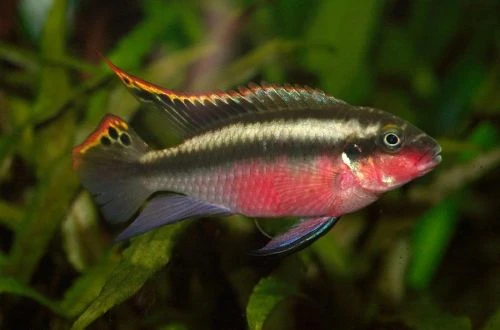
Pelvicachromis pulcher, also known as Kribensis, belongs to the Cichlidae family, and its scientific name is Pelvicachromis pulcher. Due to its vibrant coloration, it is often called the Aquarium Parrot Cichlid. Among cichlids, this species is one of the most sought-after by aquarists. Many years of breeding in artificial conditions have allowed it to acquire certain adaptive qualities: it can tolerate a wider range of water parameters, and its aggression level has become more moderate compared to its wild ancestors.
The body shape of these fish is low and elongated, and the dorsal and anal fins have characteristic pointed tips. The primary color is gray, but the belly stands out with a cherry-red color, which is especially intense in females. A dark longitudinal stripe runs the entire length of the body from the mouth to the caudal fin.
The natural habitat of this species is the Niger River basin, located in the territories of modern Nigeria and Cameroon in Africa. These fish prefer shallow areas with slow currents, especially where there is dense aquatic vegetation. Some populations have even been found in brackish waters. The requirements for their keeping conditions are presented below.
Although they are usually peaceful and even rather modest fish, their behavior changes significantly during spawning. During this period, Pelvicachromis pulcher exhibits moderate aggression, actively protecting its future offspring. They get along well with many peaceful fish species, such as Rasboras, Danios, Gouramis, as well as Corydoras catfish and similar behavioral species.
These fish are undemanding to keep and do not require special conditions. They feel comfortable in water with varying hardness (GH) and acidity (pH), as long as these parameters are within reasonable limits. For keeping a single pair of Kribensis, an aquarium of at least 70 liters is sufficient. When decorating the tank, it is advisable to provide many shelters that can serve as spawning sites. These can be decorative caves, grottoes, snags, or tangled tree roots. Depending on the overall interior design of the aquarium, clay pots or jars will also be appropriate. Although plants are not an essential element, they significantly contribute to maintaining biological balance, so their choice is at the discretion of the aquarist. Coarse sand or fine gravel is suitable as a substrate. Standard aquarium equipment includes a filter, heater, aerator, and lighting system. High water quality is maintained by weekly renewal of 10–15% of the volume and regular cleaning of the substrate from organic waste, such as uneaten food and excrement.
The fish are well adapted to consuming various types of dry or freeze-dried foods, whether pellets or flakes. They also readily eat live or frozen food, such as bloodworms or mosquito larvae. For an optimal diet, it is recommended to combine dry and live foods.
Breeding these fish at home is not difficult. They tend to form stable pairs that often stay together throughout their life cycle. However, the fish are quite selective in choosing a mate, so to ensure successful pair formation, it is recommended to acquire a group of six or more young individuals. As they mature, at least one pair should certainly form. If it is not possible or desirable to keep so many fish, you can choose the largest male and the brightest female. For spawning stimulation, quality nutrition is key: meaty foods must be present in their diet. A sign of the female's readiness to lay eggs is a change in coloration — her belly acquires a rich cherry hue and noticeably increases in volume. Spawning usually occurs in one of the shelters, for example, in a cave or grotto. During this period, it is important to maintain a slightly acidic pH of around 7.0, as water acidity affects the sex ratio of the future offspring. Thus, in more acidic water, females predominate, and in alkaline water, males. The female can lay up to 300 eggs. The incubation period lasts two to three days, and after another seven days, the fry are already actively swimming. They stay in a tight school near their parents; if danger arises the female herds them back into the cave while the male takes a defensive position. This species is a cave spawner and does not brood its eggs in the mouth. Initially, the fry are too small to eat regular food and feed on algae and detritus. Later, they can be offered specialized micro-food for fry.
Pelvicachromis pulcher is characterized by its hardiness. The main causes of diseases are usually contact with sick fish or a significant deterioration in keeping conditions and food quality.
When choosing healthy individuals, pay attention to their activity and the cleanliness of their skin. Fish should show natural curiosity, have no visible fin damage, ulcers, or white film on their bodies. Avoid specimens with sunken bellies or apathetic behavior, as this may indicate chronic stress or illness. — choose fish with bright, rich coloration appropriate for the species — observe their behavior in the store: healthy fish should not constantly hide or show signs of exhaustion — check for signs of infections, such as rapid breathing or unnatural spots on the scales.
The essentials: size, tank volume, water parameters and care
An adult reaches 9 cm in length. Plan the tank around the maximum size: the fish quickly outgrows a cramped setup.
The recommended volume is 70 L. A smaller tank speeds up nitrate build-up and raises stress levels.
Temperature 24–27 °C, pH 5–8, hardness 5–19 dGH. Stability matters more than exact values: sudden swings are harder on the fish than a small deviation from the ideal.
Around 5 years when kept properly. Lifespan depends directly on tank volume, water quality and a varied diet.
Temperament: semi-peaceful (including aggression during spawning / intraspecific conflicts). Keep this in mind when choosing tank mates.
Recommended setup: pair (male/female). Ignoring this is a common cause of stress and disease.
Diet type: any (universal). Feed small portions that are finished within a couple of minutes — overfeeding does more harm than underfeeding.
The scientific name of the species is Pelvicachromis pulcher, family Cichlids (Cichlidae). It also appears in the literature as: Pelmatochromis aureocephalus, Pelmatochromis aurocephalus, Pelmatochromis camerunensis.
The water suits 197 of 208 plants in the catalogue — the easiest ones are shown first.
Afzelius's AnubiasAnacharisAnubiasBrazilian PennywortDwarf CloverDwarf CloverDwarf HygrophilaDwarf SagittariaDwarf ValGuppy GrassHornwortJava FernJava MossMoneywortMud SwordNair's LagenandraNarrow Leaf AnacharisNarrow-leaf CloverStringy MossSüsswassertangTaiwan MossTape GrassTemple PlantUssuri Watermilfoil
Matched by family, categories and overlapping keeping conditions
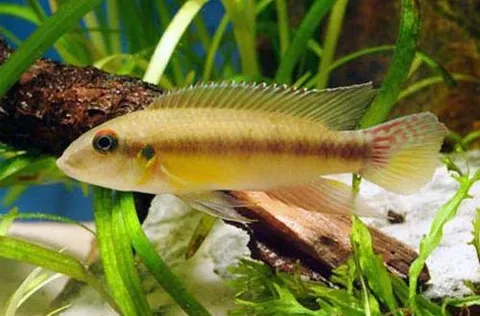
Wallaceochromis humilis
The cichlid with the scientific name Wallaceochromis humilis, also known as the Yellow-bellied Parrot Cichlid, Yellow-bellied Kribensis, or Yellow Kribensis, belongs to the family Cichlidae. It is a beautiful and…
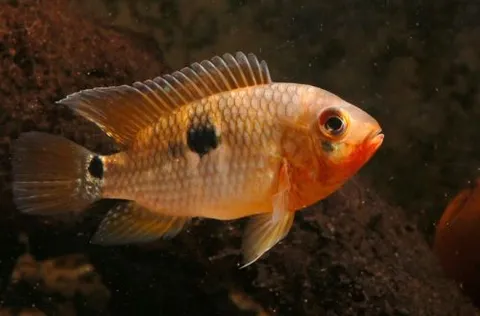
Aequidens tetramerus
Aequidens tetramerus, known scientifically as Aequidens tetramerus, belongs to the famous family Cichlidae. This is a rather large fish, attracting attention with its bright coloration. Many aquarists appreciate it for…
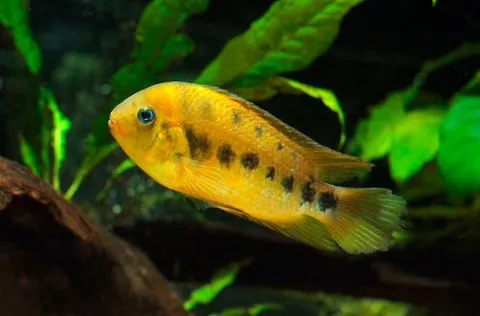
Amatitlania nanolutea
Amatitlania nanolutea, also known as the Yellow Cryptoheros or Yellow Cichlid, belongs to the family Cichlidae. Previously, the species was classified as Cryptoheros nanoluteus. This fish is distinguished by its vibrant…
Rubricatochromis lifalili
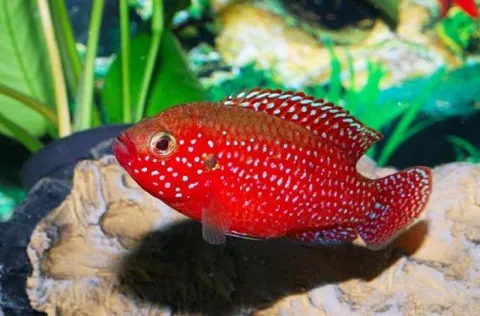
The Red Chromide, or "Red Jewel Cichlid," scientifically known as Rubricatochromis lifalili, is a member of the Cichlidae family. This is a beautiful and vibrant fish, whose keeping and breeding do not present…