Temperature20 – 26 °C
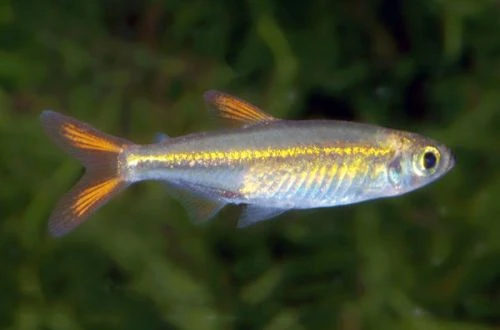
Ladigesia roloffi, scientifically known as Ladigesia roloffi, belongs to the family Alestidae, or African tetras. In the wild, this species of tetra is becoming increasingly rare due to the destruction of its natural habitat. It is likely that aquariums, both home and commercial, will soon become the only place for their conservation. These miniature and beautiful fish do not present particular difficulties in keeping, provided that the necessary hydrochemical parameters are maintained.
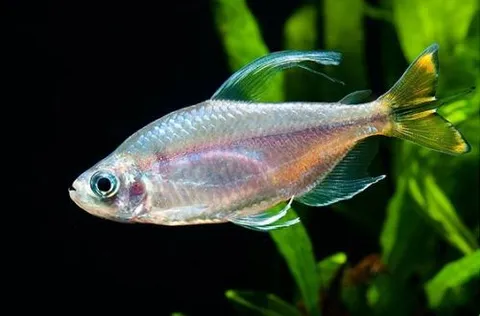
Adults reach no more than 3 cm in length. Their body is distinguished by a silvery coloration, and the caudal and dorsal fins have a bright red hue. Sexual dimorphism in these fish is weakly expressed, which makes it difficult to distinguish males from females. Only during the breeding season, by the noticeably rounded belly due to roe, can a female be unmistakably identified.
The exact natural habitat of these fish remains not fully established, but significant populations were previously observed in modern-day Sierra Leone, West Africa. Their usual habitat is shallow streams and rivers flowing through humid tropical forests. Unfortunately, 97% of the original forest cover has been destroyed for plantations. As a result, Ladigesia roloffi is now endangered, surviving only in a few protected reserves.
These fish are peaceful, active, and live in schools (it is recommended to acquire at least 8–10 individuals). They can be good tankmates for other species of similar size and temperament. However, high demands on water quality impose certain restrictions on the choice of tankmates. When kept with other fish, the aquarium volume will need to be significantly increased, at least twofold. In a larger volume, the likelihood of reaching dangerous levels of organic pollution is reduced.
For a school of 10 fish, an aquarium of at least 60 L will be required. Sand substrate and several decorative snags, which serve as shelters, are used as decor elements. Lighting should be subdued; floating plants will help further diffuse the light. Rooted plants form small thickets, arranged in groups. It is important to equip the aquarium with a protective lid to prevent accidental jumping out of the fish. Adding fallen leaves to the bottom mimics the natural environment and becomes a source of tannins and other chemical components. Before placing them in the aquarium, the leaves must be dried, and then soaked until they begin to sink. Leaves should be replaced every 1–2 weeks. Pay special attention to water quality: Ladigesia roloffi prefers very clean, soft, and slightly acidic water. It is important to regularly remove organic waste (food remnants, excrement). It is recommended to use a powerful filter with alder cone filler. At least once a week, 15–20% of the water volume must be renewed, and it is advisable to use water passed through a reverse osmosis system.
The diet of these fish consists of tiny invertebrates and other zooplankton. In aquarium conditions, they readily accept dry foods of suitable size, which are recommended to be combined with frozen or live foods such as Daphnia, Artemia, grindal worms, Moina, and so on.
Successful breeding of Ladigesia in a home aquarium, for various reasons, does not happen very often. Spawning is recommended to be carried out in a separate tank of at least 20 L. The bottom of this aquarium should be covered with a layer of peat and fine mesh to protect the eggs from adult fish. Use alder cones from pet stores, which has already been treated and disinfected. No decoration is required for the spawning aquarium. Lighting should be subdued; often, ambient room light is sufficient without using separate lamps. Essential equipment includes a heater and an air-driven filter. Water for the spawning tank should be taken from the main aquarium and added shortly before spawning begins. A change in diet, with a predominance of live foods, stimulates the onset of the breeding period. The temperature is raised to the maximum permissible 25–26°C. When the females become noticeably rounded, they, along with several males, are placed in a separate aquarium. After spawning is complete (determined by the 'thinner' females), the fish are returned to the main aquarium. Fry hatch after 24–36 hours, and after a week, they begin to swim freely in search of food. They should be fed microscopic food intended for aquarium fish fry.
The health of Ladigesia roloffi directly depends on the keeping conditions. Inappropriate water parameters, elevated levels of organic pollution, or poor-quality nutrition will immediately affect the fish. The main symptom of deteriorating health is the loss of the red coloration of the tail and dorsal fin. In such a case, it is necessary to urgently normalize all parameters.
When choosing individuals, pay attention to their activity and the cleanliness of their skin. Healthy fish should show curiosity, actively swim in the water column, and have no visible damage, spots, or signs of emaciation. Avoid purchasing fish that stay near the surface, breathe heavily, or appear sluggish, as this species is sensitive to transport conditions and water quality. Given the rarity and status of the species, it is recommended to ask the seller about the adaptation period of the batch after arrival to exclude the risk of acquiring individuals with weakened immunity.
The essentials: size, tank volume, water parameters and care
An adult reaches 3–3.1 cm in length. Plan the tank around the maximum size: the fish quickly outgrows a cramped setup.
The recommended volume is 60 L. A smaller tank speeds up nitrate build-up and raises stress levels.
Temperature 20–26 °C, pH 5–7, hardness 1–8 dGH. Stability matters more than exact values: sudden swings are harder on the fish than a small deviation from the ideal.
Around 5 years when kept properly. Lifespan depends directly on tank volume, water quality and a varied diet.
Temperament: peaceful (regular). Keep this in mind when choosing tank mates.
Recommended setup: large group (10+ individuals). Ignoring this is a common cause of stress and disease.
Diet type: any (universal). Feed small portions that are finished within a couple of minutes — overfeeding does more harm than underfeeding.
The scientific name of the species is Ladigesia roloffi, family African Tetras (Alestidae).
The water suits 197 of 208 plants in the catalogue — the easiest ones are shown first.
Afzelius's AnubiasAnacharisAnubiasBrazilian PennywortDwarf CloverDwarf CloverDwarf HygrophilaDwarf SagittariaDwarf ValGuppy GrassHornwortJava FernJava MossMoneywortMud SwordNair's LagenandraNarrow Leaf AnacharisNarrow-leaf CloverStringy MossSüsswassertangTaiwan MossTape GrassTemple PlantUssuri Watermilfoil
Matched by family, categories and overlapping keeping conditions
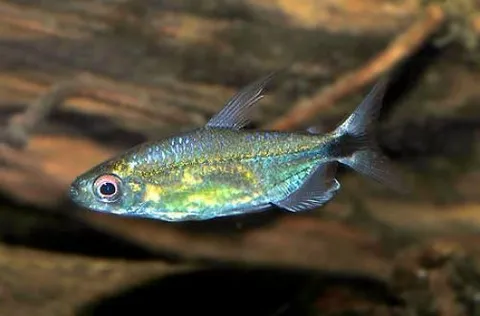
Alestopetersius smykalai
Alestopetersius smykalai, known as the Blue Diamond Tetra, belongs to the family Alestidae (African Tetras). This species is rarely found in home aquariums. In their natural habitat, they have practically disappeared,…
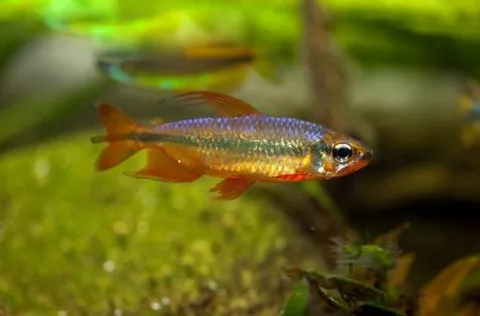
Alestopetersius brichardi
Alestopetersius brichardi is the scientific name for this species, which belongs to the family Alestidae (African Tetras). In the aquarium hobby, it is known by various names: Red Congo Tetra, Cherry Congo Tetra, or…
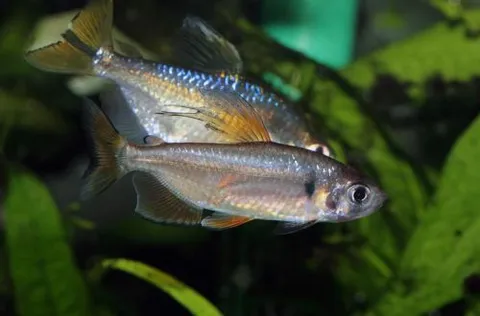
Alestopetersius nigropterus
The Red Alestopetersius, also known by the scientific designations Alestopetersius nigropterus or Alestopetersius ansorgii, belongs to the African tetra family (Alestidae). To date, this species has not yet received a…
Alestopetersius caudalis
Alestopetersius caudalis, known as the Yellow-tailed Congo Tetra or Congo Gold Tetra, belongs to the family Alestidae. Although this species may not be as widely distributed as some other African tetras, it can be…