Temperature24 – 30 °C
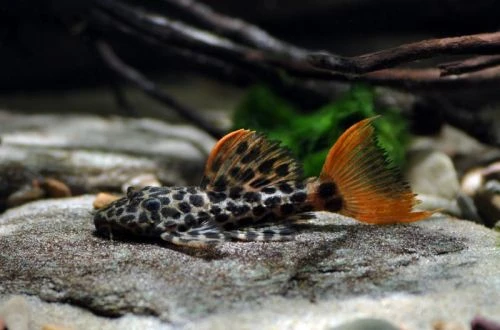
The Leopard Pleco, known scientifically as Pseudacanthicus cf. Leopardus L114, LDA007, belongs to the armored catfish family (Loricariidae). Despite its exact classification not yet being determined, this has not prevented it from gaining widespread popularity among both hobbyists and professional aquarists. Its appeal is due to its beautiful coloration, undemanding care, and good compatibility with other fish species.
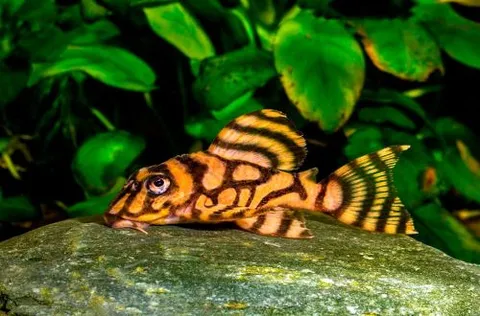
Adults of this fish typically reach 20–25 cm in length. They are characterized by a massive body and a large head. Their body is covered with rows of sharp spines, and the first rays of their fins form thorns. Young individuals have a gray coloration with noticeable rounded dark spots. As they mature, the spots diminish, and the pattern becomes leopard-like, which gave this species its name. The edges of the dorsal and caudal fins have a red tint.
The natural habitat of this catfish is South America, specifically the Rio Negro basin in the Brazilian state of Amazonas. It is noteworthy that the Leopard Pleco has also been found in some rivers of Guyana, although they are at a significant distance from the Rio Negro and do not share a common water system. This fact raises doubts among several researchers regarding the accuracy of identification of individual populations. In nature, it can be found in a wide variety of biotopes: from calm backwaters to areas with moderate or even turbulent currents.
This is a peaceful and calm catfish, however, it may show competition with other bottom-dwelling fish for territory. It is advisable to keep it with species of similar size and temperament that prefer to inhabit the middle water layers or near the surface.
For keeping one or two Leopard Plecos, the recommended aquarium volume starts from 500 liters. Their care will not be particularly difficult, provided a suitable environment is ensured. In the aquarium setup, it is advisable to use a rocky or sandy substrate, as well as boulders, stones, and large snags, which will serve as shelters. It is important to maintain stable water parameters within the permissible range of temperatures and hydrochemical indicators. For this, the aquarium must be equipped with the necessary equipment, primarily an effective filtration system, and regular maintenance should be carried out, including partial water changes and removal of organic waste.
The species is mainly carnivorous, so the diet is based on meaty foods: shrimp, krill, mussels, bloodworm and pieces of fish fillet. Plant matter is acceptable only as a supplement, not as the staple.
Successful breeding of the Leopard Pleco in home aquariums is not uncommon but requires several conditions. First of all, it is necessary to create areas with appropriately sized shelters and select a group of several sexually mature individuals, including at least one female. Sexing can be difficult, which sometimes creates problems. In favorable conditions, the male occupies one of the shelters, which will then become the spawning site. After a short courtship, the pair lays several hundred eggs. The female then leaves the clutch, and the male remains nearby, guarding the eggs until the fry hatch.
Most health problems in fish often arise from unsuitable keeping conditions. Maintaining a stable and comfortable habitat is a key factor for successful keeping. If symptoms of illness appear, the first step is to check the water quality. If deviations are found, it is important to take immediate measures to eliminate them. If the symptoms do not disappear or worsen, medicinal treatment may be required.
When purchasing Pseudacanthicus cf. leopardus, choose active individuals without visible skin damage, as the presence of open wounds or ulcers often indicates bacterial infections due to transport stress. It is important to pay attention to the condition of the fins: they should be intact, without signs of deterioration or white film. A healthy fish shows caution but should not be constantly in a state of panic or have a severely sunken abdomen, which may indicate chronic emaciation or parasitic diseases. — Avoid purchasing individuals with signs of apathy or an unnaturally bloated abdomen. — Ensure that the fish's eyes are clear, without cloudiness, and breathing is even. — Ask the seller about the current diet to ensure a smooth transition to familiar types of food.
The essentials: size, tank volume, water parameters and care
An adult reaches 20–25 cm in length. Plan the tank around the maximum size: the fish quickly outgrows a cramped setup.
The recommended volume is 500 L. A smaller tank speeds up nitrate build-up and raises stress levels.
Temperature 24–30 °C, pH 5.5–7.5, hardness 1–15 dGH. Stability matters more than exact values: sudden swings are harder on the fish than a small deviation from the ideal.
Around 12 years when kept properly. Lifespan depends directly on tank volume, water quality and a varied diet.
Temperament: peaceful (regular). Keep this in mind when choosing tank mates.
Recommended setup: both solitary and in group (flexible). Ignoring this is a common cause of stress and disease.
Diet type: sinking (meat / protein). Feed small portions that are finished within a couple of minutes — overfeeding does more harm than underfeeding.
The scientific name of the species is Pseudacanthicus cf. leopardus, family Armored Catfishes (Loricariidae).
The water suits 197 of 208 plants in the catalogue — the easiest ones are shown first.
Afzelius's AnubiasAnacharisAnubiasBrazilian PennywortDwarf CloverDwarf CloverDwarf HygrophilaDwarf SagittariaDwarf ValGuppy GrassHornwortJava FernJava MossMoneywortMud SwordNair's LagenandraNarrow Leaf AnacharisNarrow-leaf CloverStringy MossSüsswassertangTaiwan MossTape GrassTemple PlantUssuri Watermilfoil
Matched by family, categories and overlapping keeping conditions
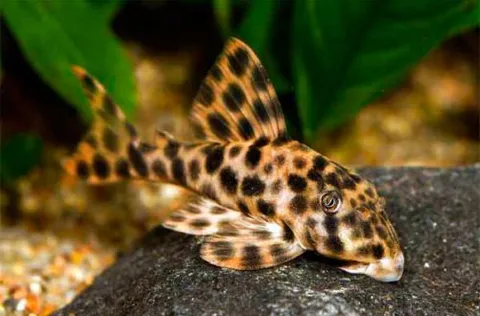
Peckoltia oligospila
This catfish, known scientifically as Peckoltia oligospila, belongs to the extensive family Loricariidae, also called Armored Catfish. The fish owes its name to the botanist and pharmacist Gustavo Peckolt, a German born…
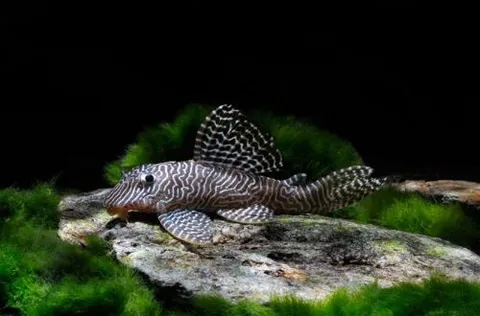
Hypancistrus sp. L260
The Queen Arabesque Pleco, or Painted Pleco, scientifically known as Hypancistrus sp. L260, belongs to the Loricariidae family, which includes armored catfish. The lack of a universally recognized scientific…
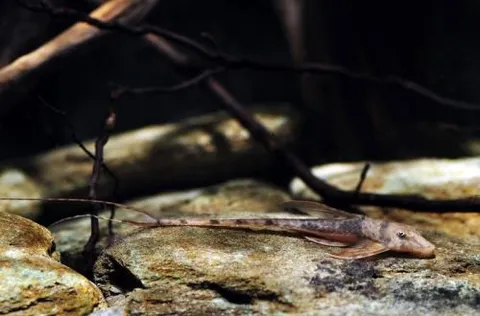
Lamontichthys filamentosus
The Threadfin Catfish, known scientifically as Lamontichthys filamentosus and also called Lamont's Fish, is a member of the Loricariidae family, or Armored Catfish. It was named in honor of Francesca Lamont, a…
Hypancistrus sp. L333
Hypancistrus sp. L 333, known as Hypancistrus "Yellow Tiger", belongs to the armored catfish family (Loricariidae). This catfish is native to the South American continent. Its natural habitat is the Xingu River basin, a…