Temperature24 – 30 °C
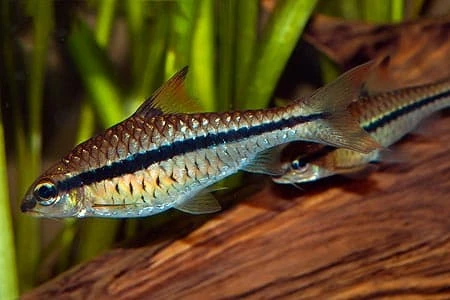
The Long-banded Barb, scientifically known as Enteromius holotaenia, belongs to the carp family (Cyprinidae). This active and peaceful fish is undemanding, making it easy to care for and suitable even for beginner aquarists.
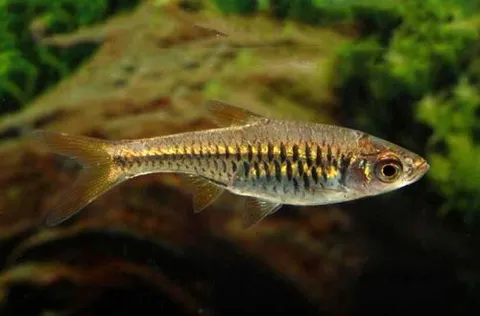
Adults of this fish typically reach a length of 10 to 12 cm. Their coloration is predominantly silvery, characterized by a broad dark stripe running along the entire body from head to tail. The caudal and dorsal fins often have a reddish tint. Sexual dimorphism is not clearly pronounced, but males are usually slightly smaller than females, which becomes particularly noticeable during spawning when the females' bellies are full of eggs.
The natural habitat of this species extends across Central and West Africa, covering the vast Congo River basin. These fish have adapted to diverse biotopes — from swift streams to calm, swampy backwaters. Schools of these barbs are typically found in small tributaries, while they are observed much less frequently in the main river channels.
This peaceful, schooling fish coexists well with other species of similar size and temperament. For their well-being and confidence, it is important to maintain a school size of at least 8–10 individuals; in smaller groups, the fish may become timid.
For the comfortable existence of a small school of Long-banded Barbs, an aquarium of at least 250 liters is recommended. The decor can be anything, the main thing is to provide enough open spaces for free swimming. These fish do not require specific conditions, so their keeping is considered relatively simple. Basic aquarium care procedures include weekly partial water changes, regular cleaning of organic waste (food remnants, excrement), as well as constant monitoring of parameters such as pH, GH, and water oxidizability, and preventive equipment maintenance.
To ensure a complete diet for the fish, it is preferable to use live or frozen foods, such as bloodworms or Artemia. Excessive consumption of exclusively dry foods, such as flakes or granules, can negatively affect digestion. Therefore, dry products should be introduced into the diet as an additional element, enriching it with essential vitamins and trace elements.
Unfortunately, at the time of writing this article, there is no confirmed information about successful breeding of the Long-banded Barb in home aquariums. Nevertheless, it is theoretically quite feasible, as their reproduction process is presumably similar to that of other barbs.
In a balanced aquarium ecosystem, where environmental parameters meet the needs of the specific species, diseases are extremely rare. Often, the cause of diseases is a deterioration of living conditions, contact with already sick fish, or physical injuries.
When choosing a Long-banded Barb, pay attention to the overall activity of the school and the absence of signs of emaciation or body deformities. A healthy individual should have clean, tightly fitting scales, transparent fins without signs of erosion or film, and clear eyes without cloudiness. Avoid purchasing fish with signs of a "bloated" abdomen or, conversely, excessively sunken sides, as this may indicate internal parasites or impaired internal organ function. Before purchasing, it is recommended to observe the fish's behavior for some time: they should be mobile, show curiosity, and actively react to external stimuli. Refuse to buy if there are dead fish or specimens with obvious skin damage in the aquarium with the chosen individuals. It is advisable to ask the seller how long the fish have been imported and ask them to demonstrate feeding: healthy individuals should show interest in food and actively compete for it.
The essentials: size, tank volume, water parameters and care
An adult reaches 10–12 cm in length. Plan the tank around the maximum size: the fish quickly outgrows a cramped setup.
The recommended volume is 250 L. A smaller tank speeds up nitrate build-up and raises stress levels.
Temperature 24–30 °C, pH 6–7, hardness 2–12 dGH. Stability matters more than exact values: sudden swings are harder on the fish than a small deviation from the ideal.
Around 6 years when kept properly. Lifespan depends directly on tank volume, water quality and a varied diet.
Temperament: peaceful (regular). Keep this in mind when choosing tank mates.
Recommended setup: group (8–10 individuals). Ignoring this is a common cause of stress and disease.
Diet type: any (universal). Feed small portions that are finished within a couple of minutes — overfeeding does more harm than underfeeding.
The scientific name of the species is Enteromius holotaenia, family Cyprinids (Cyprinidae). It also appears in the literature as: Barbus camptacanthus, Barbus holotaenia, Puntius holotaenia.
The water suits 196 of 208 plants in the catalogue — the easiest ones are shown first.
Afzelius's AnubiasAnacharisAnubiasBrazilian PennywortDwarf CloverDwarf CloverDwarf HygrophilaDwarf SagittariaDwarf ValGuppy GrassHornwortJava FernJava MossMoneywortMud SwordNair's LagenandraNarrow Leaf AnacharisNarrow-leaf CloverStringy MossSüsswassertangTaiwan MossTape GrassTemple PlantUssuri Watermilfoil
Matched by family, categories and overlapping keeping conditions
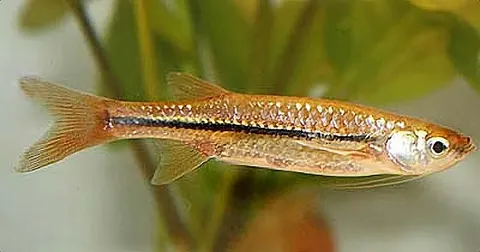
Esomus thermoicos
Esomus, scientifically known as Esomus thermoicos, belongs to the extensive Carp family (Cyprinidae). It is sometimes called the Bearded Rasbora due to the presence of two long barbels. These fish have an elongated,…
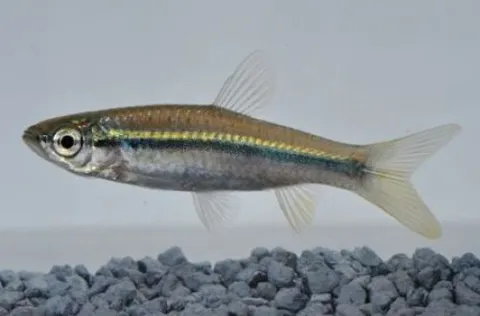
Rasbora daniconius
The Striped Rasbora, or Indian Rasbora (scientific name Rasbora daniconius), is a member of the Cyprinidae family. Although this species is not distinguished by its bright coloration among its relatives, it can still…
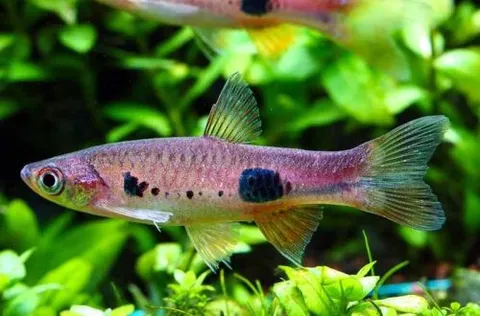
Rasbora kalochroma
A member of the Cyprinidae family, the Clown Rasbora (scientific name Rasbora kalochroma) is characterized by its peaceful nature and relative ease of care, making it a good addition to a freshwater aquarium community.
Rasbora reticulata
Rasbora reticulata, known as the Reticulated Rasbora, is a member of the carp family (Cyprinidae). This fish originates from Southeast Asia. It is found on Sumatra and on Nias Island, which lies to the west of it. It…