Temperature23 – 28 °C
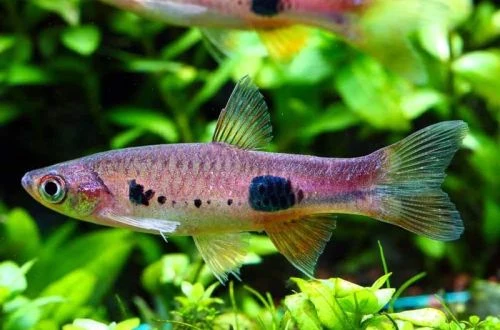
A member of the Cyprinidae family, the Clown Rasbora (scientific name Rasbora kalochroma) is characterized by its peaceful nature and relative ease of care, making it a good addition to a freshwater aquarium community.
Adults can reach a length of about 10 cm. Their coloration is predominantly red and orange, while the belly remains light. They have two large dark spots on their body, similar to those observed in the Elegant Rasbora. Young individuals, in turn, bear a resemblance to the Dwarf Rasbora. Such similarity often leads to confusion, where one species is supplied under the name of another. Sexual dimorphism is not pronounced; females are generally slightly larger than males.
This species originates from Southeast Asia, specifically the peninsular part of Malaysia, as well as the islands of Sumatra and Kalimantan. These fish favor peat swamps located deep within tropical forests, and the streams and small rivers flowing nearby. Their natural habitat is characterized by shallow waters, with bottoms covered in fallen vegetation such as branches and leaves. The decomposition of organic matter causes the water to acquire a rich brown hue. Hydrochemical parameters in such conditions show extremely low pH and dGH values.
Clown Rasboras are peaceful and friendly, which allows them to be kept in the same aquarium with many other species of comparable size. These fish prefer to stay in large shoals. It is recommended to keep a group of at least 8–10 individuals, as they may become timid if kept in smaller numbers.
For a shoal of 8–10 Clown Rasboras, the optimal aquarium volume starts from 250 liters. When decorating, it is recommended to recreate conditions resembling their natural habitat. Sand substrate, driftwood, and shade-loving plants, which can be planted in dense groups, will be an excellent choice. Lighting should be subdued. Floating vegetation can also provide additional shade. The use of leaves from trees such as oak, birch, maple, or exotic Indian almond will be a useful decorative element. As they decompose, the leaves release tannins, which give the water its characteristic brown color. It is important to note that when keeping Clown Rasboras, water quality plays a key role, even more so than decor. It is necessary to maintain low hydrochemical parameters and avoid sharp fluctuations. Regular aquarium maintenance and the installation of a powerful filtration system will help maintain water at the proper quality level.
This species is omnivorous and readily accepts most common aquarium fish foods. The daily diet can consist of dry, frozen, or live foods of appropriate size.
As is typical for most members of the carp family, Clown Rasboras are highly prolific and do not exhibit parental care for their offspring. Under favorable conditions, with sufficient hiding places, for example, in the form of dense vegetation, the fish will spawn regularly, and some fry are quite capable of surviving even in a community tank.
Clown Rasbora is a hardy and undemanding fish. When suitable keeping conditions are met, health problems usually do not arise. Diseases can appear in cases of injury, contact with already sick fish, or a significant deterioration of habitat parameters (for example, in a dirty aquarium or with poor nutrition).
When purchasing Clown Rasboras, choose active individuals that stay in a shoal and do not show signs of lethargy or a tendency to isolate themselves. Carefully inspect the fish for fin damage, ulcers, white spots, or unnatural growths on the body, as these symptoms may indicate infectious diseases. Avoid individuals with signs of emaciation or sunken bellies. Since this species is often confused with other members of the genus, ensure correct identification: Rasbora kalochroma has a characteristic coloration with two large dark spots on its sides and a reddish body hue. In the store, the fish should be kept in clean water, and their behavior should be natural for a schooling species. Remember that due to their timidity, they may appear paler in retail tanks than in a home environment with subdued lighting.
The essentials: size, tank volume, water parameters and care
An adult reaches 10 cm in length. Plan the tank around the maximum size: the fish quickly outgrows a cramped setup.
The recommended volume is 250 L. A smaller tank speeds up nitrate build-up and raises stress levels.
Temperature 23–28 °C, pH 5–7.5, hardness 1–10 dGH. Stability matters more than exact values: sudden swings are harder on the fish than a small deviation from the ideal.
Around 4 years when kept properly. Lifespan depends directly on tank volume, water quality and a varied diet.
Temperament: peaceful (regular). Keep this in mind when choosing tank mates.
Recommended setup: group (8–10 individuals). Ignoring this is a common cause of stress and disease.
Diet type: any (universal). Feed small portions that are finished within a couple of minutes — overfeeding does more harm than underfeeding.
The scientific name of the species is Rasbora kalochroma, family Cyprinids (Cyprinidae). It also appears in the literature as: Leuciscus kalochroma, Rasbora kalachroma.
The water suits 198 of 208 plants in the catalogue — the easiest ones are shown first.
Afzelius's AnubiasAnacharisAnubiasBrazilian PennywortDwarf CloverDwarf CloverDwarf HygrophilaDwarf SagittariaDwarf ValGuppy GrassHornwortJava FernJava MossMoneywortMud SwordNair's LagenandraNarrow Leaf AnacharisNarrow-leaf CloverStringy MossSüsswassertangTaiwan MossTape GrassTemple PlantUssuri Watermilfoil
Matched by family, categories and overlapping keeping conditions
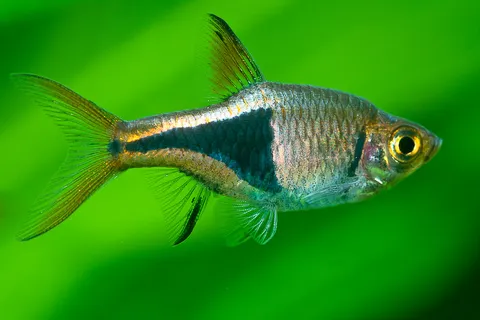
Trigonostigma heteromorpha
The Harlequin Rasbora, also known as the Wedge-spot Rasbora (Trigonostigma heteromorpha), belongs to the family Cyprinidae. This fish has been popular among aquarists since the early 20th century. Thanks to targeted…
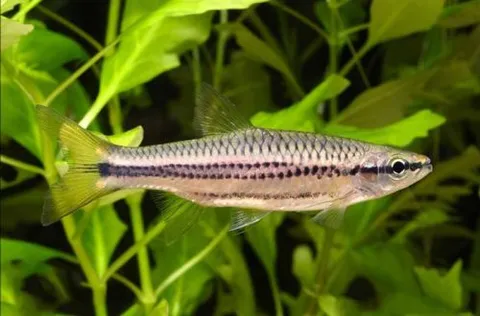
Rasbora cephalotaenia
Rasbora cephalotaenia, known in the aquarium hobby as the Two-striped Rasbora, is a member of the Cyprinidae family.
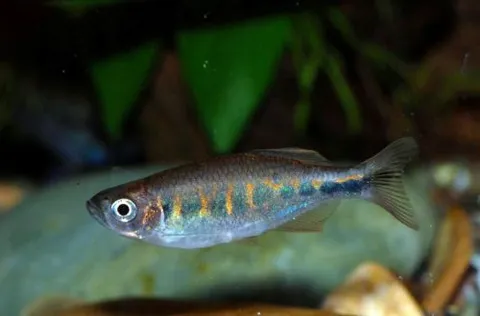
Devario pathirana
The Patirana Danio, or Ceylon Danio, also known as the Ceylon Tiger Danio (scientific name Devario pathirana), is a member of the Cyprinidae family. This name was given in honour of Ananda Pathirana, who made the…
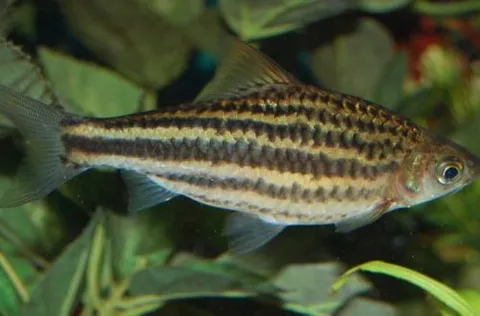
Desmopuntius johorensis
Desmopuntius johorensis, also known as the Five-banded Barb or Striped Barb, belongs to the Cyprinidae family. This fish is attractive due to its unique body pattern. Thanks to its unpretentiousness and peaceful nature,…