Temperature21 – 26 °C
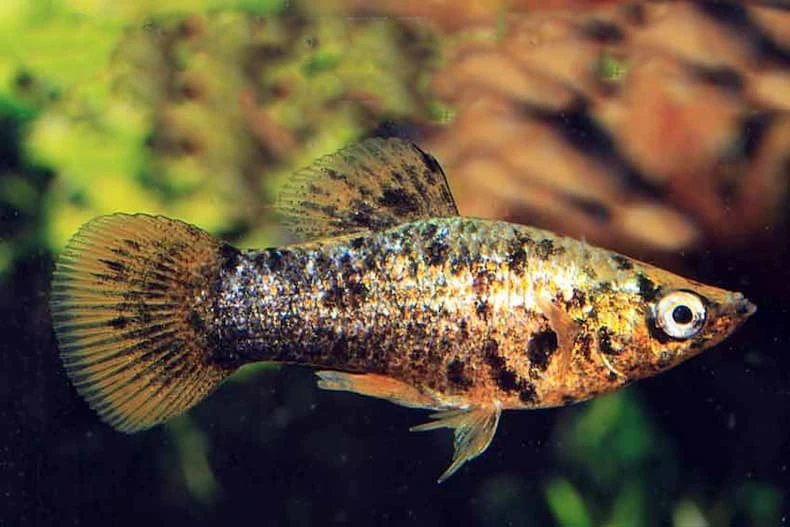
In English-speaking countries, the trade name “Marble Molly” or “Molly Marble” refers not to a specific breed of fish, but to a particular color variation. This pattern can be found in several selective forms, such as Poecilia velifera, Poecilia latipinna, Poecilia sphenops, as well as their hybrids.
The Marble Molly is a selective breeding form characterized by a distinctive spotted coloration resembling the texture of marble. The fish has a robust body with broad fins. Depending on the variety, it can have standard fin shapes, as well as veil or lyre-tailed variations. Sexual dimorphism is clearly expressed: males are usually more slender, have a pointed anal fin transformed into a gonopodium, and often possess more developed dorsal fins. Females are larger than males, and their anal fin is rounded.
The natural ancestors of the species inhabit freshwater and brackish waters of Central and North America, including coastal lagoons and river estuaries. In their natural environment, these fish prefer areas with dense vegetation where the water is well warmed by the sun. Water parameters in nature are characterized by an alkaline reaction and increased hardness, which is due to their proximity to marine coasts and the species' ability to adapt to varying degrees of salinity.
These fish have a peaceful and friendly disposition, making them excellent tank mates for other non-aggressive species in a community aquarium. However, it should be noted that males can sometimes display very active courtship towards females, which can be tiring for the latter. Although the presence of hiding places helps to mitigate excessive attention, in smaller aquariums it is preferable to keep such a group on a “harem” principle: one male and several females.
The size of adults depends on the breed: females grow to about 10–12 cm and males to about 6–8 cm. Therefore, when planning an aquarium, one should aim for spacious tanks—from 100 to 150 liters. This volume will be sufficient for the comfortable keeping of 3–4 fish, provided diligent care and a properly functioning filtration system. Vegetation plays a central role in aquarium design. Lush thickets will provide excellent refuges where subdominant males, females during spawning, and, of course, fry can hide. In addition, plants can serve as a supplement to their diet. Mollies tend to nibble on tender plant parts, so it is preferable to choose fast-growing and undemanding varieties. Marble Mollies thrive best in slightly alkaline water with high general hardness. They can also adapt to conditions of moderate salinity. It is worth noting that through many years of selective breeding, these fish have successfully adapted to other conditions, such as prolonged living in softer water.
These fish are considered omnivores. Their daily diet can be based on common dry foods, presented as flakes or pellets. It is advisable to choose products enriched with vegetable additives, or to use specialized Molly foods produced by many manufacturers. This option significantly reduces the risk of damage to aquarium plants.
Breeding these fish is not very difficult. Under favorable conditions, they regularly produce offspring. The only obstacle a beginner aquarist might face is that adult fish tend to eat their own fry. In an overcrowded aquarium, with insufficient feeding and a lack of reliable hiding places, only a few fry will survive to adulthood. If you plan to save the entire brood, it is recommended to transfer them to a separate aquarium.
Marble Mollies are sensitive to water quality and temperature. When kept in soft or acidic water, or with sudden temperature fluctuations, the fish are susceptible to ichthyophthiriasis, which manifests as white spots on the body. Fungal infections (Saprolegnia) are also possible with injuries or weakened immunity. Prevention includes maintaining stable hardness and pH parameters, regular water changes, and adding a small amount of non-iodized salt, which helps strengthen the body's protective functions.
When purchasing, one should choose active fish with clean fins, free of signs of damage, film, or white spots. It is important to pay attention to behavior: a healthy specimen should be mobile, show no signs of apathy, and not constantly stay at the water surface. Avoid specimens with sunken bellies or spinal deformities, unless this is a specific characteristic of a particular selective breeding form. It is recommended to purchase fish from the same batch to minimize the risk of introducing infections.
The essentials: size, tank volume, water parameters and care
An adult reaches 8–12 cm in length. Plan the tank around the maximum size: the fish quickly outgrows a cramped setup.
The recommended volume is 150 L. A smaller tank speeds up nitrate build-up and raises stress levels.
Temperature 21–26 °C, pH 7–8.5, hardness 15–30 dGH. Stability matters more than exact values: sudden swings are harder on the fish than a small deviation from the ideal.
Around 4 years when kept properly. Lifespan depends directly on tank volume, water quality and a varied diet.
Temperament: peaceful (regular). Keep this in mind when choosing tank mates.
Recommended setup: mixed (solitary / pair / group). Ignoring this is a common cause of stress and disease.
Diet type: mixed diet (meat + plant-based). Feed small portions that are finished within a couple of minutes — overfeeding does more harm than underfeeding.
The scientific name of the species is Poecilia sphenops, family Poeciliidae. It also appears in the literature as: Gambusia modesta, Gambusia plumbea, Lembesseia parvianalis.
This fish damages plants, especially when its diet is short of vegetable food.
African Onion PlantAfzelius's AnubiasAmazon FrogbitAmazon SwordAnacharisAnubiasArrowhead CryptAsian WatermossBalansa Water TrumpetBanana PlantBarth's SwordBeckett's Water TrumpetBlue BuceBoivin's AponogetonBroad-leaf Water SpriteBrookweedChristmas MossCognac AmmanniaCongo AnubiasCreeping JennyCreeping SpotflowerCrinkled AponogetonDark SwordDelta ArrowheadDense MayacaDitch StonecropDwarf AmbuliaDwarf CloverDwarf CloverDwarf HairgrassDwarf HygrophilaDwarf RanalismaDwarf RotalaDwarf SagittariaDwarf ValDwarf Water TrumpetEelgrassFanwortFeathered LimnophilaFloating Aponogeton
Matched by family, categories and overlapping keeping conditions
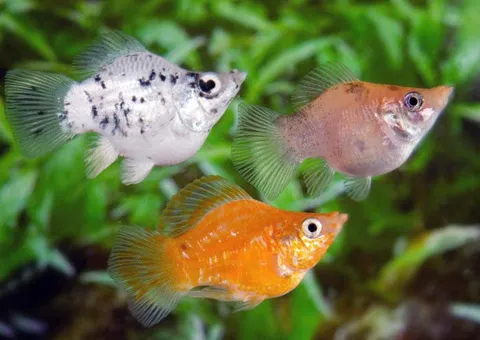
Poecilia sphenops
The Balloon Molly, also known as the Balloon Molly, is called the Balloon Molly in English-speaking trade. This common name is given to selective breeding forms obtained by breeding based on Poecilia sphenops, Poecilia…
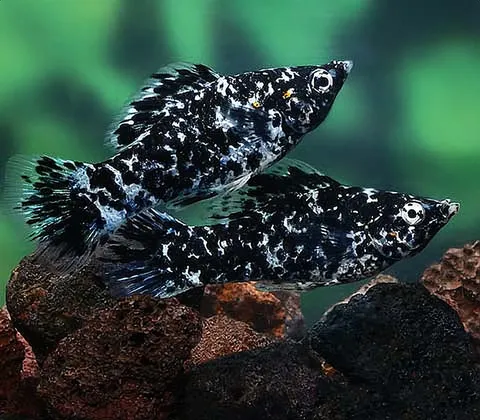
Poecilia sphenops
The collective term “black and white molly” usually refers to several selective breeding forms, distinguished by their characteristic body coloration, where white and black tones predominate. Examples of such forms…
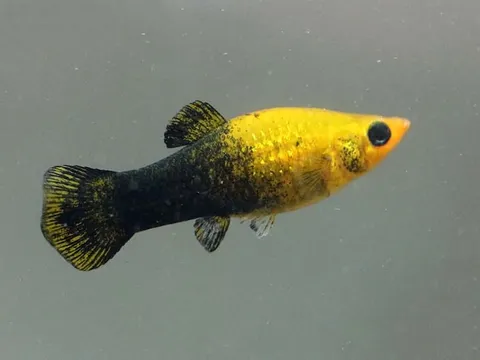
Poecilia sphenops
The Black and Yellow Molly, also known as the “Gold Dust Molly,” gets its names from the English trade names Gold And Black Molly Fish and Gold Dust Molly, respectively. These names refer to a color morph of Poecilia…
Poecilia sphenops
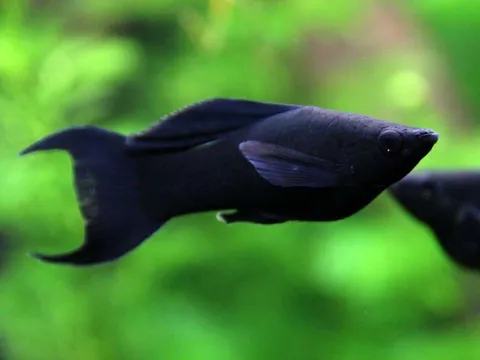
The Black Molly, often simply called Black Molly, is apparently a selective color variation of the well-known Sailfin Molly (Poecilia sphenops). At the same time, some authoritative breeders prefer the version that it…