Temperature23 – 28 °C
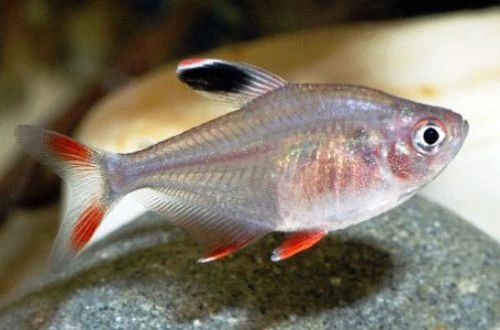
The Ornate Tetra, also known as the Common Ornate Tetra or by its scientific name Megalamphodus bentosi, belongs to the family Acestrorhamphidae. This species is a classic representative of the extensive group of tetras, which share a similar body shape and characteristic markings. It is a close relative of species such as the Red-Spotted Tetra and the Rosy Tetra.
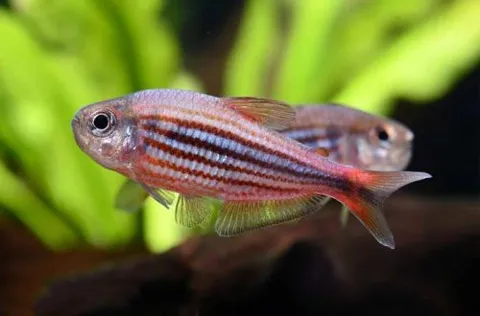
The fish's body is laterally compressed, with noticeably high dorsal and anal fins, and a distinctly forked tail. The predominant body coloration is pink, which can acquire more saturated hues depending on the individual's region of origin and its keeping conditions. The tail is usually reddish, and the fins show black markings with white tips. It is this feature that distinguishes this species from the Rosy Tetra, with which it is practically identical in all other respects. Therefore, it is sometimes called the False Rosy Tetra. Males are distinguished by longer fins. At the same time, females are noticeably larger and have a rounder abdomen.
This fish is widespread in South America, in the tributaries of the Amazon River. It prefers slow-moving small rivers and streams with dense vegetation, which flow through tropical jungles under the canopy of trees. In its natural habitat, the main component of these fish's diet consists of small invertebrates.
In natural conditions, the Ornate Tetra lives in groups of more than 50 individuals. In aquarium conditions, the minimum number of fish in a group should not be less than six. These fish coexist perfectly with related species, as well as with other tetras of similar size. However, noisy and overly active neighbors can cause them discomfort.
The Common Ornate Tetra does not tolerate strong water movement, so it is advisable to direct the filter outlet towards the aquarium wall to soften the flow. As with most tetra species, it is desirable to use alder cones as filter media to acidify the water. The lighting system should be set to dim light, imitating a forest canopy. Other necessary equipment includes a heater and an aerator. Floating plants are welcome in the aquarium's decor, as they will create additional shade. Other plants are recommended to be placed in groups along the side and back walls of the tank. River sand is suitable as a substrate; a few dry leaves can be added to give the water a light brown tint, recreating the natural habitat. The leaves should be replaced every two weeks.
These fish readily consume dry commercial foods, which, however, must be of high quality and rich in vitamins and minerals. It is recommended to choose foods specifically designed for tetras. A lack of trace elements can manifest as the fish starting to nip at plant leaves. Their diet can be diversified with small crustaceans, such as daphnia, for young individuals, while adult fish can be fed bloodworms.
Successful breeding is possible in a separate tank. A volume of 40 L is quite sufficient for a spawning aquarium, with water parameters matching those of the main aquarium. The equipment set includes a filter, aerator, heater, and lighting system. Plants with fine leaves and a sandy substrate are essential for the aquarium's decor. The pair is isolated in a separate tank. Freeze-dried meat products or live bloodworms are added to their daily diet. After some time, the female will become gravid with eggs; after a brief courtship, she lays the eggs on plant leaves, and the male fertilizes them. The parents are returned to the main aquarium. Fry appear in approximately five days; at this point, half of the water is replaced with water of the same parameters. They can be fed micro-foods and Artemia.
As long as the water and keeping conditions are maintained properly, no health problems arise. This species is not prone to specific diseases.
When selecting individuals, attention should be paid to their activity and the absence of visible damage: fins should be intact, without signs of deterioration or white film, and scales should be tightly adhering. A healthy fish shows curiosity, stays in the water column, and actively responds to food. Avoid purchasing fish with signs of emaciation, sunken bellies, or unnatural behavior, such as constantly hovering near the surface or attempting to rub against decorations. Since the species is schooling, it is recommended to acquire a group of 8–10 individuals at once to minimize stress during adaptation to new aquarium conditions.
The essentials: size, tank volume, water parameters and care
An adult reaches 4.3–4.5 cm in length. Plan the tank around the maximum size: the fish quickly outgrows a cramped setup.
The recommended volume is 81 L. A smaller tank speeds up nitrate build-up and raises stress levels.
Temperature 23–28 °C, pH 5.8–7.5, hardness 5–19 dGH. Stability matters more than exact values: sudden swings are harder on the fish than a small deviation from the ideal.
Around 5 years when kept properly. Lifespan depends directly on tank volume, water quality and a varied diet.
Temperament: peaceful, active/mobile. Keep this in mind when choosing tank mates.
Recommended setup: schooling (usually from 5–6 individuals and more). Ignoring this is a common cause of stress and disease.
Diet type: any (universal). Feed small portions that are finished within a couple of minutes — overfeeding does more harm than underfeeding.
The scientific name of the species is Megalamphodus bentosi, family Acestrorhamphidae. It also appears in the literature as: Hyphessobrycon robertsi.
The water suits 197 of 208 plants in the catalogue — the easiest ones are shown first.
Afzelius's AnubiasAnacharisAnubiasBrazilian PennywortDwarf CloverDwarf CloverDwarf HygrophilaDwarf SagittariaDwarf ValGuppy GrassHornwortJava FernJava MossMoneywortMud SwordNair's LagenandraNarrow Leaf AnacharisNarrow-leaf CloverStringy MossSüsswassertangTaiwan MossTape GrassTemple PlantUssuri Watermilfoil
Matched by family, categories and overlapping keeping conditions
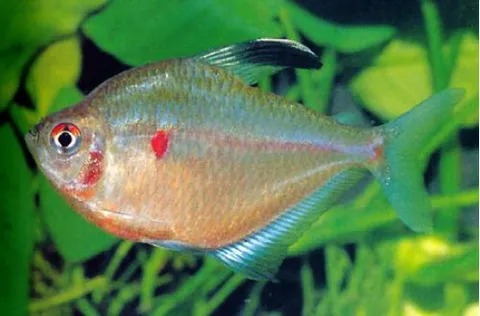
Megalamphodus erythrostigma
The Red-Spotted Tetra, also known as Rubrostigma or Ornate Red-Spotted Tetra (scientific name Megalamphodus erythrostigma), belongs to the Acestrorhamphidae family. This active, peaceful fish, distinguished by its…
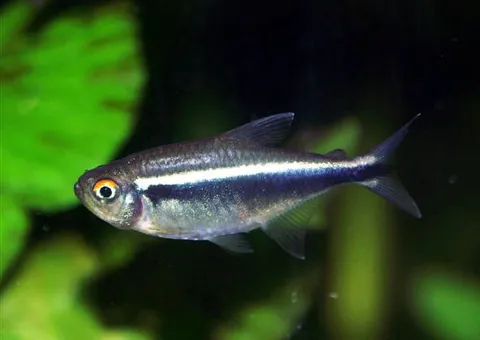
Hyphessobrycon herbertaxelrodi
Hyphessobrycon herbertaxelrodi, also known as the Black Neon Tetra, belongs to the family Acestrorhamphidae. This fish is characterized by its energetic nature and attractive appearance, especially due to the bright,…
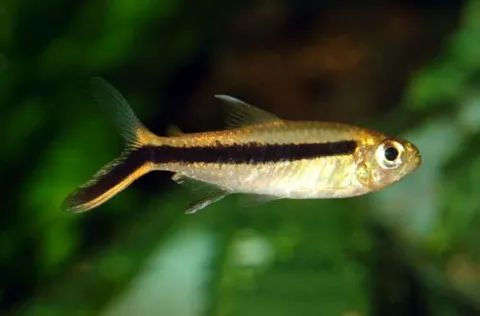
Thayeria boehlkei
The Crooked-Striped Thayeria, widely known as the Penguin Tetra, with the scientific name Thayeria boehlkei, is a member of the Acestrorhamphidae family. These fish are characterized by their cheerful, energetic, and…
Moenkhausia agnesae
Moenkhausia agnesae, known in scientific literature as Moenkhausia agnesae, belongs to the Acestrorhamphidae family. This fish is native to South America, specifically found in the upper reaches of the Amazon River. It…