Temperature22 – 28 °C
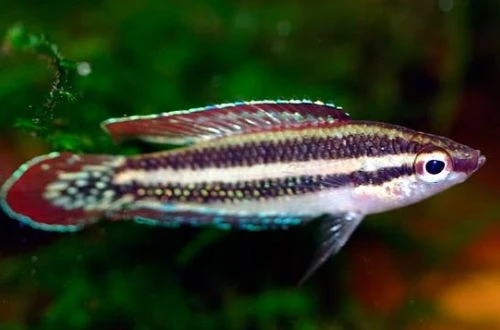
Parosphromenus quindecim, known as the Fifteen-rayed Licorice Gourami or Fifteen-rayed Betta, is a member of the Osphronemidae family. Its unusual name is due to the structure of its dorsal fin: unlike most relatives, this species has 14–15 rays that rise above the edge like spines. This species is rarely found in pet stores and presents certain difficulties in keeping, so it is not recommended for inexperienced aquarists.
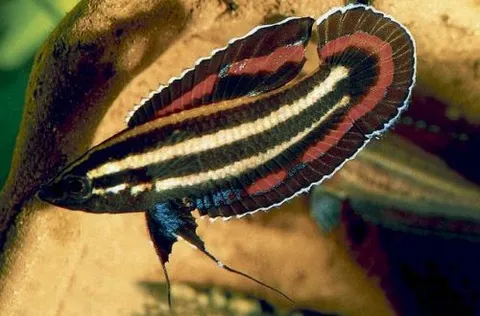
Adult fish reach a length of about 4 cm. Their bodies are adorned with a striped pattern consisting of alternating light and dark horizontal bands. Males have bluish fin bases and edges, with a red area in between. A black spot with turquoise speckles is noticeable at the base of the tail. During the breeding season, their coloration becomes more vibrant. Females, however, look much more modest, their main color being pale yellow.
Parosphromenus quindecim originates from Southeast Asia, specifically from the Indonesian part of Borneo, where it is known from the Pawan and Liong river basins in south-eastern West Kalimantan province. The natural habitat of these fish is swamps and marshy areas of rivers, covered by dense tropical forest. In natural conditions, the fish find shelter among numerous snags and plant debris, such as fallen leaves and tree roots. Lighting in these areas is low, as dense tree canopies allow little light to pass through. The water acquires a rich brown hue due to the high concentration of humic and tannic substances, which are formed as a result of the decomposition of plant organic matter.
Males show competition for the attention of females, but this does not escalate into fierce rivalry, characteristic of related Betta fighting fish. If there are enough shelters in the aquarium, several males can be kept together with females. Peaceful fish of a similar size, such as small species of Rasboras from the Cyprinidae family, are suitable as tankmates. Joint keeping of different species of Licorice Gouramis should be avoided to prevent the appearance of hybrid offspring.
For keeping a pair of fish, an aquarium of 30–40 liters will be required. It is important to provide a sufficient number of shelters in the decor. Natural snags and dense thickets of live plants are perfectly suitable. A layer of dried leaves from certain trees, previously soaked to prevent floating, can be placed on the bottom. Dim lighting is preferable; floating plants will create additional shading. When keeping Parosphromenus quindecim, special attention should be paid to the hydrochemical composition of the water. The fish require very low pH and dGH values. In this regard, during water preparation, it may be necessary to use a reverse osmosis unit or other traditional methods for obtaining soft water. Notably, the use of leaves will help create a water chemistry similar to the natural habitat of this species, thanks to the tannins they release. The stability of the aquatic environment is maintained by the uninterrupted operation of equipment, especially the filtration system, as well as regular aquarium maintenance. This includes timely removal of organic residues and weekly replacement of 10–15% of the water volume with fresh water. Filtration should not be too intense to avoid strong internal currents. In some cases, a regular air-driven sponge filter is quite sufficient.
In a home aquarium, these fish prefer mainly live foods. Their diet readily includes bloodworms, Daphnia, Artemia, and mosquito larvae. Frozen analogues of these products can also be included. Dry foods are generally ignored by them.
The likelihood of spawning increases with suitable water conditions and a balanced diet. When the breeding season arrives, the male chooses an area on the aquarium bottom, in the center of which there is a suitable shelter for the clutch. Forming a temporary pair, the male and female perform a courtship dance. During spawning, the fertilized eggs are placed in the shelter. After this, the female leaves the spawning site, and the male remains to guard the clutch. He cares for the offspring until the fry begin to swim freely, which usually takes about a week. After this period, parental instincts fade.
Maintaining a stable biological system, providing a balanced diet, and eliminating stress factors (e.g., harassment by aggressive tank mates) are the best guarantees for preserving fish health. If the first signs of illness appear, the first thing to pay attention to is precisely these three aspects, as deviations have likely occurred in one of them. As a rule, eliminating the problem leads to self-recovery. However, if the immune system proves to be insufficiently strong, medicinal treatment may be required.
When selecting individuals, preference should be given to active fish with clean fins without signs of damage, coatings, or white spots. It is important to ensure that the fish exhibit natural behavior and do not appear emaciated, as this species is sensitive to keeping conditions and stress during transportation. Since Parosphromenus quindecim is rarely found for sale and is most often represented by individuals from old breeding lines, it is recommended to clarify the origin of the fish with the seller. Avoid purchasing specimens that stay near the water surface or appear lethargic, as this may indicate unsatisfactory conditions in the store or hidden diseases. Acquiring healthy individuals requires careful inspection, as due to the limited range of the species in nature and its rarity in aquariums, population recovery in case of death can be difficult.
The essentials: size, tank volume, water parameters and care
An adult reaches 2.9–4 cm in length. Plan the tank around the maximum size: the fish quickly outgrows a cramped setup.
The recommended volume is 40 L. A smaller tank speeds up nitrate build-up and raises stress levels.
Temperature 22–28 °C, pH 3–6.5, hardness 1–5 dGH. Stability matters more than exact values: sudden swings are harder on the fish than a small deviation from the ideal.
Around 4 years when kept properly. Lifespan depends directly on tank volume, water quality and a varied diet.
Temperament: peaceful (regular). Keep this in mind when choosing tank mates.
Recommended setup: schooling (usually from 5–6 individuals and more). Ignoring this is a common cause of stress and disease.
Diet type: high protein (predominantly meat). Feed small portions that are finished within a couple of minutes — overfeeding does more harm than underfeeding.
The scientific name of the species is Parosphromenus quindecim, family Osphronemidae.
The water suits 197 of 208 plants in the catalogue — the easiest ones are shown first.
Afzelius's AnubiasAnacharisAnubiasBrazilian PennywortDwarf CloverDwarf CloverDwarf HygrophilaDwarf SagittariaDwarf ValGuppy GrassHornwortJava FernJava MossMoneywortMud SwordNair's LagenandraNarrow Leaf AnacharisNarrow-leaf CloverStringy MossSüsswassertangTaiwan MossTape GrassTemple PlantUssuri Watermilfoil
Matched by family, categories and overlapping keeping conditions
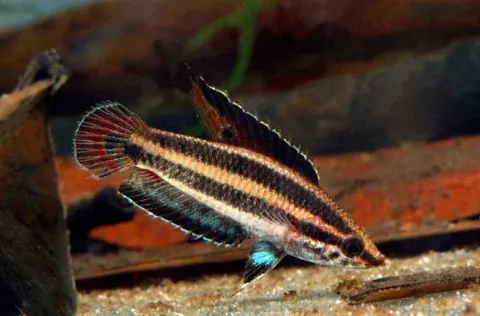
Parosphromenus allani
Parosphromenus allani, known as Allan's Licorice Gourami or Allan's Betta, belongs to the family Osphronemidae. It was named in honour of Allan Brown, who collected these fish in Sarawak, Borneo, in 1986; the species…
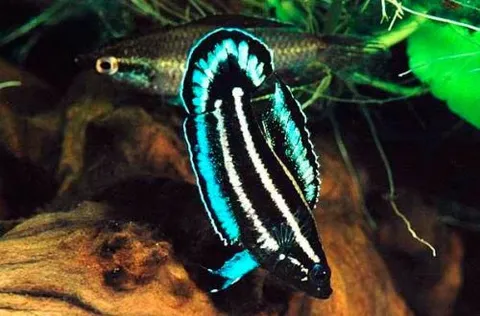
Parosphromenus harveyi
The Harvey's Licorice Gourami, or Parosphromenus harveyi, known scientifically as Parosphromenus harveyi, is a member of the family Osphronemidae. The species is named after the researcher Willy Harvey. In aquaristics,…
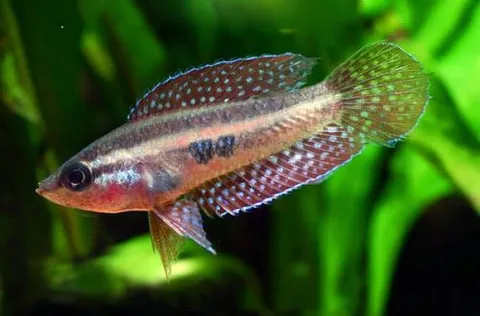
Parosphromenus linkei
Parosphromenus linkei, also known as Linke's Licorice Gourami, belongs to the family Osphronemidae. This vibrant and attractive fish appears quite regularly in the trade. Among other Parosphromenus species, its keeping…
Parosphromenus tweediei
The fish Parosphromenus tweediei, also known as Tweedie's Licorice Gourami, is a member of the family Osphronemidae. Its name was given in honour of Michael W. F. Tweedie (1907–1993), a naturalist and archaeologist who…