Temperature20 – 27 °C
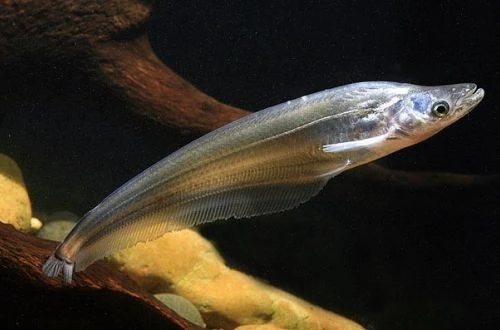
The scientific name Phalacronotus apogon, or Phalacronotus, belongs to the family Siluridae. As a rule, this species is not classified as an aquarium fish due to its significant size. Its primary use is in large public or private aquariums, the maintenance of which is carried out by specialized companies.
Adults of this fish can reach a length of 60–70 cm. Its body is elongated, noticeably compressed laterally, resembling the shape of a knife blade. An interesting feature is the absence of a dorsal fin, as well as a long anal fin that extends almost from the head to the very tail, complementing its appearance. The body coloration is usually grayish-silver. Speckles or thin stripes can be seen on its body, the presence of which depends on the specific region from which the fish originates.
The origin of this fish is associated with Southeast Asia, where its natural habitat covers vast territories: from the northern provinces of Thailand through Laos, Cambodia, Vietnam and Peninsular Malaysia, as well as the Greater Sunda Islands of Sumatra, Borneo and Java. Phalacronotus is found in all major river systems of the region, inhabiting main channels and large tributaries, and also penetrating into flooded areas of the tropical forest during the rainy season.
Despite its predatory nature, this fish is surprisingly peaceful. It coexists well with both its own kind and other species, the main condition being that they are large enough not to be perceived as prey. However, it should be remembered that any small fish will inevitably become a target for hunting.
Such a large fish naturally requires an aquarium of appropriate size. A volume of at least 1500 liters is recommended for a single specimen. The choice of decor is not critical; it is sufficient to provide subdued lighting and leave enough open swimming space. Keeping Phalacronotus involves certain difficulties. The most laborious and expensive task is maintaining stable water conditions within an acceptable range of temperatures and hydrochemical values. A tank weighing more than one ton, as well as all water purification systems, imply solving serious engineering problems, which puts such a project beyond the scope of ordinary amateur aquaristics.
This fish can be classified as a predator that hunts primarily in the water column or near the surface. Catfish caught in the wild often refuse alternative products and require live fish for feeding. At the same time, individuals raised in captivity on commercial fish farms have successfully adapted to a diet of fresh or frozen meat products. They must not be fed mammalian or avian meat: the lipids it contains cannot be properly metabolised by the fish and lead to excess fat deposits and even organ degeneration.
At the time of writing, breeding of this catfish species in aquarium conditions has not been recorded. The main source for commercial trade is fish farms, where reproduction is stimulated using hormonal preparations.
Most health problems in fish often arise from unsuitable keeping conditions. Maintaining a stable and comfortable habitat is a key factor for successful keeping. If symptoms of illness appear, the first step is to check the water quality. If deviations are found, it is important to take immediate measures to eliminate them. If the symptoms do not disappear or worsen, medicinal treatment may be required.
When purchasing Phalacronotus, it should be noted that it is a large predator requiring significant space, so acquisition is only permissible if a prepared aquarium of 500–1000 liters or more is available. Young specimens are often sold without proper information about their future size, which can reach 70 cm. When choosing, it is important to assess the condition of the fish in the store: — absence of skin damage, ulcers, film, or spots on the body; — clean and intact fins without signs of erosion or torn edges; — clear, not cloudy eyes without signs of inflammation; — calm but confident behavior, absence of signs of panic or apathy. It is recommended to clarify the type of diet with the seller, as wild specimens may refuse non-live food, preferring live fish. Avoid purchasing specimens that appear emaciated or show signs of stress, such as constant chaotic movement or attempts to jump out of the aquarium. Given the predatory nature of the species, do not purchase the fish if your aquarium contains small tankmates that could become prey. It is also worth ensuring there are no signs of disease in other inhabitants of the communal aquarium in the store, as this species is sensitive to water quality and parameter instability in a new environment.
The essentials: size, tank volume, water parameters and care
An adult reaches 70 cm in length. Plan the tank around the maximum size: the fish quickly outgrows a cramped setup.
The recommended volume is 1500 L. A smaller tank speeds up nitrate build-up and raises stress levels.
Temperature 20–27 °C, pH 6–7.5, hardness 2–15 dGH. Stability matters more than exact values: sudden swings are harder on the fish than a small deviation from the ideal.
Around 10 years when kept properly. Lifespan depends directly on tank volume, water quality and a varied diet.
Temperament: predator, but semi-peaceful (gets along with large ones). This is a predatory species — any fish small enough to fit in its mouth will eventually be eaten.
Recommended setup: both solitary and in group (flexible). Ignoring this is a common cause of stress and disease.
Diet type: for carnivores (live fish, insects, etc.). Feed small portions that are finished within a couple of minutes — overfeeding does more harm than underfeeding.
The scientific name of the species is Phalacronotus apogon, family Sheatfishes (Siluridae). It also appears in the literature as: Cryptopterus apogon, Cryptopterus micropogon, Kryptopterus apogon.
The water suits 197 of 208 plants in the catalogue — the easiest ones are shown first.
Afzelius's AnubiasAnacharisAnubiasBrazilian PennywortDwarf CloverDwarf CloverDwarf HygrophilaDwarf SagittariaDwarf ValGuppy GrassHornwortJava FernJava MossMoneywortMud SwordNair's LagenandraNarrow Leaf AnacharisNarrow-leaf CloverStringy MossSüsswassertangTaiwan MossTape GrassTemple PlantUssuri Watermilfoil
Matched by family, categories and overlapping keeping conditions
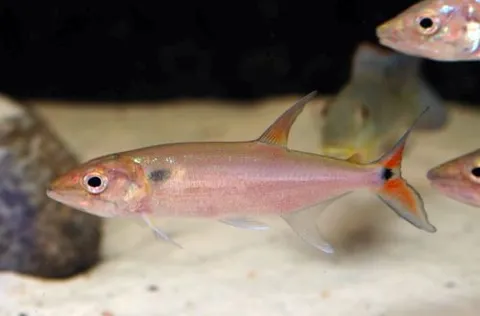
Acestrorhynchus falcatus
The Sickle Barracuda, scientifically known as Acestrorhynchus falcatus, belongs to the family Acestrorhynchidae. This fish earned the name "barracuda" due to its external resemblance to marine barracudas, although there…
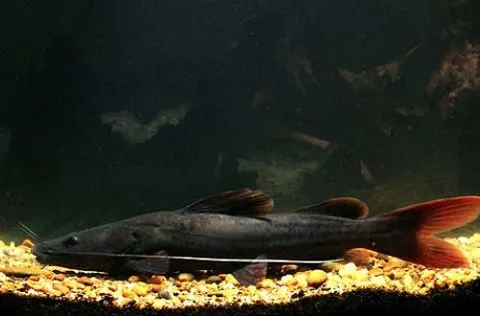
Hemibagrus wyckioides
The Asian Red-tailed Catfish, known scientifically as Hemibagrus wyckioides, is a member of the Bagridae family (Bagrid Catfishes). This is a very large and aggressive predatory fish, rarely suitable for beginner…
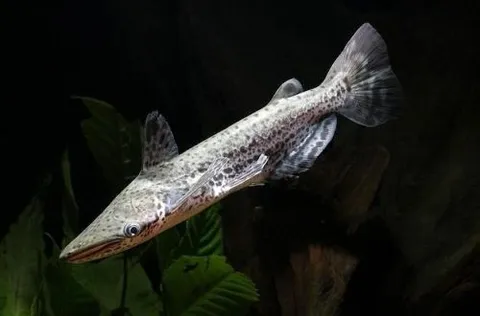
Ageneiosus marmoratus
Ageneiosus marmoratus, also known as the Hammer Catfish, Guyana Catfish, or Marbled Ageneiosus, is a member of the Auchenipteridae family. This small but remarkable fish differs from most catfish in its active…
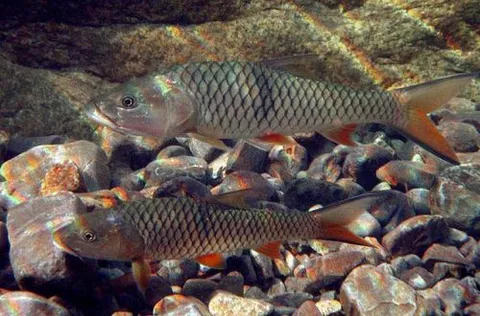
Hampala macrolepidota
The Hampala Barb, also known as the Jungle Perch (scientific name Hampala macrolepidota), is a member of the Cyprinidae family. This relatively large freshwater predator requires very spacious aquariums. In its natural…