Temperature20 – 26 °C
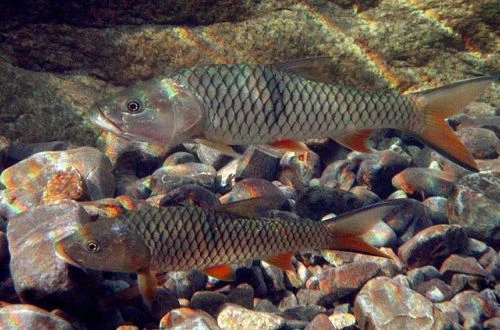
The Hampala Barb, also known as the Jungle Perch (scientific name Hampala macrolepidota), is a member of the Cyprinidae family. This relatively large freshwater predator requires very spacious aquariums. In its natural habitat, it is widely known as a sport fish.
Adults of this fish can reach 50–70 cm in length and weigh up to 5 kg. Their coloration varies from light grey to silvery. The caudal fin is red with dark edges; reddish hues are also visible on the other fins. A distinctive feature is a large vertical black stripe located below the dorsal fin. A noticeable dark spot is also present at the base of the tail. Young fish are distinguished by a pattern of 5–6 vertical stripes on a reddish background, with their fins being semi-transparent. Sexual dimorphism is weakly expressed; no obvious external differences between male and female are observed.
This fish originates from Southeast Asia, where its natural range covers vast territories: from the southwestern provinces of China and Myanmar, through Thailand, to Malaysia and the Greater Sunda Islands, including Kalimantan, Sumatra, and Java. It inhabits the channels of all significant rivers in the region, such as the Mekong, Chao Phraya, and Mae Klong, and is also found in the basins of smaller rivers, lakes, canals, and reservoirs. Despite its widespread distribution, the species prefers areas with clean, clear, oxygen-rich water and sandy, gravelly, or rocky substrate. During the rainy season, it migrates to flooded areas of tropical forests for spawning.
Despite its predatory nature, the Jungle Perch is peaceful towards fish of comparable size. Good tankmates for it can be the Red-tailed, Silver, or Hard-lipped Barb, as well as Hypsibarbus. Smaller species will inevitably be perceived as a food source.
Even for a single Hampala Barb, an aquarium of at least 500 liters will be required. The tank's decor is not critical, but it is important to provide ample open swimming space. A key aspect is maintaining high water quality. Since the Hampala Barb originates from flowing waters, it is extremely sensitive to the accumulation of organic waste and requires a high concentration of dissolved oxygen. Regular aquarium maintenance and the installation of a powerful filtration system are essential for successful keeping.
This is a predatory fish. In the wild, its diet consists of small fish, crustaceans, and amphibians. Young individuals primarily feed on insects and worms. In a home aquarium, similar foods should be offered, as well as pieces of fish meat, shrimp, or mussels. Dry foods can be used in limited quantities as a source of vitamins and trace elements. They must not be fed mammalian or avian meat: the lipids it contains cannot be properly metabolised by the fish and lead to excess fat deposits and even organ degeneration.
In natural conditions, reproduction is seasonal and coincides with the monsoon period. Cases of successful breeding of this species in home aquariums have not yet been recorded.
This fish is hardy, and instances of disease are rare. The main causes of ailments are usually an unsuitable habitat or poor quality food. When kept in spacious aquariums and regularly fed fresh products, health problems generally do not arise.
When choosing a Hampala Barb, it is advisable to select young individuals, as they adapt more easily to aquarium conditions. A healthy fish should be active, have clean fins without signs of erosion or film, and even scales without damage. Pay attention to behavior: the fish should be mobile, not apathetic or lying on the bottom. Avoid specimens with sunken bellies or visible body deformities. Since this species is a predator, when purchasing, it is important to clarify what the fish are fed in the store. It is desirable to choose individuals that are already accustomed to various types of food, including dry pellets, and not just live fish. Given the timidity of young fish, they may be cautious in the presence of a buyer, but in general, healthy individuals should show curiosity and a normal reaction to external stimuli.
The essentials: size, tank volume, water parameters and care
An adult reaches 70 cm in length. Plan the tank around the maximum size: the fish quickly outgrows a cramped setup.
The recommended volume is 500 L. A smaller tank speeds up nitrate build-up and raises stress levels.
Temperature 20–26 °C, pH 5.5–8, hardness 2–20 dGH. Stability matters more than exact values: sudden swings are harder on the fish than a small deviation from the ideal.
Around 8 years when kept properly. Lifespan depends directly on tank volume, water quality and a varied diet.
Temperament: predator, but semi-peaceful (gets along with large ones). This is a predatory species — any fish small enough to fit in its mouth will eventually be eaten.
Recommended setup: both solitary and in group (flexible). Ignoring this is a common cause of stress and disease.
Diet type: high protein (predominantly meat). Feed small portions that are finished within a couple of minutes — overfeeding does more harm than underfeeding.
The scientific name of the species is Hampala macrolepidota, family Cyprinids (Cyprinidae). It also appears in the literature as: Barbus hampal, Barbus macrolepidotus, Capoeta macrolepidota.
The water suits 198 of 208 plants in the catalogue — the easiest ones are shown first.
Afzelius's AnubiasAnacharisAnubiasBrazilian PennywortDwarf CloverDwarf CloverDwarf HygrophilaDwarf SagittariaDwarf ValGuppy GrassHornwortJava FernJava MossMoneywortMud SwordNair's LagenandraNarrow Leaf AnacharisNarrow-leaf CloverStringy MossSüsswassertangTaiwan MossTape GrassTemple PlantUssuri Watermilfoil
Matched by family, categories and overlapping keeping conditions
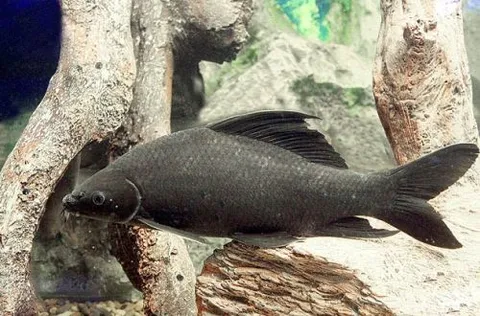
Labeo chrysophekadion
Labeo chrysophekadion, also known as the Black Labeo, belongs to the family Cyprinidae. Due to its impressive size and complex temperament, this species is quite demanding and not recommended for aquarium beginners.
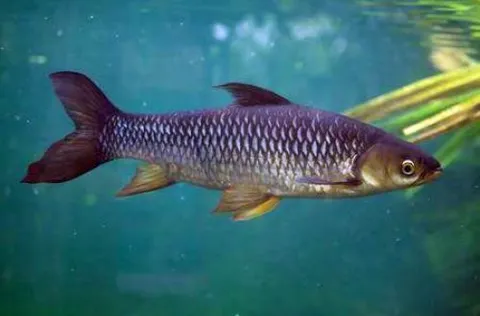
Leptobarbus hoevenii
The fish known as Hoven's Carp (Leptobarbus hoevenii) belongs to the family Cyprinidae. It is named after the zoologist Jan van der Hoeven (1801–1868). Due to its impressive size, this species is rarely found in amateur…
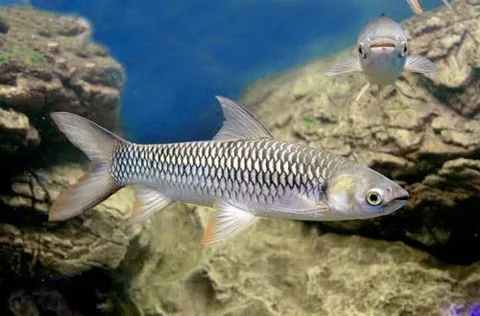
Leptobarbus rubripinna
The Red-Finned Leptobarbus, also known as the Sultan Fish, belongs to the family Cyprinidae and bears the scientific name Leptobarbus rubripinna. This is a hardy and undemanding species that exhibits a peaceful…
Phalacronotus apogon
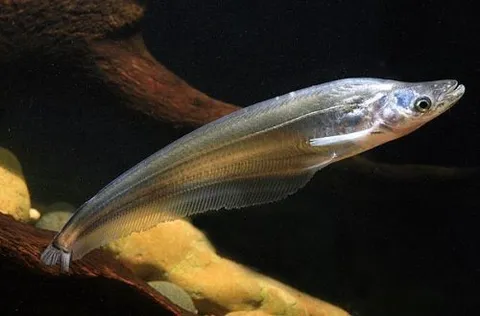
The scientific name Phalacronotus apogon, or Phalacronotus, belongs to the family Siluridae. As a rule, this species is not classified as an aquarium fish due to its significant size. Its primary use is in large public…