Temperature20 – 26 °C
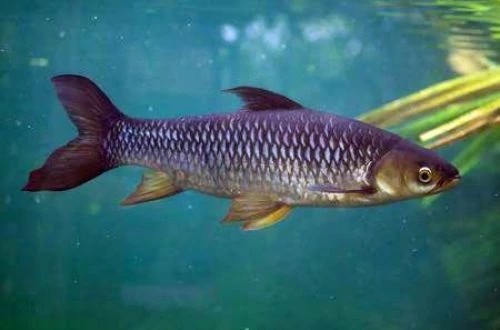
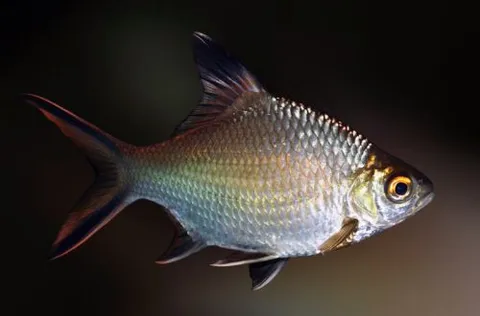
The fish known as Hoven's Carp (Leptobarbus hoevenii) belongs to the family Cyprinidae. It is named after the zoologist Jan van der Hoeven (1801–1868). Due to its impressive size, this species is rarely found in amateur aquariums. In its natural habitat, it is a popular target for sport fishing.
This is a large fish, capable of reaching a meter in length. Adults are uniformly colored in shades of steel or bronze, while juveniles have a silvery coloration. Sexual dimorphism in these fish is weakly expressed, and males and females are outwardly difficult to distinguish. It is important to note that there is some confusion with a related species – the Red-tailed Leptobarbus – due to their external similarity. Often, both of these species are sold under the same name.
The natural habitat of this species covers Southeast Asia, including peninsular Malaysia and large Sunda Islands such as Sumatra, Kalimantan, and Java. These fish prefer the main channels of large rivers in the region. During the rainy season, they move into flooded areas of the tropical forest, where spawning occurs.
These fish are distinguished by their peaceful and calm disposition, which allows them to be kept with other species large enough not to become food for them. They can live both alone and in groups.
Due to the significant size of Hoven's Barb, it is necessary to provide an appropriately sized aquarium. For the comfortable keeping of a single specimen, a tank with a volume of 1000 liters or more is desirable. The aquarium's decor can be arbitrary and is chosen at the owner's discretion. It is critically important to maintain high water quality. These fish are very sensitive to the accumulation of organic waste, such as food remnants and excrement. Therefore, regular, weekly partial water changes and a powerful filtration system are necessary conditions for their long-term and successful keeping. It should be noted that these fish are prone to jumping out of the water. Thus, the aquarium must be equipped with a lid and a splash-proof lighting system.
Representatives of this species are omnivores. In nature, their diet includes almost any food they can swallow, such as tree fruits, various insects, worms, and even small fish. In aquarium conditions, they readily adapt to most popular dry foods, which can become the main part of their diet.
Breeding in a home aquarium is not possible. However, on a commercial basis, the reproduction of these fish is organized in special nurseries on the island of Sumatra, where the spawning process is stimulated with hormonal preparations.
This fish is hardy, and instances of disease are rare. The main causes of ailments are usually an unsuitable habitat or poor quality food. When kept in spacious aquariums and regularly fed fresh products, health problems generally do not arise.
When purchasing, one should choose active, mobile specimens with clean scales and no visible damage or signs of infection on their fins. It is important to note that in the aquarium trade, a closely related species, Leptobarbus rubripinna, which is externally very similar but has differences in stripe coloration, is often sold under the name Hoven's Carp. It is recommended to acquire juveniles, as adult specimens are extremely demanding regarding water volume and difficult to transport. Avoid fish showing signs of lethargy, damaged gill covers, or unnatural behavior, as this species is sensitive to water quality and stress during relocation.
The essentials: size, tank volume, water parameters and care
An adult reaches 80–100 cm in length. Plan the tank around the maximum size: the fish quickly outgrows a cramped setup.
The recommended volume is 1000 L. A smaller tank speeds up nitrate build-up and raises stress levels.
Temperature 20–26 °C, pH 6–8, hardness 2–15 dGH. Stability matters more than exact values: sudden swings are harder on the fish than a small deviation from the ideal.
Around 10 years when kept properly. Lifespan depends directly on tank volume, water quality and a varied diet.
Temperament: semi-peaceful (dangerous to smaller ones). Not a predatory species, but small fish that fit in its mouth will eventually be eaten.
Recommended setup: both solitary and in group (flexible). Ignoring this is a common cause of stress and disease.
Diet type: any (universal). Feed small portions that are finished within a couple of minutes — overfeeding does more harm than underfeeding.
The scientific name of the species is Leptobarbus hoevenii, family Cyprinids (Cyprinidae). It also appears in the literature as: Barbus hoevenii, Leptobarbus hoenenii.
The water suits 197 of 208 plants in the catalogue — the easiest ones are shown first.
Afzelius's AnubiasAnacharisAnubiasBrazilian PennywortDwarf CloverDwarf CloverDwarf HygrophilaDwarf SagittariaDwarf ValGuppy GrassHornwortJava FernJava MossMoneywortMud SwordNair's LagenandraNarrow Leaf AnacharisNarrow-leaf CloverStringy MossSüsswassertangTaiwan MossTape GrassTemple PlantUssuri Watermilfoil
Matched by family, categories and overlapping keeping conditions
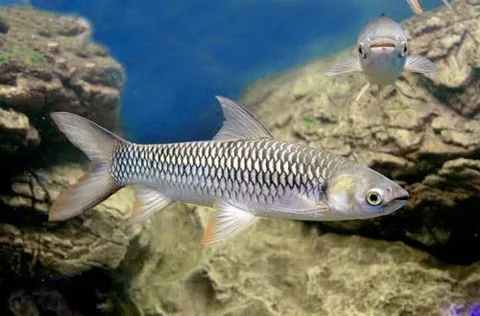
Leptobarbus rubripinna
The Red-Finned Leptobarbus, also known as the Sultan Fish, belongs to the family Cyprinidae and bears the scientific name Leptobarbus rubripinna. This is a hardy and undemanding species that exhibits a peaceful…
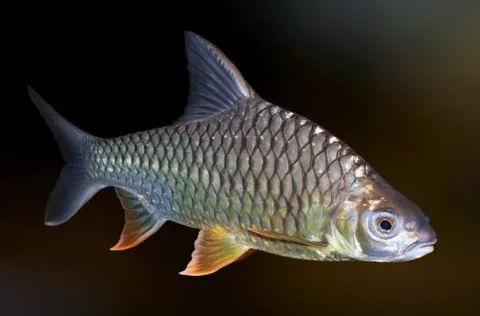
Hypsibarbus wetmorei
Hypsibarbus, or Lemonfin Barb (scientific name Hypsibarbus wetmorei), belongs to the Cyprinidae family. This active and large fish lives in schools. Although it is undemanding and quite easy to keep, the necessity of…
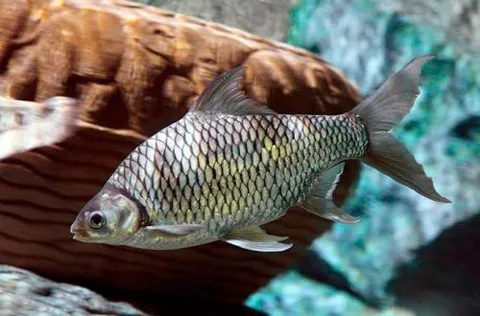
Barbonymus gonionotus
The Silver Barb, scientifically known as Barbonymus gonionotus, belongs to the Cyprinidae family. This fish is most commonly found in commercial fisheries and is not a typical inhabitant of home aquariums. Its…
Barbonymus schwanefeldii
Barbonymus schwanefeldii, known as the Tinfoil Barb and belonging to the Cyprinidae family, attracts attention with its impressive size and characteristic silvery coloration. These fish, which have a schooling nature,…