Temperature20 – 25 °C
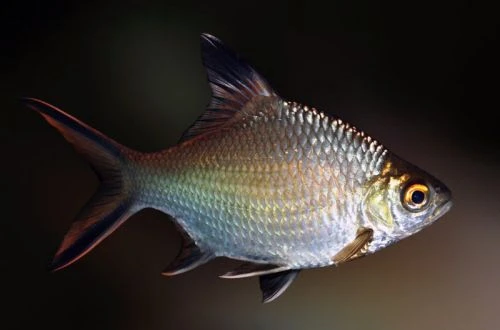
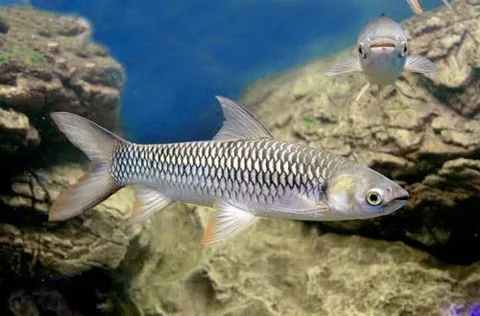
Barbonymus schwanefeldii, known as the Tinfoil Barb and belonging to the Cyprinidae family, attracts attention with its impressive size and characteristic silvery coloration. These fish, which have a schooling nature, stand out in an aquarium, making them sought after in commercial aquaristics. They are most often seen in spacious tanks located in public places, such as large office centers or shopping malls, whereas they are quite rare in home aquariums.
This large fish is characterized by a high body, noticeably compressed laterally, resembling the outline of a freshwater bream. Adults can reach an impressive length of up to 35 cm. It is almost impossible to distinguish males and females by external signs, except during the spawning period when the females' bodies become rounded due to eggs. The coloration is usually silvery, sometimes with a slight golden hue. The fins and caudal fin are bright red, with characteristic dark streaks along the edges, which are clearly visible. A close relative of the Tinfoil Barb is the Red-tailed Tinfoil Barb, which is smaller and does not have dark streaks on its fins and tail. Otherwise, these two species are very similar, which often leads to confusion.
In Southeast Asian regions, Tinfoil Barbs are widespread and can be found in several significant river systems, such as the Mekong and Chao Phraya. Interestingly, this species was previously considered extinct in Singapore, but recent discoveries of wild individuals indicate a population recovery. The fish predominantly inhabit extensive river channels with high water levels and coastal floodplains. During the rainy season, they migrate to flooded forest areas for spawning, and when the water recedes, they return to the riverbeds.
Being a schooling species, these fish need to be kept in groups of at least 6 individuals. In the absence of interaction with their conspecifics, aggression or, conversely, lethargy is not uncommon. Tinfoil Barbs themselves are not predators, but they may catch smaller fish if the opportunity arises. They are compatible only with other large or medium-sized species, such as carp, catfish, and even some cichlids.
Keeping such large fish is quite a troublesome and expensive endeavor, which is why Tinfoil Barbs are rarely found in home aquariums, although they are generally not considered demanding species. The aquarium setup can be anything: the fish feel perfectly fine even in a completely empty tank. However, if funds allow for an aquarium of 700 L or more, it is worth investing in its decoration. Simulating a riverbed is the most natural way to decorate: a rocky substrate with several large smooth boulders, a voluminous background resembling a bank, and a few snags. Live plants, although they adorn the aquarium, will be quickly destroyed in this case. The fish have much stricter requirements for water quality. Since the barb lives in clean, flowing, oxygen-rich waters, it is extremely intolerant of accumulated organic waste. The water must be crystal clear. As for its parameters, the permissible pH range is quite wide, and the amount of dissolved calcium and magnesium salts should be low. Details on pH and dGH parameters can be found in the "Hydrochemical composition of water" section. A large aquarium will also require appropriate equipment. The filtration system is key and should include at least two filters working in tandem or duplicating each other in case one fails. Other important equipment includes lighting, aeration, and heating systems; heating elements should be masked to prevent accidental damage by the fish. Aquarium maintenance involves weekly water changes of 15–20% with fresh water of identical pH, dGH, and temperature, as well as regular cleaning of the substrate from organic waste.
The diet of Tinfoil Barbs is diverse and includes various dry, frozen, live, and plant-based foods. They readily consume pieces of cabbage, spinach, lettuce, as well as other vegetables and fruits. However, it should be remembered that these fish can swallow smaller tank mates. Feeding is recommended 2–3 times a day, giving an amount of food that will be eaten within 5 minutes. It is important to avoid overfeeding, as barbs tend not to feel satiated, which can cause digestive problems.
The onset of the breeding season for these fish coincides with changes in external conditions triggered by the rainy season and subsequent migration to flooded areas of the tropical forest. Such reproductive behavior creates significant difficulties when attempting to breed Tinfoil Barbs in home conditions, requiring huge aquariums with regulated water parameters. For the aquarium trade, these fish are either caught from the wild or bred in specialized hatcheries using hormonal stimulation.
The Tinfoil Barb has a strong immune system and, when kept in proper conditions, is rarely susceptible to specific diseases. The main health risks are associated with poor water quality, accumulation of organic waste, and mechanical injuries that the fish may sustain from fright, hitting decorations or aquarium walls. In such cases, ulcers, scale damage, or corneal clouding of the eyes may appear on the body. To prevent diseases, it is critically important to maintain water cleanliness, ensure powerful filtration, and avoid overpopulation. The fish are sensitive to water composition, so regular water changes are essential. If symptoms of bacterial infections, such as ulcers or film, appear, it is necessary to check the environmental parameters and provide the fish with rest in clean water.
When purchasing, choose active fish with shiny scales without visible damage, ulcers, or spots. It is important to ensure that the fins show no signs of deterioration or clumping, and that the eyes are clear and bright. In stores, fish are often sold at a young age, so it is necessary to consider their potential size of up to 35 cm and rapid growth rate. Avoid individuals that appear apathetic, stay at the surface, or, conversely, constantly hide in corners, unless this is due to stress from transport. Given the timid nature of the species, when inspecting them in the store, it is best to avoid sudden movements to prevent panic, which can lead to injuries to the fish in cramped commercial aquariums.
The essentials: size, tank volume, water parameters and care
An adult reaches 35 cm in length. Plan the tank around the maximum size: the fish quickly outgrows a cramped setup.
The recommended volume is 700 L. A smaller tank speeds up nitrate build-up and raises stress levels.
Temperature 20–25 °C, pH 6–8, hardness 3–19 dGH. Stability matters more than exact values: sudden swings are harder on the fish than a small deviation from the ideal.
Around 10 years when kept properly. Lifespan depends directly on tank volume, water quality and a varied diet.
Temperament: semi-peaceful (dangerous to smaller ones). Not a predatory species, but small fish that fit in its mouth will eventually be eaten.
Recommended setup: schooling (usually from 5–6 individuals and more). Ignoring this is a common cause of stress and disease.
Diet type: any (universal). Feed small portions that are finished within a couple of minutes — overfeeding does more harm than underfeeding.
The scientific name of the species is Barbonymus schwanefeldii, family Cyprinids (Cyprinidae).
The water suits 196 of 208 plants in the catalogue — the easiest ones are shown first.
Afzelius's AnubiasAnacharisAnubiasBrazilian PennywortDwarf CloverDwarf CloverDwarf HygrophilaDwarf SagittariaDwarf ValGuppy GrassHornwortJava FernJava MossMoneywortMud SwordNarrow Leaf AnacharisNarrow-leaf CloverStringy MossSüsswassertangTaiwan MossTape GrassTemple PlantUssuri WatermilfoilWater Wisteria
Matched by family, categories and overlapping keeping conditions
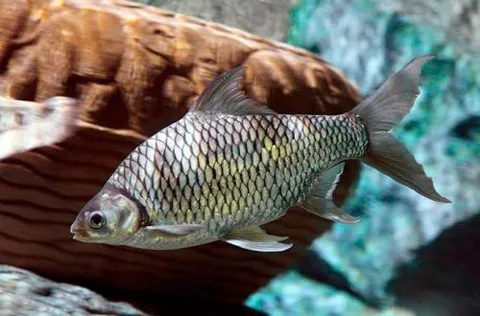
Barbonymus gonionotus
The Silver Barb, scientifically known as Barbonymus gonionotus, belongs to the Cyprinidae family. This fish is most commonly found in commercial fisheries and is not a typical inhabitant of home aquariums. Its…
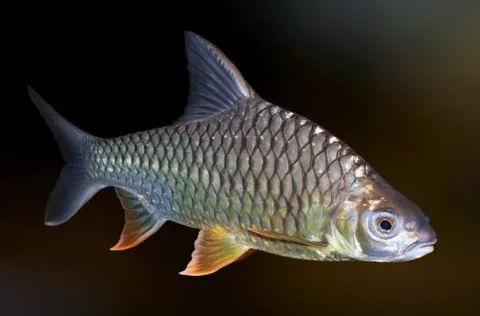
Hypsibarbus wetmorei
Hypsibarbus, or Lemonfin Barb (scientific name Hypsibarbus wetmorei), belongs to the Cyprinidae family. This active and large fish lives in schools. Although it is undemanding and quite easy to keep, the necessity of…
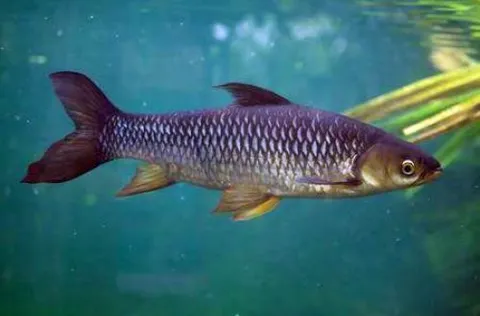
Leptobarbus hoevenii
The fish known as Hoven's Carp (Leptobarbus hoevenii) belongs to the family Cyprinidae. It is named after the zoologist Jan van der Hoeven (1801–1868). Due to its impressive size, this species is rarely found in amateur…
Leptobarbus rubripinna
The Red-Finned Leptobarbus, also known as the Sultan Fish, belongs to the family Cyprinidae and bears the scientific name Leptobarbus rubripinna. This is a hardy and undemanding species that exhibits a peaceful…