Temperature20 – 26 °C
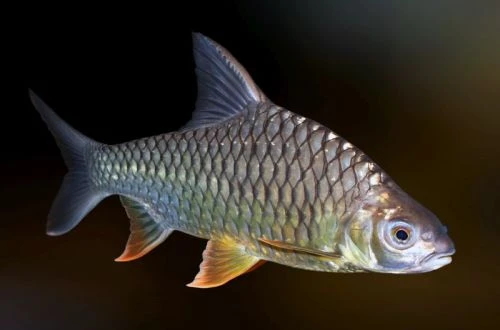
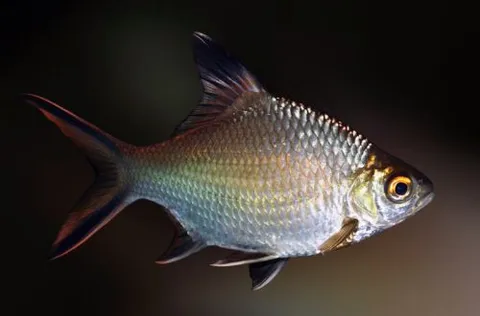
Hypsibarbus, or Lemonfin Barb (scientific name Hypsibarbus wetmorei), belongs to the Cyprinidae family. This active and large fish lives in schools. Although it is undemanding and quite easy to keep, the necessity of providing a large aquarium of about 400 liters can create certain difficulties in a home environment. However, for large public aquariums, such as those in cafes, restaurants, or spas, the silvery coloration and impressive size of a school of these fish will be a true decoration, invariably attracting public attention.
This is a rather large fish: adults can reach 21 cm in length. Females are usually larger than males, but that's where their main external differences end. The fish's body has a silvery coloration, covered with large scales, which are often outlined with darker stripes. The characteristic lemon-orange hue is present only on the lower fins; the dorsal and caudal fins remain colorless.
The natural habitat of this species covers mainland Southeast Asia, including the territories of modern countries such as Laos, Thailand, Cambodia, Vietnam, and northern Peninsular Malaysia. These fish inhabit numerous rivers and their tributaries, including the Mekong — one of the largest rivers in Indochina. They prefer bodies of water with flowing current and abundant riparian vegetation, avoiding stagnant waters.
This schooling species shows no aggression and is quite friendly towards fish of similar size and temperament, provided there is enough free space in the aquarium. Due to its high activity, it is not recommended to keep it with slow-moving or timid fish; moreover, smaller species may become prey.
The choice of decor is less important compared to water quality and the amount of free swimming space. The Lemonfin Barb will feel excellent even in a practically empty aquarium. However, if possible, the aquarium can be decorated to resemble a section of a large river, placing large smooth stones and boulders on a gravel substrate. Along one of the side walls, dense thickets of robust plants with a strong root system can be planted. Like many fish inhabiting flowing waters, the barb tolerates the accumulation of organic waste poorly and requires very clean water with high oxygen content. This necessitates increased demands on the filtration system. The minimum necessary equipment also includes a heater, lighting fixtures, and an air pump with several diffusers. Aquarium care involves weekly partial water changes (15–20% of the total volume) with fresh water and regular cleaning of the substrate from organic residues.
The diet can include all types of dry (flakes, granules), frozen, and live foods, such as bloodworms, insect larvae, or earthworms, with a significant addition of plant components. The key condition is a varied diet. Fish should not be fed the same product for a long time; it is important to combine and mix various supplements. Feeding is recommended 2–3 times a day, providing an amount of food that will be eaten within 5 minutes. Any uneaten remnants should be promptly removed to avoid water pollution.
Organizing spawning in a home environment is a very complex task. For this reason, the breeding of Lemonfin Barbs is usually carried out by specialized fish farms, mainly in its native region.
The main cause of diseases in most aquarium fish often lies in unsuitable keeping conditions or poor water quality. If all aquarium requirements are met and it is serviced in a timely manner, the risk of diseases is minimized. Nevertheless, in case of health problems with fish, it is sometimes not enough to simply normalize conditions: medication may be required. For this, it is critically important to accurately determine the cause of the disease.
When purchasing, choose active individuals with clean fins and scales without visible damage, ulcers, or white spots. Avoid fish with signs of emaciation, sunken bellies, or unnatural behavior, such as constantly hovering near the water surface. Given the large size of adult individuals, ensure that the fish in the store are kept in conditions appropriate for their needs, as stress from overcrowding often provokes the development of infectious diseases.
The essentials: size, tank volume, water parameters and care
An adult reaches 21 cm in length. Plan the tank around the maximum size: the fish quickly outgrows a cramped setup.
The recommended volume is 864 L. A smaller tank speeds up nitrate build-up and raises stress levels.
Temperature 20–26 °C, pH 6–8, hardness 3–15 dGH. Stability matters more than exact values: sudden swings are harder on the fish than a small deviation from the ideal.
Around 7 years when kept properly. Lifespan depends directly on tank volume, water quality and a varied diet.
Temperament: semi-peaceful (dangerous to smaller ones). Not a predatory species, but small fish that fit in its mouth will eventually be eaten.
Recommended setup: schooling (usually from 5–6 individuals and more). Ignoring this is a common cause of stress and disease.
Diet type: any (universal). Feed small portions that are finished within a couple of minutes — overfeeding does more harm than underfeeding.
The scientific name of the species is Hypsibarbus wetmorei, family Cyprinids (Cyprinidae). It also appears in the literature as: Barbodes daruphani, Barbus beasleyi, Barbus daruphani.
The water suits 197 of 208 plants in the catalogue — the easiest ones are shown first.
Afzelius's AnubiasAnacharisAnubiasBrazilian PennywortDwarf CloverDwarf CloverDwarf HygrophilaDwarf SagittariaDwarf ValGuppy GrassHornwortJava FernJava MossMoneywortMud SwordNair's LagenandraNarrow Leaf AnacharisNarrow-leaf CloverStringy MossSüsswassertangTaiwan MossTape GrassTemple PlantUssuri Watermilfoil
Matched by family, categories and overlapping keeping conditions
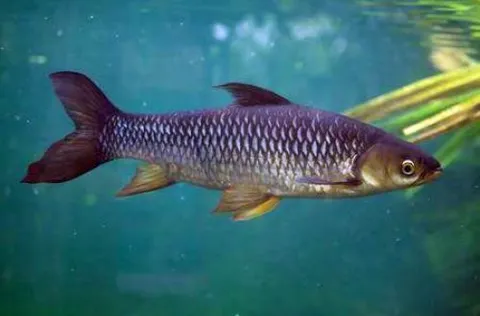
Leptobarbus hoevenii
The fish known as Hoven's Carp (Leptobarbus hoevenii) belongs to the family Cyprinidae. It is named after the zoologist Jan van der Hoeven (1801–1868). Due to its impressive size, this species is rarely found in amateur…
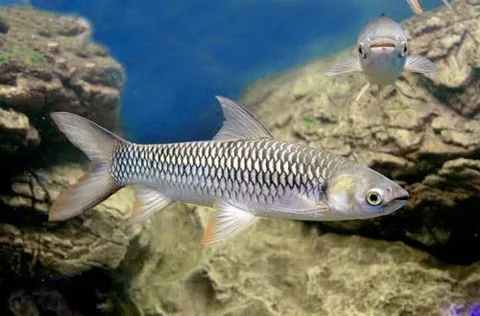
Leptobarbus rubripinna
The Red-Finned Leptobarbus, also known as the Sultan Fish, belongs to the family Cyprinidae and bears the scientific name Leptobarbus rubripinna. This is a hardy and undemanding species that exhibits a peaceful…
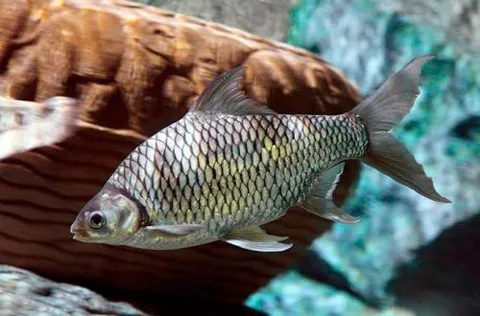
Barbonymus gonionotus
The Silver Barb, scientifically known as Barbonymus gonionotus, belongs to the Cyprinidae family. This fish is most commonly found in commercial fisheries and is not a typical inhabitant of home aquariums. Its…
Barbonymus schwanefeldii
Barbonymus schwanefeldii, known as the Tinfoil Barb and belonging to the Cyprinidae family, attracts attention with its impressive size and characteristic silvery coloration. These fish, which have a schooling nature,…