Temperature22 – 28 °C
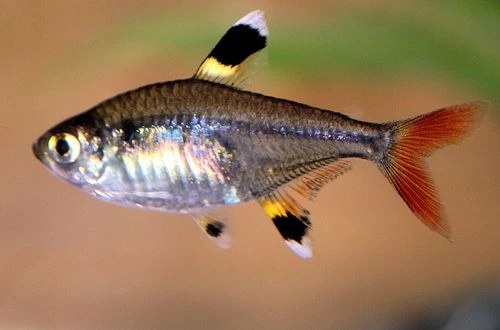
The Pristella Tetra, also known as the X-ray Tetra or Golden Pristella Tetra (scientific name Pristella maxillaris), belongs to the family Acestrorhamphidae. A distinguishing feature of this fish is its remarkable coloration, or rather, its almost complete lack of pigmentation. When viewed, it appears transparent; the spine and internal bones are clearly visible through the body, resembling an X-ray. Thanks to its ease of care and unpretentiousness, combined with its unusual appearance, it is an excellent choice even for beginner aquarists.
This is a small and rather slender fish, reaching a length of 4–5 cm as an adult. Its body has a silvery or golden sheen, which is due to the special refraction of light by its scales, which, like the fish itself, are mostly transparent. The caudal fin has a reddish hue, while the other fins have a notable coloration with alternating colors: a yellow streak at the base, a black band in the middle, and a white tip at the end of the fin. Males are distinguished by a more slender physique, while females, especially during spawning, appear fuller, with a noticeably rounded abdomen due to the roe.
This fish species is widely distributed throughout the aquatic systems of the entire Amazon and other large rivers of South America. They prefer to inhabit small streams and channels characterized by dense aquatic vegetation. During the rainy season, these fish can migrate to flooded areas. They can also be found in coastal zones and river deltas flowing into the ocean, which explains their ability to tolerate brackish water. In their natural habitat, their diet consists of various worms, small crustaceans, and insects.
This fish is peaceful and sociable. Thanks to its calm disposition and adaptability to various conditions, it is perfectly suited for keeping with other small and peaceful species. It is recommended to keep them in a school of at least 6 individuals.
These fish can successfully adapt to a wide range of water parameters: from slightly acidic to alkaline environments, and from soft to hard water. In some cases, for example, for the prevention of parasitic diseases, they can also tolerate brackish water. If it becomes necessary to salt the water, the concentration of marine salt should not exceed 2 grams per 10 liters. It is important to consider that salt can negatively affect beneficial bacterial colonies in the biological filter, which could potentially trigger a renewed nitrogen cycle, posing a danger to all aquarium organisms. To prevent such situations, it is recommended to use a powerful canister filter. Despite the additional cost, this is justified. However, if experiments with salinity are not planned, a simpler filter will suffice. Other necessary equipment includes a heater, a low-power lighting system, and an air pump. Aquarium decoration can be quite simple: several groups of plants planted along the back and side walls; shelters made of driftwood, grottoes, or twisted roots; river sand is used as substrate. Adding dried leaves will help give the water a light brown tint, characteristic of the fish's natural habitat. Leaves should be replaced every two weeks.
Pristellas are omnivorous and readily consume both dry commercial and live foods. An optimal diet for them may consist of high-quality flakes or pellets, supplemented with meaty foods (such as bloodworms, daphnia, mosquito larvae) once or twice a week.
Breeding this species is not very difficult, however, in small groups, difficulties may arise in choosing a suitable partner, as Pristellas are quite demanding in this aspect. Such problems do not occur when the school numbers 15–20 fish. For successful spawning, a separate tank should be prepared, which should replicate the conditions of the main aquarium, but with a smaller volume — 30–40 liters is quite sufficient. Spawning can be stimulated by adding meaty foods to their daily diet. As soon as a pair forms, the fish begin a courtship dance, circling each other. At this point, they should be transferred to a separate container. The female lays 300 to 400 eggs, from which fry emerge in approximately 24 hours. After spawning, the parents are immediately returned to the main aquarium to prevent them from eating the eggs and fry. The new offspring are fed micro-foods and Artemia.
This species is hardy and undemanding; health problems in a balanced aquarium usually do not arise. Only a sharp deterioration in keeping conditions or the introduction of an infected fish can provoke an outbreak of diseases.
When selecting Pristella Tetras, pay attention to the overall activity of the school in the aquarium: healthy fish are constantly moving and show interest in their surroundings. Avoid individuals with signs of emaciation, fin damage, or whitish spots on the body, which may indicate the presence of infections. It is recommended to ask the seller to feed the fish before purchase to ensure there are no appetite problems. Purchase a group of 6 or more individuals, as solitary keeping causes severe stress in this species.
The essentials: size, tank volume, water parameters and care
An adult reaches 4–4.5 cm in length. Plan the tank around the maximum size: the fish quickly outgrows a cramped setup.
The recommended volume is 60 L. A smaller tank speeds up nitrate build-up and raises stress levels.
Temperature 22–28 °C, pH 6–7.5, hardness 2–20 dGH. Stability matters more than exact values: sudden swings are harder on the fish than a small deviation from the ideal.
Around 5 years when kept properly. Lifespan depends directly on tank volume, water quality and a varied diet.
Temperament: peaceful (regular). Keep this in mind when choosing tank mates.
Recommended setup: group (8–10 individuals). Ignoring this is a common cause of stress and disease.
Diet type: any (universal). Feed small portions that are finished within a couple of minutes — overfeeding does more harm than underfeeding.
The scientific name of the species is Pristella maxillaris, family Acestrorhamphidae. It also appears in the literature as: Aphyocarax maxillaris, Aphyocharax maxillaris, Holopristes riddlei.
The water suits 197 of 208 plants in the catalogue — the easiest ones are shown first.
Afzelius's AnubiasAnacharisAnubiasBrazilian PennywortDwarf CloverDwarf CloverDwarf HygrophilaDwarf SagittariaDwarf ValGuppy GrassHornwortJava FernJava MossMoneywortMud SwordNair's LagenandraNarrow Leaf AnacharisNarrow-leaf CloverStringy MossSüsswassertangTaiwan MossTape GrassTemple PlantUssuri Watermilfoil
Matched by family, categories and overlapping keeping conditions
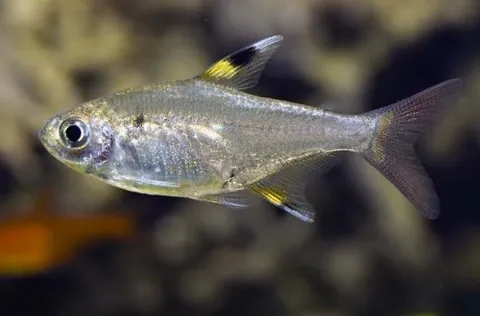
Pristella maxillaris
The Albino Pristella, also known as the Albino X-Ray Tetra, scientifically classified as Pristella maxillaris, belongs to the Acestrorhamphidae family. This species is considered one of the most common and accessible…
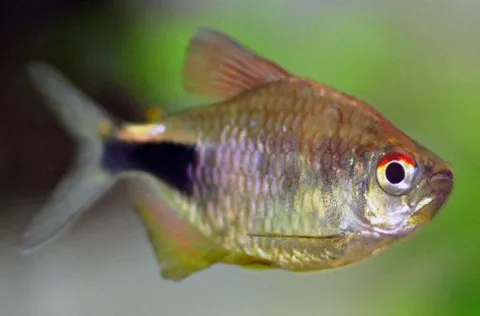
Holopristis pulchra
The Pulcher fish, also known by its scientific name Holopristis pulchra, belongs to the Acestrorhamphidae family. Despite its rather narrow natural habitat, it has gained popularity among aquarists worldwide due to its…
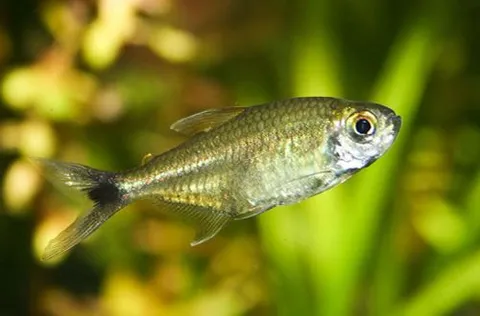
Hemigrammus rodwayi
The Golden Tetra, scientifically known as Hemigrammus rodwayi, belongs to the Acestrorhamphidae family. This fish gets its name from its bright golden scales. In reality, this "gilded" effect is due to the presence of…
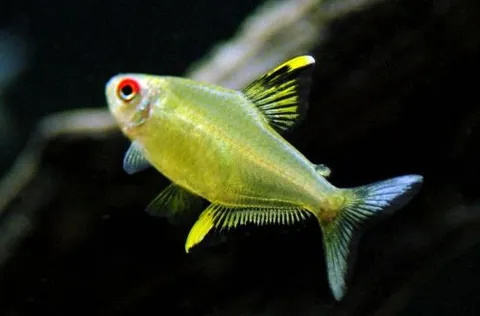
Hyphessobrycon pulchripinnis
The Lemon Tetra, or Hyphessobrycon pulchripinnis, is a representative of the Acestrorhamphidae family. This fish attracts attention with both its appearance and behavior. Its coloration, ranging from yellow to lemon,…