Temperature20 – 28 °C
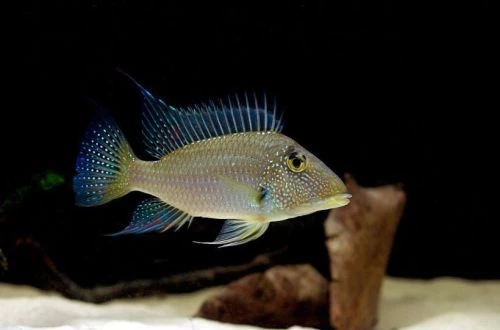
The scientific name Satanoperca leucosticta belongs to the family Cichlidae, and in English, this fish is called Satanoperca leucosticta. Its name, seemingly very formidable, comes from the Ancient Greek words Σατάν (Satan), meaning “devil,” and πέρκη (pérkē) — “perch.” However, such a “devilish” image does not correspond at all to the true nature of these fish: they are quite peaceful and coexist easily with other aquarium inhabitants. The second part of the name — λευκός (leukós), meaning “white,” and στικτóς (stiktos) — “spotted,” presumably refers to the characteristic body pattern consisting of light speckles.
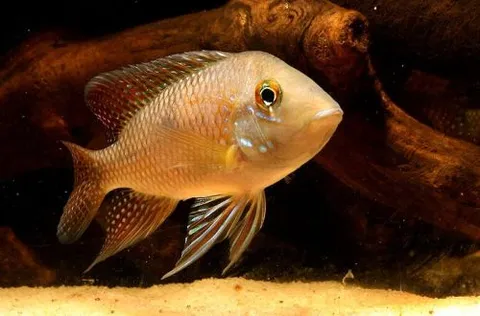
Adults of this fish reach a length of 13–15 cm. Sexual dimorphism is not pronounced: males are generally slightly larger than females, but no other significant differences are observed. The body coloration of Satanoperca leucosticta is gray, adorned with numerous white speckles distributed over the entire body and even extending onto the translucent fins.
These fish originate from South America, their range extending from the eastern regions of Venezuela to the northern regions of Brazil, also covering the territories of Guyana and Suriname. Satanoperca inhabit the basins of rivers such as Essequibo, Demerara, and Nickerie. They favor small tributaries and flood plain lakes where the bottom is covered with sand and abundantly strewn with fallen leaves and numerous snags.
This peaceful and sociable fish coexists well with other non-aggressive species of comparable size. Satanoperca are considered safe even for rather small aquarium neighbors. Within a group, their relationships are based on a hierarchy between stronger and weaker individuals. It is important to keep these fish in groups of 5–8 individuals; with fewer, alpha males may begin to persecute weaker kin.
For a group of 5–8 of these fish, the optimal aquarium volume starts from 600 liters. The aquascape can be chosen at your discretion, but one of the most significant elements is the substrate. Given the feeding habits of Satanoperca leucosticta, a sandy substrate is recommended. Although the fish does not have strict requirements for its environment, it will look most impressive and feel more comfortable in conditions close to its natural habitat — among snags and with moderate lighting. Experienced aquarists often use leaves of certain trees to recreate the atmosphere of natural bodies of water. As leaves decompose, tannins are released into the water, which not only form the necessary chemical composition but also give the water a characteristic brownish tint. Water quality plays a crucial role. Satanoperca leucosticta are very sensitive to the accumulation of nitrogen cycle products (ammonia, nitrites, nitrates) and to fluctuations in water parameters, so they absolutely cannot be introduced into an aquarium with an unstable biological balance. Long-term and successful keeping of these fish directly depends on maintaining stable water conditions. In addition to installing the necessary equipment, regular aquarium maintenance is a key factor in achieving the desired result. Standard procedures include weekly water changes of approximately 50% of the volume with fresh water, timely removal of organic residues (uneaten food, excrement), and prophylactic inspection and maintenance of equipment.
Satanoperca are an omnivorous species that feeds on everything they can find. They feed at the bottom, actively sifting sand through their mouths in search of the smallest food particles. The daily diet of these fish can include dry flakes and granules, as well as frozen daphnia, artemia, and small pieces of bloodworms. It is important that food portions are small. It is recommended to feed them 3–4 times a day in small portions.
Breeding Satanoperca in aquariums is quite common, especially if the fish are kept in suitable conditions and receive a complete diet. The male initiates courtship: he occupies a spot on the bottom and actively attracts females. Spawning occurs on any flat, even surface, most often on a stone. After the eggs are laid, the clutch is covered with a thin layer of substrate. The female remains near the clutch, awaiting the appearance of fry, while the male “patrols” the nearby territory, reliably protecting it from any potential danger. If the aquarium is not large enough, other inhabitants may be attacked by the male. The incubation period lasts from 36 to 48 hours. The hatched fry are collected by the female into her mouth, where the fry spend another 7–8 days. Often during this period, the male loses interest in the female and his offspring and may begin new courtship.
The main cause of diseases often lies in the keeping conditions: if they go beyond acceptable limits, immunity decreases, making the fish vulnerable to various infections inevitably present in the environment. At the first suspicion of illness, it is important first of all to check the water parameters and ensure there are no dangerous concentrations of nitrogen cycle products. Often, restoring normal, suitable conditions promotes recovery. However, in some cases, medication may be required.
When choosing individuals, preference should be given to active fish with clean fins and no visible body damage. It is important to avoid specimens with sunken bellies or signs of emaciation, as these fish are sensitive to water quality and may suffer greatly from transport stress. It is recommended to purchase a group of 5–8 young individuals so that they can form a natural social hierarchy. Before purchasing, it is worth ensuring that the fish are kept in an aquarium with a soft sandy substrate, as the absence of suitable substrate in the store can negatively affect their health. Since the species is schooling, purchasing single individuals is undesirable, as this often leads to timid behavior and the development of aggression from more dominant fish in the group.
The essentials: size, tank volume, water parameters and care
An adult reaches 13–15 cm in length. Plan the tank around the maximum size: the fish quickly outgrows a cramped setup.
The recommended volume is 600 L. A smaller tank speeds up nitrate build-up and raises stress levels.
Temperature 20–28 °C, pH 5.5–7, hardness 2–12 dGH. Stability matters more than exact values: sudden swings are harder on the fish than a small deviation from the ideal.
Around 10 years when kept properly. Lifespan depends directly on tank volume, water quality and a varied diet.
Temperament: peaceful (regular). Keep this in mind when choosing tank mates.
Recommended setup: medium group (6–8 individuals). Ignoring this is a common cause of stress and disease.
Diet type: sinking (any). Feed small portions that are finished within a couple of minutes — overfeeding does more harm than underfeeding.
The scientific name of the species is Satanoperca leucosticta, family Cichlids (Cichlidae). It also appears in the literature as: Geophagus leucostictus, Satanoperca macrolepis.
The water suits 198 of 208 plants in the catalogue — the easiest ones are shown first.
Afzelius's AnubiasAnacharisAnubiasBrazilian PennywortDwarf CloverDwarf CloverDwarf HygrophilaDwarf SagittariaDwarf ValGuppy GrassHornwortJava FernJava MossMoneywortMud SwordNair's LagenandraNarrow Leaf AnacharisNarrow-leaf CloverStringy MossSüsswassertangTaiwan MossTape GrassTemple PlantUssuri Watermilfoil
Matched by family, categories and overlapping keeping conditions
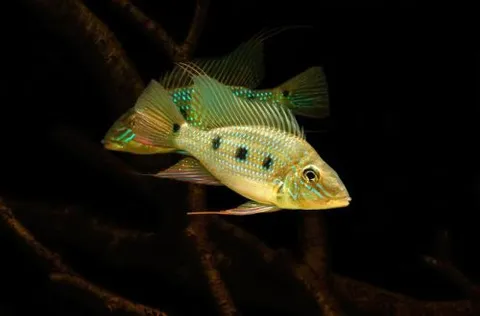
Satanoperca acuticeps
Satanoperca acuticeps, formerly known as Geophagus heckelii, belongs to the family Cichlidae. This South American cichlid did not get its name by chance: it is characterized by a distinctive pointed head. This feature…
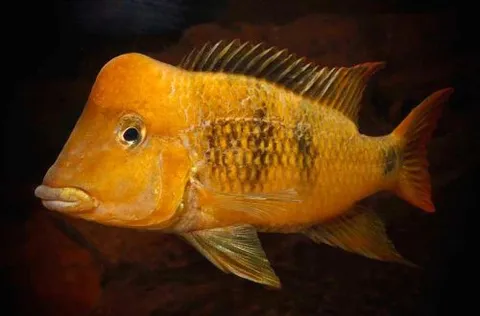
Geophagus pellegrini
Geophagus pellegrini, also known as the Yellow Hump Geophagus (scientific name Geophagus pellegrini), belongs to the Cichlidae family. This fish was named in honour of the French zoologist Jacques Pellegrin. Although it…
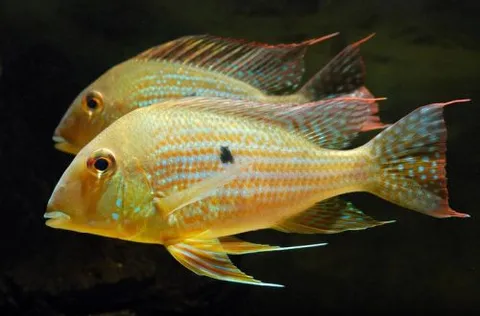
Geophagus neambi
Geophagus neambi, widely known as Geophagus neambi or Geophagus Tocantins, is a member of the Cichlidae family. This popular American cichlid is actively offered to buyers, and its keeping, as well as breeding, does not…
Geophagus iporangensis
Geophagus iporangensis, known as Geophagus Iporanga, is a member of the Cichlidae family. This fish was named after Iporanga, a municipality in the Brazilian state of São Paulo, where it was first discovered.…