Temperature20 – 26 °C
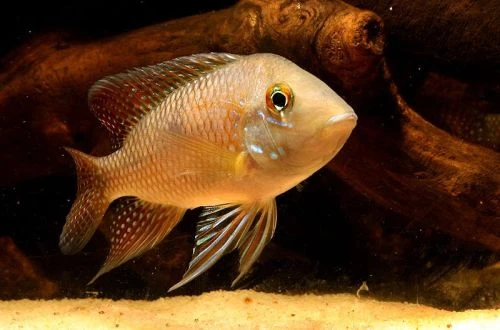
Geophagus iporangensis, known as Geophagus Iporanga, is a member of the Cichlidae family. This fish was named after Iporanga, a municipality in the Brazilian state of São Paulo, where it was first discovered. Characterized by its ease of keeping and breeding, it coexists well with other freshwater species. Despite these qualities, Geophagus iporangensis remains a rather rare inhabitant of home aquariums.
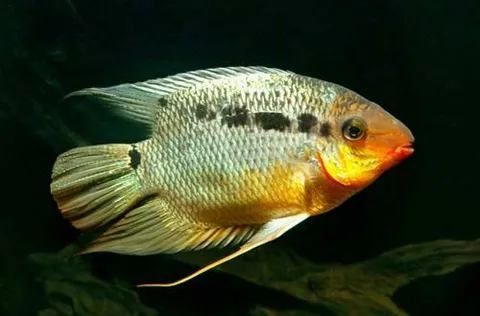
Adult males can reach 9–10 cm in length, while females typically grow to 6–8 cm. In addition to size differences, dominant males sometimes develop a pronounced nuchal hump. The main body coloration is light brown, with sparse bluish speckles. These speckles become significantly more numerous on the fins and tail, which have a dark red hue.
Its natural habitat is in South America, in the Rio Ribeira de Iguape basin, located in the southern part of the Brazilian state of São Paulo, slightly south of the city of the same name. A significant portion of this river's course flows through tropical forests, which leads to an abundance of plant organic matter — leaves, roots, and tree branches. Their decomposition process releases tannins, which give the water a characteristic brownish tint. The fish prefer to stay in shaded areas of the rivers, choosing sandy substrates and finding shelter among snags.
During spawning, the male exhibits territorial behavior, actively defending the chosen area on the aquarium bottom and the fry from potential danger. At other times, Geophagus iporangensis has a friendly disposition and coexists well with many non-aggressive fish species of similar or smaller size. Within the school, relationships are built on hierarchy, where alpha males dominate the rest. Subdominant individuals, when in a group of 5–8 fish, usually do not experience aggression from stronger conspecifics. However, with fewer fish or in cramped aquarium conditions, certain difficulties may arise.
For a group of 5–8 fish, the optimal aquarium volume starts from 100 liters. The substrate is one of the key elements of the setup. Sand is recommended to avoid problems with food intake, as mentioned earlier. Several large, smooth stones can become an ideal place for future spawning, and various snags will offer the fish shelter. Lighting should be subdued. Although aquatic plants are not mandatory, several unpretentious, shade-loving species can be planted. These cichlids show high sensitivity to changes in water quality – the accumulation of nitrogen cycle products, as well as fluctuations in temperature and hydrochemical parameters. It is important to ensure stable conditions. The most effective way to achieve this is to install a powerful filtration system in combination with regular aquarium maintenance. These procedures include weekly water changes of approximately 50% of the volume with fresh water, removal of organic debris (uneaten food, excrement), and a prophylactic inspection of the equipment.
This species is omnivorous, most often finding food in the bottom layer. Unlike some of its geophagine relatives, which actively sift substrate through their mouths in search of small invertebrates, this feeding method is not primary for Geophagus iporangensis. These fish readily accept most sinking foods, including dry flakes and pellets, as well as frozen artemia, daphnia, and small pieces of bloodworms.
Under favorable conditions and with a complete diet, the fish are capable of successfully entering a spawning state. With the onset of the breeding season, the alpha male and one of the females form a temporary pair, which, however, can sometimes last quite a long time. For laying eggs, the fish choose a suitable spot on the aquarium bottom. Most often, this is any flat surface — such as a stone or a piece of driftwood. After spawning, the female stays near the eggs, protecting them. The male keeps a little further away, guarding the boundaries of his territory. After the fry hatch, both parents continue to care for the offspring for some time until the young reach a sufficient size and independence.
The main cause of diseases often lies in the keeping conditions: if they go beyond acceptable limits, immunity decreases, making the fish vulnerable to various infections inevitably present in the environment. At the first suspicion of illness, it is important first of all to check the water parameters and ensure there are no dangerous concentrations of nitrogen cycle products. Often, restoring normal, suitable conditions promotes recovery. However, in some cases, medication may be required.
When purchasing, choose active fish with clean fins and no external body damage. Avoid individuals with sunken bellies, signs of emaciation, or unnatural behavior, such as constantly staying near the water surface. Since this species is a geophage, it is important to ensure that the fish shows interest in the substrate and performs characteristic sand-sifting movements, which indicates its normal well-being. It is recommended to purchase healthy individuals from reputable breeders, as in general store tanks they may experience stress and be susceptible to secondary infections due to non-compliance with specific water quality requirements and soft substrate.
The essentials: size, tank volume, water parameters and care
An adult reaches 10 cm in length. Plan the tank around the maximum size: the fish quickly outgrows a cramped setup.
The recommended volume is 100 L. A smaller tank speeds up nitrate build-up and raises stress levels.
Temperature 20–26 °C, pH 6–7, hardness 1–10 dGH. Stability matters more than exact values: sudden swings are harder on the fish than a small deviation from the ideal.
Around 10 years when kept properly. Lifespan depends directly on tank volume, water quality and a varied diet.
Temperament: peaceful (regular). Keep this in mind when choosing tank mates.
Recommended setup: medium group (6–8 individuals). Ignoring this is a common cause of stress and disease.
Diet type: sinking (any). Feed small portions that are finished within a couple of minutes — overfeeding does more harm than underfeeding.
The scientific name of the species is Geophagus iporangensis, family Cichlids (Cichlidae). It also appears in the literature as: Geophagus brasiliensis.
The water suits 197 of 208 plants in the catalogue — the easiest ones are shown first.
Afzelius's AnubiasAnacharisAnubiasBrazilian PennywortDwarf CloverDwarf CloverDwarf HygrophilaDwarf SagittariaDwarf ValGuppy GrassHornwortJava FernJava MossMoneywortMud SwordNair's LagenandraNarrow Leaf AnacharisNarrow-leaf CloverStringy MossSüsswassertangTaiwan MossTape GrassTemple PlantUssuri Watermilfoil
Matched by family, categories and overlapping keeping conditions
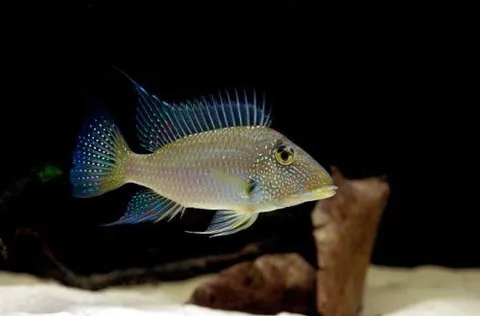
Satanoperca leucosticta
The scientific name Satanoperca leucosticta belongs to the family Cichlidae, and in English, this fish is called Satanoperca leucosticta. Its name, seemingly very formidable, comes from the Ancient Greek words Σατάν…
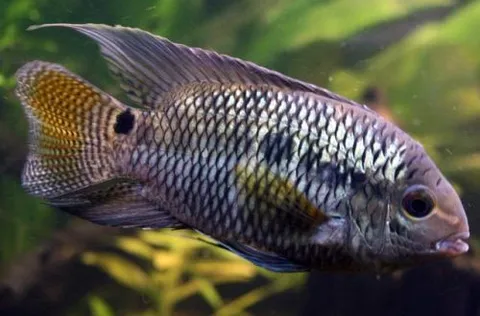
Cichlasoma portalegrense
Cichlasoma portalegrense, more commonly known as the Porto Alegre Acara, belongs to the Cichlidae family. This undemanding fish is distinguished by its peaceful nature, which sets it apart from other cichlids. Its…
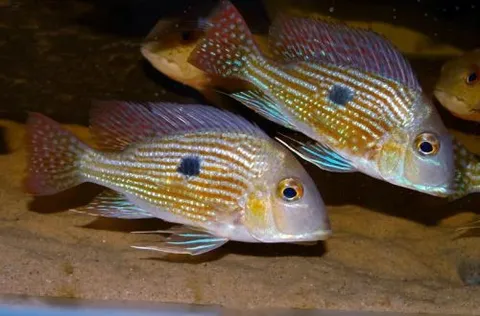
Geophagus sp. Pindare
Geophagus sp. Pindare, or Geophagus pindare, belongs to the family Cichlidae. This fish was named after the Pindaré River, where it was first discovered. In general, these fish are considered quite undemanding in terms…
Mesonauta insignis
Mesonauta insignis, scientifically known as Mesonauta insignis, belongs to the family Cichlidae. Its natural habitat is located in South America, specifically in the basins of the Rio Negro and Orinoco rivers, extending…