Temperature26 – 29 °C
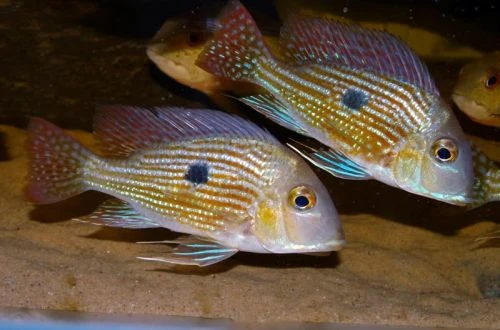
Geophagus sp. Pindare, or Geophagus pindare, belongs to the family Cichlidae. This fish was named after the Pindaré River, where it was first discovered. In general, these fish are considered quite undemanding in terms of keeping and breeding, and they get along well with peaceful tankmates of similar size. Aquarists with little experience can certainly keep them, provided they can offer a sufficiently spacious aquarium.
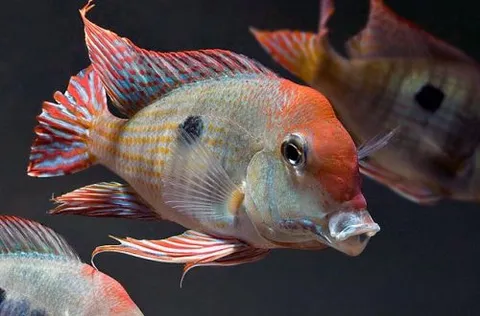
Adult Geophagus reach 14–15 cm in length. Sexual dimorphism is weakly expressed, and it is quite difficult to distinguish males from females externally. The fish's body is large, deep, with a noticeable head. The pelvic and anal fins are characterized by elongated posterior rays. The dorsal fin resembles a crest and extends from the head to the tail. The coloration of Geophagus is silvery-blue, complemented by rows of narrow horizontal stripes of a dirty orange color. A large dark spot can be seen in the central part of the body. The fins and tail are colored in reddish tones with blue iridescence. When the lighting changes, the fish may appear simply gray, and their pattern becomes barely discernible.
This species originates from South America. Its range is limited to the Pindaré River basin, which is located in the Brazilian state of Maranhão and flows into the Atlantic Ocean, into the Bay of Saint Marcos. The natural habitat is characterized by clear water with a brownish tint. This color is due to the high content of tannins released during the decomposition of fallen leaves, branches, and other plant debris. The riverbed is sandy, snags are found, and aquatic vegetation is mainly concentrated along the banks.
During spawning, Geophagus pindare may exhibit protective behavior, becoming less-than-ideal neighbors for other inhabitants, as they will actively guard their offspring. At other times, they are peaceful and calm fish, capable of coexisting harmoniously with many other freshwater species. It is recommended to avoid keeping them with aggressive or territorial fish. Within the group, a hierarchy is observed between stronger and weaker individuals, where the dominant position is usually occupied by the alpha male. It is advisable to keep a group of 5–8 individuals.
For a group of 5–8 individuals, the optimal aquarium volume starts from 300 liters. The aquarium setup can be arbitrary, according to the aquarist's taste. However, a sandy substrate is essential, as it is necessary for the fish's natural feeding method, as mentioned earlier. A couple of large, flat stones can serve as suitable sites for future spawning. Water quality and its hydrochemical parameters play a key role in the long-term keeping of these cichlids. It is important to avoid sudden fluctuations in temperature, pH, and dGH values, as well as excessive accumulation of nitrogen cycle products (nitrites, nitrates, ammonia). To maintain stable water conditions, it is recommended to install a powerful filtration system and perform regular aquarium maintenance, including weekly water changes of approximately 50% of the volume with fresh water.
These fish forage for food from the bottom, sifting the substrate with their mouths in search of small particles. In a home aquarium, they are not picky and readily accept any sinking foods of appropriate size. Geophagus pindare are accustomed to small pieces of food. Their daily diet can include dry flakes and pellets, as well as frozen brine shrimp, daphnia, and bloodworms.
Breeding these fish generally does not present serious difficulties, provided optimal keeping conditions and a complete diet are maintained. When the breeding season arrives, a temporary pair forms between a male and a female, which, however, can persist for a long time. For spawning, the pair seeks a suitable spot on the bottom, usually a flat, even surface such as a stone. After the eggs are fertilized, the male takes a position slightly further away, guarding the approaches to the clutch, while the female remains directly with the eggs. Incubation takes approximately 3 days, and immediately after hatching, the fry are moved into the female's mouth; this is not for consumption, but for reliable protection. The young remain there until they reach a certain size, periodically leaving their 'shelter' to search for food. Notably, sometimes the male also participates in this brooding process.
The main cause of diseases often lies in the keeping conditions: if they go beyond acceptable limits, immunity decreases, making the fish vulnerable to various infections inevitably present in the environment. At the first suspicion of illness, it is important first of all to check the water parameters and ensure there are no dangerous concentrations of nitrogen cycle products. Often, restoring normal, suitable conditions promotes recovery. However, in some cases, medication may be required.
When selecting individuals, attention should be paid to the fish's activity and the condition of its skin. A healthy Geophagus should show curiosity, actively explore the substrate, and have no visible damage, ulcers, or white film on its body and fins. Avoid purchasing fish with sunken bellies or signs of emaciation, as this may indicate internal parasites or chronic stress. It is important to assess the group's behavior in the store: healthy fish stay together, demonstrating a natural hierarchy, rather than hiding in the corners of the aquarium. It is also recommended to ask the seller about the keeping conditions and diet to ensure there are no abrupt transitions in water parameters, to which this species is extremely sensitive.
The essentials: size, tank volume, water parameters and care
An adult reaches 14–15 cm in length. Plan the tank around the maximum size: the fish quickly outgrows a cramped setup.
The recommended volume is 300 L. A smaller tank speeds up nitrate build-up and raises stress levels.
Temperature 26–29 °C, pH 6–7, hardness 1–8 dGH. Stability matters more than exact values: sudden swings are harder on the fish than a small deviation from the ideal.
Around 8 years when kept properly. Lifespan depends directly on tank volume, water quality and a varied diet.
Temperament: peaceful (regular). Keep this in mind when choosing tank mates.
Recommended setup: medium group (6–8 individuals). Ignoring this is a common cause of stress and disease.
Diet type: sinking (any). Feed small portions that are finished within a couple of minutes — overfeeding does more harm than underfeeding.
The scientific name of the species is Geophagus sp. Pindare, family Cichlids (Cichlidae).
The water suits 173 of 208 plants in the catalogue — the easiest ones are shown first.
Afzelius's AnubiasAnacharisAnubiasBrazilian PennywortDwarf CloverDwarf CloverDwarf HygrophilaDwarf SagittariaDwarf ValGuppy GrassHornwortJava FernJava MossMoneywortMud SwordNair's LagenandraNarrow Leaf AnacharisNarrow-leaf CloverSüsswassertangTaiwan MossTape GrassTemple PlantUssuri WatermilfoilWater Wisteria
Matched by family, categories and overlapping keeping conditions
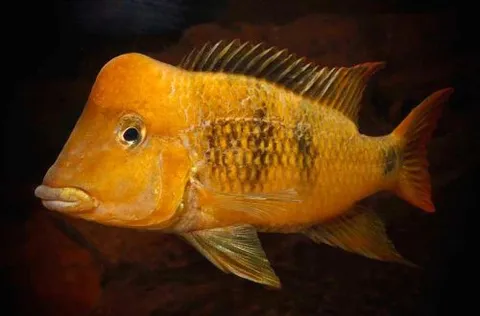
Geophagus pellegrini
Geophagus pellegrini, also known as the Yellow Hump Geophagus (scientific name Geophagus pellegrini), belongs to the Cichlidae family. This fish was named in honour of the French zoologist Jacques Pellegrin. Although it…
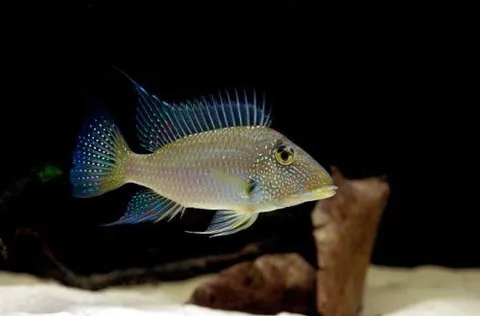
Satanoperca leucosticta
The scientific name Satanoperca leucosticta belongs to the family Cichlidae, and in English, this fish is called Satanoperca leucosticta. Its name, seemingly very formidable, comes from the Ancient Greek words Σατάν…
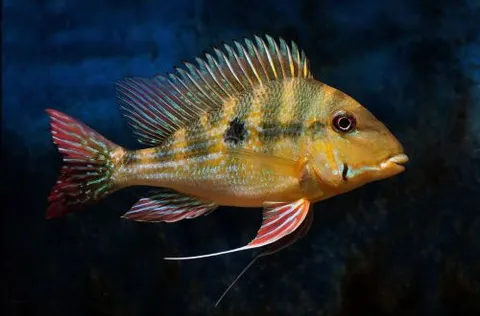
Geophagus dicrozoster
Geophagus dicrozoster, a member of the Cichlidae family, is the scientific name for this aquarium fish. In the trade, it can often be found under other names, such as Geophagus Surinam, Geophagus Colombia, or Geophagus…
Geophagus sp. «Orange head»
Geophagus sp. «Orange head», widely known as the Orange Head or Red Hump Geophagus, belongs to the Cichlidae family. This South American cichlid has gained significant popularity among aquarists due to its ease of care…