Temperature22 – 28 °C
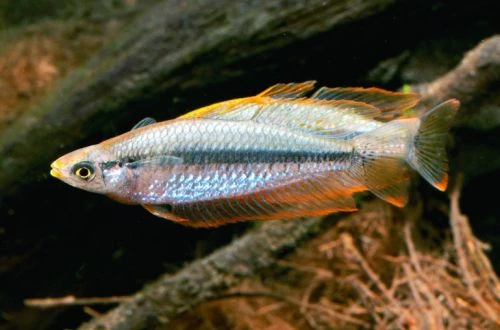
The Slender Rainbowfish, also known as Melanotaenia gracilis, belongs to the family Melanotaeniidae. This fish is an excellent choice for beginner aquarists due to its hardiness and ease of care, while its attractive coloration adds charm to the aquarium. Furthermore, it cohabits well with many other species.
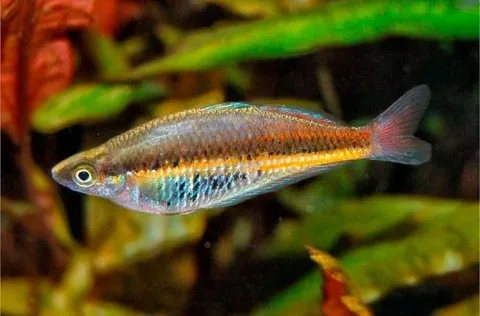
This species is among the most miniature of the Melanotaenia: adult specimens reach a maximum length of 7.5 cm. Their body has a more elongated shape compared to other Rainbowfish. The fish's coloration is grey-blue, and its fins feature a translucent red-orange hue. A prominent dark stripe runs along the entire body, from head to tail. Sexual dimorphism is weakly expressed, although males are usually slightly larger than females and boast more intense colors.
The natural habitat of this fish is the Kimberley region in Northwest Australia. Melanotaenia gracilis inhabits the Drysdale and Carson river basins, whose waters flow into the Timor Sea. These fish prefer areas with slow currents, typically staying near the shoreline. During periods of drought, they often find themselves in isolated bodies of water.
Active and peaceful, these fish get along excellently with their own kind and with other non-aggressive species of similar size. It is recommended to keep them in a group consisting of at least 6–8 individuals of both sexes. It has been observed that in the presence of competitors, males display more vibrant and intense coloration than when kept alone.
For a small school of these fish, an aquarium of at least 70 liters is necessary. The decor can be somewhat simple: a rocky substrate supplemented with a few snags can be used. However, the fish will feel equally comfortable in dense thickets of aquatic vegetation. Maintaining high water quality plays a key role here. To create optimal living conditions, an efficient filtration system should be provided, and 15–20% of the water volume should be replaced weekly with fresh water. It is also important to consider that the Slender Rainbowfish does not tolerate strong water movement well, so internal current in the aquarium should be minimized.
These fish are completely undemanding in terms of food. They readily accept most available foods, whether dry, frozen, or live. To maintain their health and vibrant coloration, it is recommended to diversify their diet. For example, flakes and granules can be alternated with treats such as bloodworms or Artemia, which will allow the fish to fully display their best colors.
Reproduction occurs through spawning, which is possible in both a community tank and a separate breeding tank. To stimulate the process, breeders are fed live or frozen foods abundantly for 1–2 weeks, keeping them separate. Fine-leaved plants or special substrates for collecting eggs are placed in the spawning tank. — The female lays up to 50 eggs daily for a week. — After spawning, the parents should be removed to prevent them from eating the eggs. — The incubation period lasts 6–8 days. — Fry begin to swim and search for food after their swim bladder fills with air; infusoria, rotifers, and Artemia nauplii are used as initial food.
Health problems in these fish arise only in the presence of injuries or keeping in unsuitable conditions, which leads to a weakening of the immune system and the subsequent occurrence of various diseases. At the first signs of illness, it is necessary first to check the water parameters for exceeding permissible values or the presence of toxic substances (such as nitrites, nitrates, ammonia). If deviations are found, all indicators should be normalized, and then treatment should begin.
When choosing a Slender Rainbowfish, attention should be paid to overall activity and fin condition. A healthy fish should be active, show curiosity, and have no visible damage, sores, or white film on its body. It is important to ensure that the coloration matches the species characteristics, and the fish's breathing is even and calm. — Avoid purchasing individuals with signs of emaciation or sunken bellies. — Observe their behavior in the store: the fish should stay in a school and not show signs of apathy. — Check for any signs of infectious diseases in other fish in the same tank, as this indicates poor husbandry.
The essentials: size, tank volume, water parameters and care
An adult reaches 7 cm in length. Plan the tank around the maximum size: the fish quickly outgrows a cramped setup.
The recommended volume is 70 L. A smaller tank speeds up nitrate build-up and raises stress levels.
Temperature 22–28 °C, pH 7–8, hardness 10–20 dGH. Stability matters more than exact values: sudden swings are harder on the fish than a small deviation from the ideal.
Around 5 years when kept properly. Lifespan depends directly on tank volume, water quality and a varied diet.
Temperament: peaceful (regular). Keep this in mind when choosing tank mates.
Recommended setup: medium group (6–8 individuals). Ignoring this is a common cause of stress and disease.
Diet type: any (universal). Feed small portions that are finished within a couple of minutes — overfeeding does more harm than underfeeding.
The scientific name of the species is Melanotaenia gracilis, family Rainbowfishes (Melanotaeniidae).
The water suits 114 of 208 plants in the catalogue — the easiest ones are shown first.
African Onion PlantAfzelius's AnubiasAmazon FrogbitAmazon SwordAnacharisAnubiasArrowhead CryptDwarf CloverDwarf CloverDwarf HygrophilaDwarf SagittariaDwarf ValGuppy GrassHornwortJava MossMoneywortMud SwordNair's LagenandraNarrow Leaf AnacharisNarrow-leaf CloverStringy MossTaiwan MossTape GrassUssuri Watermilfoil
Matched by family, categories and overlapping keeping conditions
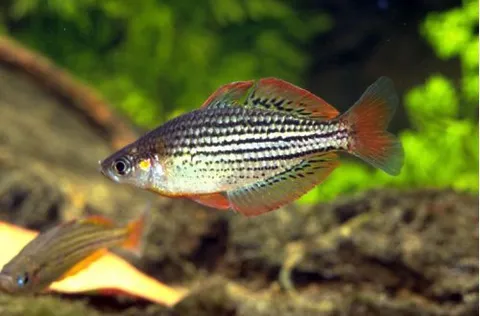
Melanotaenia maccullochi
McCulloch's Rainbowfish, or Dwarf Rainbowfish (scientific name Melanotaenia maccullochi), belongs to the family Melanotaeniidae. This Rainbowfish, characterized by its relatively small size among its relatives, is a…
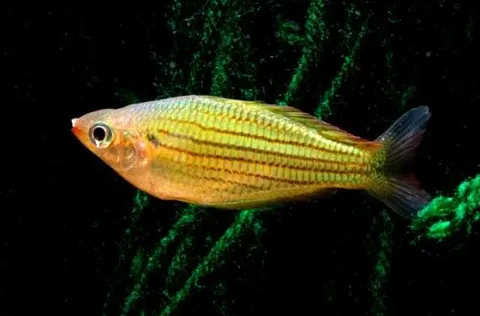
Melanotaenia sexlineata
The Fly River Rainbowfish, also known as the Fly Rainbowfish, bears the scientific name Melanotaenia sexlineata and belongs to the family Melanotaeniidae. One of its names reflects its habitat — the Fly River basin on…
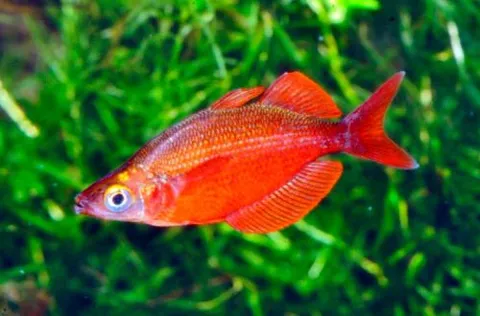
Glossolepis pseudoincisa
Glossolepis pseudoincisa, or Tami Rainbowfish, belongs to the family Melanotaeniidae. This species is endemic to the island of New Guinea. In the wild the species is known above all from a small oxbow lake near the Tami…
Glossolepis ramuensis
The Ramu Rainbowfish, scientifically known as Glossolepis ramuensis, belongs to the family Melanotaeniidae, or Rainbowfish. This fish originates from the island of New Guinea. Its natural habitat is the Ramu River…