Temperature19 – 25 °C
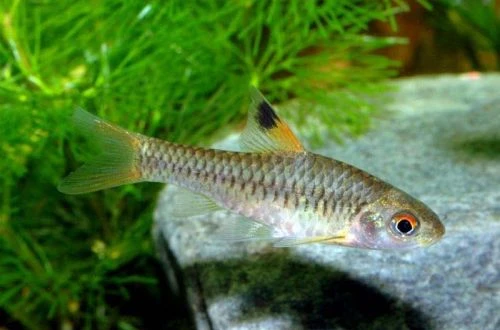
The fish known as the Specklefin Barb, bearing the scientific name Enteromius callipterus, belongs to the Carp family (Cyprinidae). Its initial discovery by European biologists occurred in 1907, with the species originally registered as Barbus callipterus. It is a native of Africa, whose natural habitat encompasses the river systems of Côte d'Ivoire, Chad, Nigeria, and Cameroon.
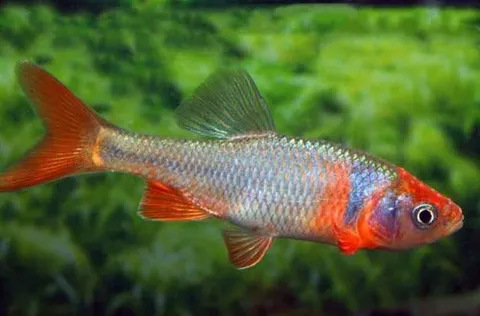
Adults of this fish grow up to 9 cm in length. Their body is covered with large, steel-colored scales. A distinctive feature of the species is its brightly colored dorsal fin: it is red-orange with a noticeable black mark. Sexual dimorphism is not strongly pronounced. Nevertheless, females usually appear somewhat larger, especially during the spawning period.
The species inhabits freshwater and brackish waters of West Africa. Its range covers coastal basins from Côte d'Ivoire to Cameroon, including the Lake Chad basin, the Niger River, and the Benue River. The fish prefer to stay in small streams and rivers with flowing water, where they lead a benthopelagic lifestyle.
This fish is distinguished by its activity and peaceful disposition. It is recommended to keep them in a school, as in this case, all activity will be concentrated within the group. Otherwise, solitary barbs may show excessive curiosity towards other aquarium inhabitants. They are quite compatible with many species of similar size and temperament.
For comfortable keeping of a school of 6–8 of these fish, an aquarium of at least 150–200 liters will be required. It is important to create areas for both free swimming and hiding, for example, in the form of dense plant thickets. It should be remembered that the Specklefin Barb is not only an active swimmer but also capable of jumping out of the water. To prevent such incidents, it is recommended to use floating plants and always cover the tank with a lid. In addition, there is an observation that too bright light can negatively affect the intensity of the fish's coloration. Dimmed lighting is considered more suitable, and for substrate, darker options are preferred. Long-term successful keeping largely depends on regular aquarium maintenance and a well-chosen diet. Being omnivores, they readily accept most common dry, frozen, and live foods.
Being an omnivorous species, this fish readily accepts most popular dry, frozen, and live foods. It is distinguished by its activity and peaceful nature. It is recommended to keep it in a group, as then the main activity will be concentrated within the school. Otherwise, barbs may cause some disturbance to other aquarium inhabitants. They show good compatibility with many species of comparable size and temperament.
Breeding occurs in spawning tanks, densely planted with fine-leaved plants. Males actively pursue females, encouraging them to spawn. Fish tend to eat their own eggs, so it is recommended to install a protective mesh on the bottom. The incubation period for the eggs is about 30 hours, after which the larvae begin free swimming within a few days. Fry are fed infusoria, followed by Artemia nauplii.
No specific diseases unique to this species have been identified. Like other members of the carp family, the Specklefin Barb is sensitive to deteriorating water quality and improper keeping conditions, which can lead to weakened immunity and the development of infections. The most common problems include: — Bacterial lesions, manifesting as ulcers, fin rot, or cloudy eyes. — Parasitic infestations, such as ichthyophthiriasis, often occurring under stress or sudden temperature changes. — Fungal infections, which usually develop on damaged skin or fins. Prevention involves maintaining stable water parameters, regular partial water changes, and providing a complete diet. It is important to avoid overpopulation and monitor for sudden temperature fluctuations, as fish are prone to stress in an unfavorable environment.
When purchasing, choose active and lively individuals with clean fins and no visible damage or growths on the body. It is important to pay attention to the overall condition of the school in the store: the fish should show curiosity and interest in food. It is recommended to avoid individuals with signs of emaciation, sunken bellies, or apathetic behavior, as this may indicate stress or hidden diseases after transportation.
The essentials: size, tank volume, water parameters and care
An adult reaches 9 cm in length. Plan the tank around the maximum size: the fish quickly outgrows a cramped setup.
The recommended volume is 200 L. A smaller tank speeds up nitrate build-up and raises stress levels.
Temperature 19–25 °C, pH 6–7, hardness 3–12 dGH. Stability matters more than exact values: sudden swings are harder on the fish than a small deviation from the ideal.
Around 5 years when kept properly. Lifespan depends directly on tank volume, water quality and a varied diet.
Temperament: peaceful (regular). Keep this in mind when choosing tank mates.
Recommended setup: medium group (6–8 individuals). Ignoring this is a common cause of stress and disease.
Diet type: any (universal). Feed small portions that are finished within a couple of minutes — overfeeding does more harm than underfeeding.
The scientific name of the species is Enteromius callipterus, family Cyprinids (Cyprinidae). It also appears in the literature as: Barbodes callipterus, Barbus callipterus, Puntius callipterus.
The water suits 196 of 208 plants in the catalogue — the easiest ones are shown first.
Afzelius's AnubiasAnacharisAnubiasBrazilian PennywortDwarf CloverDwarf CloverDwarf HygrophilaDwarf SagittariaDwarf ValGuppy GrassHornwortJava FernJava MossMoneywortMud SwordNarrow Leaf AnacharisNarrow-leaf CloverStringy MossSüsswassertangTaiwan MossTape GrassTemple PlantUssuri WatermilfoilWater Wisteria
Matched by family, categories and overlapping keeping conditions
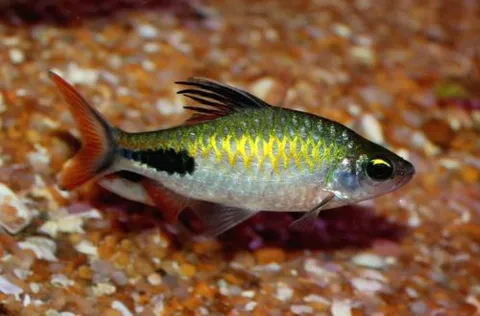
Dawkinsia rohani
The fish known as Rohan's Barb (Dawkinsia rohani by its scientific name) belongs to the family Cyprinidae. Its name is a tribute to two prominent biologist-ichthyologists, Richard Dawkins and Rohan Pethiyagoda. This…
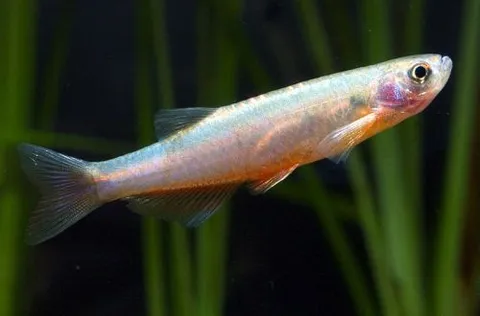
Danio roseus
The Rosy Danio, scientifically known as Danio roseus, belongs to the family Cyprinidae (Carps). This fish is a relatively recent addition to the aquarium hobby but has quickly gained popularity. Its care and breeding…
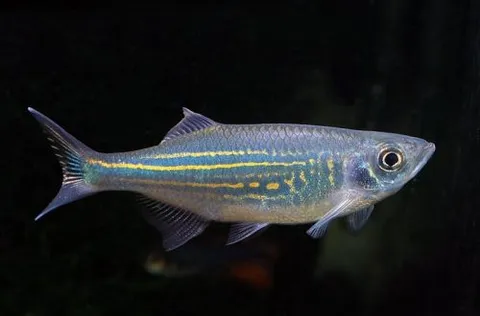
Devario malabaricus
The Malabar Danio, scientifically known as Devario malabaricus, belongs to the family Cyprinidae. These fish are undemanding in both keeping and breeding. They coexist perfectly with many freshwater species, making them…
Cyprinella lutrensis
The Red Shiner, or Cyprinella lutrensis (until recently known as Notropis lutrensis), is a representative of the carp family (Cyprinidae). Its natural habitat is located in North America, where it is found in both swift…