Temperature24 – 28 °C
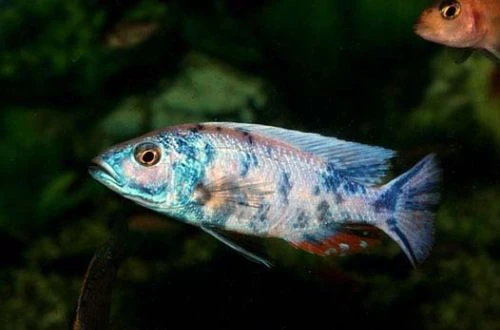
The Spotted Hap, also known by its trade name Electric Blue Hap OB, is not found in the wild. This species is a hybrid bred from the Electric Blue Hap and Aulonocara multicolor. Its artificial origin is clearly indicated by the abbreviation "OB" at the end of its trade name.
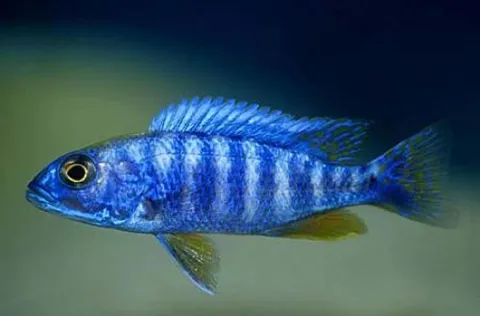
Although the maximum size of adult specimens can vary depending on the specific parent subspecies, in aquarium conditions these fish typically reach 18–19 cm. Males are distinguished by a bluish body with a dark blue speckled pattern. Females and juveniles look different: they are predominantly grey or silver in tone.
This fish has no natural range: the OB Hap is an aquarium hybrid that does not occur in the wild and has no valid scientific name. According to the version most widely accepted among breeders, the line was produced from the electric blue hap (Sciaenochromis fryeri) and an OB peacock — itself a hybrid — followed by backcrossing; the exact pedigree is undocumented and differs from line to line. The OB pattern itself — from 'orange blotch' — occurs in the wild only among the mbuna of Lake Malawi, and almost exclusively in females, and is caused by a sex-linked mutation in a regulatory region of the Pax7 gene. This is precisely why the pattern segregates unpredictably in the offspring and no two fish are coloured alike. The ancestral species come from Lake Malawi in East Africa, but that no longer applies to the hybrid itself.
This fish has an active and temperamental character. During the breeding season, the male's courtship of females can be accompanied by rather aggressive behavior. To alleviate tension in an aquarium environment, it is recommended to form a "harem" group, where there are 3–4 females per male, which helps distribute his attention. The Spotted Hap coexists well with other Lake Malawi cichlids, such as Utaka and Aulonocara, that can thrive in an alkaline environment. In spacious aquariums, cohabitation with Mbuna group fish is even possible. However, it should be noted that very small fish may become targets of harassment or predation.
The Spotted Hap inherited most of its genetic material from the Electric Blue Hap, so its care requirements are similar. The recommended aquarium volume for a group of 3–4 individuals is at least 300 liters. These fish need ample open space for swimming. For decoration, it is sufficient to arrange only the bottom level, where a layer of sandy substrate and several large stones are placed. The long-term well-being of the species largely depends on maintaining stable hydrochemical water parameters with high pH and dGH values. These indicators are influenced not only by the water preparation process but also by the regularity of aquarium maintenance and the uninterrupted operation of equipment, especially the filtration system.
The daily diet should be based on high-protein foods. These can be dry foods in the form of flakes and granules, as well as live or frozen foods, such as Artemia or bloodworms.
Like all Malawi cichlids, this fish is a mouthbrooder: the female picks up the eggs and carries the clutch in her buccal cavity for about three weeks, barely feeding all that time, and the released fry continue to shelter in her mouth when threatened. The hybrid is kept in a harem — one male to four or more females, ideally eight — and under good conditions it spawns readily. Breeding it, however, is strongly discouraged. The aquarium community takes one of its firmest positions on hybrid Malawi cichlids: captive populations serve as a reserve for wild ones, and there are documented cases of nearly extinct Malawi cichlid lines being restored from hobby stock. A hybrid that finds its way into a pure line contaminates it irreversibly, and at juvenile size hybrids are often indistinguishable from pure species. The problem is compounded by the readiness of mbuna, peacocks and haps to interbreed whenever partners of their own species are absent. This fish is therefore kept as a purely ornamental animal, is not housed with Aulonocara, Sciaenochromis or mbuna intended for breeding, and its fry should never be passed on as any named species. In addition, because the OB pattern is inherited in a sex-linked manner, its segregation in the offspring is unpredictable.
This species is susceptible to diseases typical of African cichlids, often arising from disrupted water parameters or an unbalanced diet. These include bloat, caused by improper feeding, and bacterial infections, manifesting as erosions on the body or fin damage. Prevention involves maintaining stable hardness and pH levels, regular water changes, and excluding foods from the diet that provoke obesity or digestive problems.
When purchasing, choose active individuals with clear eyes and undamaged fins. It is important to look for the absence of signs of emaciation, sunken belly, or unnatural film on the scales. Healthy fish should show curiosity and react to movement near the glass. It is recommended to avoid individuals that constantly hide in the corner of the aquarium, appear lethargic, or show signs of injury, as this may indicate stress or hidden infections.
The essentials: size, tank volume, water parameters and care
An adult reaches 15–18 cm in length. Plan the tank around the maximum size: the fish quickly outgrows a cramped setup.
The recommended volume is 280 L. A smaller tank speeds up nitrate build-up and raises stress levels.
Temperature 24–28 °C, pH 7.6–9, hardness 10–25 dGH. Stability matters more than exact values: sudden swings are harder on the fish than a small deviation from the ideal.
Around 10 years when kept properly. Lifespan depends directly on tank volume, water quality and a varied diet.
Temperament: semi-peaceful (including aggression during spawning / intraspecific conflicts). Keep this in mind when choosing tank mates.
Recommended setup: harem (1 male and several females). Ignoring this is a common cause of stress and disease.
Diet type: plant-based (algae, vegetables). Feed small portions that are finished within a couple of minutes — overfeeding does more harm than underfeeding.
The water suits 113 of 208 plants in the catalogue — the easiest ones are shown first.
African Onion PlantAfzelius's AnubiasAmazon FrogbitAmazon SwordAnacharisAnubiasArrowhead CryptDwarf CloverDwarf CloverDwarf HygrophilaDwarf SagittariaDwarf ValGuppy GrassHornwortJava MossMoneywortMud SwordNair's LagenandraNarrow Leaf AnacharisNarrow-leaf CloverStringy MossTaiwan MossTape GrassUssuri Watermilfoil
Matched by family, categories and overlapping keeping conditions
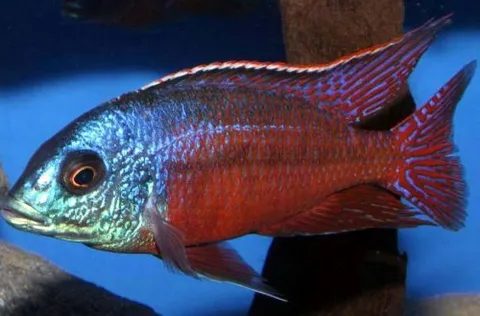
Protomelas taeniolatus
Protomelas, or the 'Red Empress' Cichlid, also known by its scientific name Protomelas taeniolatus (formerly classified as Haplochromis taeniolatus), is a member of the Cichlidae family. A distinguishing feature of this…
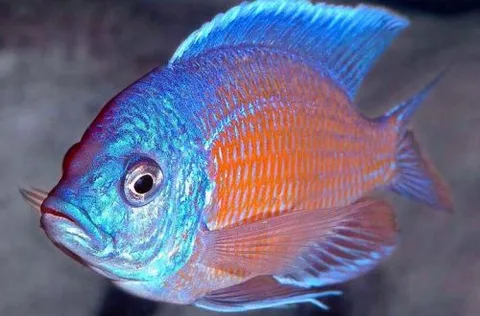
Copadichromis borleyi
Copadichromis Kadango, also known as Red Kadango, or by its scientific name Copadichromis borleyi, belongs to the Cichlidae family. This fish can be considered relatively peaceful; aggression is characteristic only…
Nyassachromis boadzulu
The fish, known scientifically as Nyassachromis boadzulu, is a member of the Cichlidae family, or Cichlids. Previously, the species was designated as Haplochromis boadzulu, hence the frequently used prefix…
Sciaenochromis fryeri
The Electric Blue Hap, known scientifically as Sciaenochromis fryeri, belongs to the Cichlidae family. This is an energetic and brightly colored fish, however, its temperament can be quite complex. For this reason, it…