Temperature23 – 28 °C
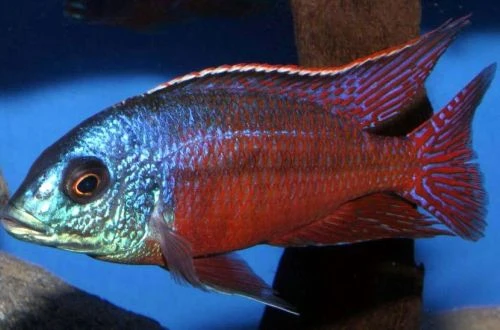
Protomelas, or the 'Red Empress' Cichlid, also known by its scientific name Protomelas taeniolatus (formerly classified as Haplochromis taeniolatus), is a member of the Cichlidae family. A distinguishing feature of this species is its extraordinarily bright coloration, dominated by fiery red and orange tones, complemented by an elegant pattern on its fins. Thanks to its attractiveness and relative undemanding nature regarding keeping and breeding conditions, this species deservedly ranks among the most popular African cichlids.
The body structure of Protomelas is typical for most cichlids. Males are distinguished by a more saturated and vibrant appearance compared to females. Their bodies are colored in bright orange-red hues, and their heads have a bluish sheen. The fins are adorned with patterns of red and bluish lines and dots. Notably, the pattern can vary even within the same species, as there are different color variations inhabiting different parts of the lake. Females and juveniles, however, appear significantly paler, most often having a silvery base color, sometimes with a slight orange tint on their sides.
This species is endemic and found exclusively in the freshwaters of African Lake Malawi. Protomelas taeniolatus are widely distributed throughout the body of water, preferring to stay in coastal areas where rocky shorelines alternate with sandy bottoms. In their natural habitat, the diet of these fish consists of algae growing on rocks, as well as microscopic zooplankton.
This species is relatively peaceful and coexists well with fish such as Livingston's Cichlid and the 'Golden Leopard' Cichlid. However, it is strongly not recommended to keep them with aggressive Mbuna group species. Intraspecific relationships in Protomelas are structured on a harem principle: one dominant male lives with several females. Keeping multiple males together is generally impossible due to their animosity, except in aquariums of 600 liters or more, where there is enough space for a couple of males with their harems to coexist.
Success in keeping these fish largely depends on the aquarium volume; the least amount of trouble will come from a tank of 300 liters or more for a group of 3–4 individuals. When aquascaping, a sandy substrate should be used, with several flat stones scattered haphazardly. To imitate a rocky shore, rock formations can be created with vertically placed stones reaching the water surface. These structures should be placed near one of the aquarium walls to maintain sufficient free swimming space. It is important to provide several shelters, such as crevices or grottoes, when creating stone structures. As decoration, several groups of Vallisneria plants are permissible, but they should not be allowed to overgrow.The main difficulty lies in the need to replicate the chemical composition of the water characteristic of Lake Malawi. The water there has a medium to high hardness (dH) and is slightly alkaline in pH. More detailed information on pH and dH parameters, as well as methods for changing them, can be found in the "Hydrochemical composition of water" section. To maintain high water quality and cleanliness, 10–20% of its volume must be renewed weekly, and the substrate cleaned of organic debris (uneaten food, excrement) using a siphon. The installation of a high-performance filter plays a key role in this process; economizing on this equipment is undesirable, as it ensures the stability of the entire aquarium biosystem. Other important equipment includes an aerator, heater, and lighting system. The list can be expanded depending on specific needs.
Protomelas readily accepts a variety of foods: dry, live, and frozen. A key condition for maintaining health is a diverse diet, with the mandatory inclusion of plant components. The optimal diet includes spirulina flakes combined with flakes or granules containing protein elements, or live food such as bloodworms or mosquito larvae. Specialized foods for African cichlids are available on the market, providing all necessary nutrients. It is recommended to feed the fish 2–3 times a day, offering a portion they can completely eat within 5 minutes.
The 'Red Empress' successfully breeds in a home aquarium provided that proper water quality is maintained. During the spawning period, the male selects a suitable place for the future nest, be it a flat stone or simply a cleared area of the bottom, meticulously preparing it. He then actively attracts females to this improvised nest. The female lays 40 to 50 eggs, which she immediately collects in her mouth. This mechanism, characteristic of most cichlids, represents a unique evolutionary strategy for protecting offspring. Throughout the process, the male remains close to the female. His anal fin has a special pattern of spots that mimic eggs in shape and color. When the female mistakenly tries to collect these 'virtual' eggs into her mouth, the male releases sperm, and fertilization occurs. The entire incubation period, which lasts from 21 to 28 days, the eggs remain in the female's mouth. The instinct to protect offspring persists even after the fry hatch: they stay near the mother and, if danger arises, instantly hide in her mouth.
Under unsuitable keeping conditions, fish become vulnerable to most typical diseases. Conversely, in a balanced aquarium ecosystem, health problems are extremely rare. An unbalanced or monotonous diet often leads to the development of a disease known as 'Malawi Bloat,' which primarily affects representatives of the eponymous lake.
When choosing a 'Red Empress' Protomelas, first assess the fish's external condition: scales should be tightly adhering, without damage, ulcers, or white film, and eyes should be clear and transparent. Avoid individuals with signs of emaciation, sunken bellies, or unnaturally bloated abdomens. Observe their behavior in the store: a healthy fish is active, interested in its surroundings, and does not constantly stay near the water surface or in a corner, trying to hide from tankmates. Keep in mind that juveniles and females have modest, predominantly gray or brownish coloration with stripes, so they can easily be confused with other cichlid species. Purchase fish only from reputable sellers who can confirm the species. Before buying, ensure there are no dead individuals in the fish tank, as this may indicate the presence of infectious diseases in the system.
The essentials: size, tank volume, water parameters and care
An adult reaches 15 cm in length. Plan the tank around the maximum size: the fish quickly outgrows a cramped setup.
The recommended volume is 280 L. A smaller tank speeds up nitrate build-up and raises stress levels.
Temperature 23–28 °C, pH 7.6–8.8, hardness 10–25 dGH. Stability matters more than exact values: sudden swings are harder on the fish than a small deviation from the ideal.
Around 10 years when kept properly. Lifespan depends directly on tank volume, water quality and a varied diet.
Temperament: semi-peaceful (including aggression during spawning / intraspecific conflicts). Keep this in mind when choosing tank mates.
Recommended setup: harem (1 male and several females). Ignoring this is a common cause of stress and disease.
Diet type: plant-based (algae, vegetables). Feed small portions that are finished within a couple of minutes — overfeeding does more harm than underfeeding.
The scientific name of the species is Protomelas taeniolatus, family Cichlids (Cichlidae). It also appears in the literature as: Cyrtocara taeniolatus, Haplochromis cancellus, Haplochromis taeniolatus.
The water suits 114 of 208 plants in the catalogue — the easiest ones are shown first.
African Onion PlantAfzelius's AnubiasAmazon FrogbitAmazon SwordAnacharisAnubiasArrowhead CryptDwarf CloverDwarf CloverDwarf HygrophilaDwarf SagittariaDwarf ValGuppy GrassHornwortJava MossMoneywortMud SwordNair's LagenandraNarrow Leaf AnacharisNarrow-leaf CloverStringy MossTaiwan MossTape GrassUssuri Watermilfoil
Matched by family, categories and overlapping keeping conditions
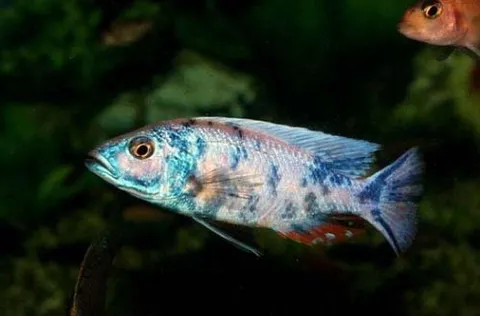
The Spotted Hap, also known by its trade name Electric Blue Hap OB, is not found in the wild. This species is a hybrid bred from the Electric Blue Hap and Aulonocara multicolor. Its artificial origin is clearly…
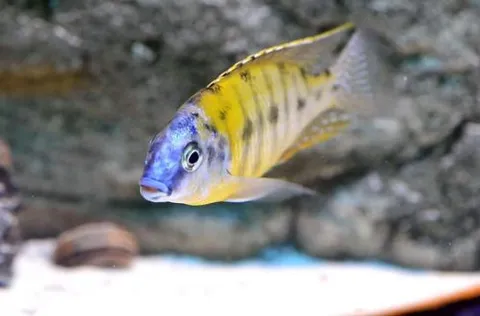
Protomelas fenestratus
Protomelas fenestratus, known as Fenestratus, belongs to the Cichlidae family. This species is endemic and found exclusively in Lake Malawi, located on the African continent.
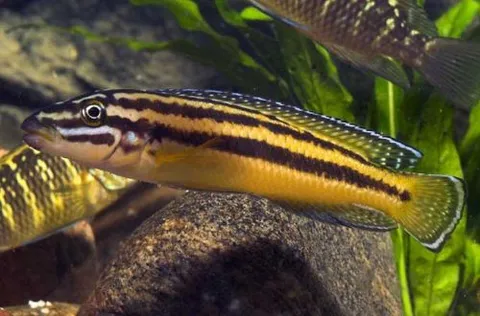
Julidochromis regani
Julidochromis regani, with the scientific name Julidochromis regani, belongs to the family Cichlidae. This cichlid is quite popular among aquarists. Like many members of its family, it can show aggression towards…
Sciaenochromis fryeri
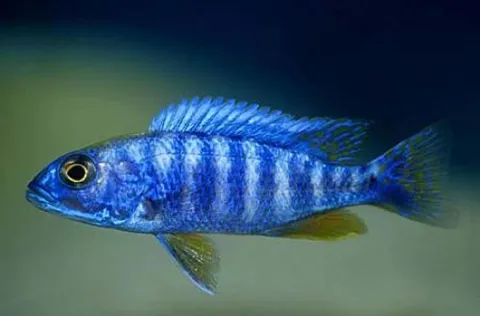
The Electric Blue Hap, known scientifically as Sciaenochromis fryeri, belongs to the Cichlidae family. This is an energetic and brightly colored fish, however, its temperament can be quite complex. For this reason, it…