Temperature2 – 23 °C
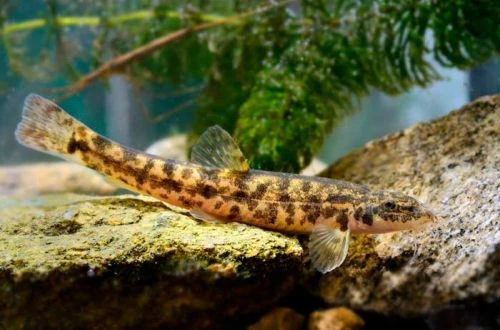
A representative of the Nemacheilidae family, known by its scientific name Barbatula barbatula, or Stone Loach, is distributed throughout Europe, including the Baltic countries and Central Russia. It inhabits various biotopes with clean, oxygen-rich water. Most often, it can be found in fast-flowing rivers, but it also occurs in the lower reaches of rivers and in lakes.
Adults of this fish reach a length of about 10–12 cm. Their body is elongated and slender, with a rather large head. The fins are rounded, slightly serrated at the edges. Near the mouth, there are three pairs of barbels that serve a sensory function. Their coloration is yellowish-brown, with a pattern of dark, irregularly shaped spots and speckles. Sexual dimorphism is weakly expressed, so visible differences between males and females are practically impossible to notice.
The Stone Loach is widespread in Europe and parts of Asia, inhabiting rivers, streams, and lakes with clean, well-aerated water. It prefers areas with stony, gravelly, or sandy bottoms, where it leads a benthic lifestyle, often burrowing into the substrate. In nature, it inhabits water bodies with moderate or fast currents, avoiding stagnant, heavily polluted, or brackish waters.
In spacious aquariums, the Stone Loach coexists well with its congeners and with other fish species of comparable size. By nature, it leads a secretive lifestyle; accordingly, in the presence of overly active or unfriendly fish, its inconspicuousness will only intensify. Other river fish, as well as Goldfish and Koi carp, will make good neighbors for it.
The aquarium volume for 3–4 individuals should be at least 100 liters. When decorating, it is recommended to create shelters using large stones and snags. Plants are not a mandatory decorative element. Similar conditions are necessary when keeping the fish in a pond. The most comfortable environment for the Stone Loach is slightly alkaline or neutral water of medium hardness, with a temperature not exceeding 23 °C. Aquarium care for the Stone Loach is similar to that for tropical fish: weekly partial water changes and removal of organic waste (food remnants, excrement), usually combined with siphoning the substrate. Equipment maintenance should be performed according to the manufacturer's instructions.
The Stone Loach is capable of adapting well to alternative foods, such as sinking flakes and granules. It is best to feed the fish in the evening, shortly before the lights are turned off, as this species exhibits maximum activity during twilight hours.
Spawning occurs in spring and summer, from April to August, depending on climatic conditions and the productivity of the water body. Females lay eggs in portions on a substrate of stones, gravel, or among aquatic vegetation. In aquarium conditions, breeding is difficult and requires simulating natural conditions: creating a water flow, maintaining high oxygen levels, and using fine-grained substrate to mimic the spawning biotope.
The species is sensitive to water quality, especially oxygen content and the presence of heavy metals; under unfavorable conditions, fish are prone to stress, which manifests as the appearance of dark stripes on the body. The Stone Loach can act as an intermediate host for various helminths, including nematodes, and can also be an asymptomatic carrier of viral diseases affecting carp fish. Prevention includes maintaining cleanliness in the aquarium and regular water changes.
When purchasing, choose active individuals without visible skin damage, ulcers, or signs of emaciation. Healthy fish should exhibit natural behavior, actively exploring the bottom with their barbels, and show no signs of apathy or unnaturally dark coloration indicating stress. It is recommended to avoid individuals with cloudy eyes or damaged fins, and to clarify the keeping conditions at the store, as the species is demanding regarding temperature.
The essentials: size, tank volume, water parameters and care
An adult reaches 10–12 cm in length. Plan the tank around the maximum size: the fish quickly outgrows a cramped setup.
The recommended volume is 100 L. A smaller tank speeds up nitrate build-up and raises stress levels.
Temperature 2–23 °C, pH 7–7.5, hardness 10–15 dGH. Stability matters more than exact values: sudden swings are harder on the fish than a small deviation from the ideal.
Around 7 years when kept properly. Lifespan depends directly on tank volume, water quality and a varied diet.
Temperament: peaceful (regular). Keep this in mind when choosing tank mates.
Recommended setup: small group (3–4 individuals). Ignoring this is a common cause of stress and disease.
Diet type: sinking (any). Feed small portions that are finished within a couple of minutes — overfeeding does more harm than underfeeding.
The scientific name of the species is Barbatula barbatula, family Nemacheilidae. It also appears in the literature as: Barbatula oreas, Barbatula sibirica, Cobitis barbatula.
The water suits 113 of 208 plants in the catalogue — the easiest ones are shown first.
African Onion PlantAfzelius's AnubiasAmazon FrogbitAmazon SwordAnacharisAnubiasArrowhead CryptAsian WatermossDwarf CloverDwarf CloverDwarf HygrophilaDwarf SagittariaDwarf ValGuppy GrassHornwortJava MossMoneywortMud SwordNarrow Leaf AnacharisNarrow-leaf CloverStringy MossTaiwan MossTape GrassUssuri Watermilfoil
Matched by family, categories and overlapping keeping conditions
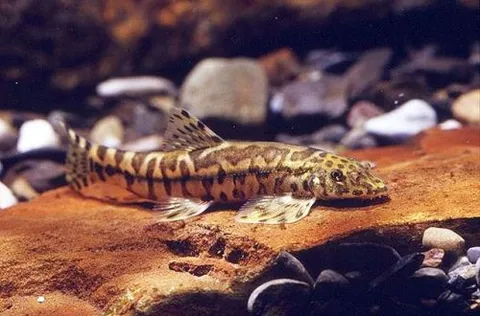
Formosania lacustris
Formosania lacustris, also known as the Brushmouth Loach, belongs to the family Balitoridae, known as river loaches. The fish owes its name to its body structure: it is elongated and slender, but has a rather large…
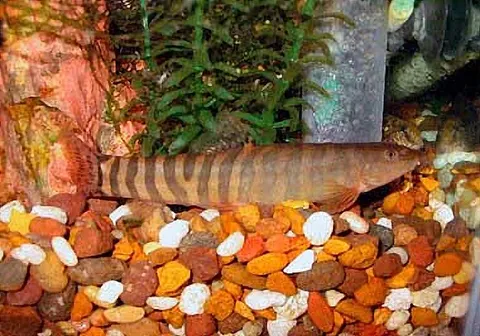
Schistura scaturigina
The fish, known scientifically as Schistura scaturigina and belonging to the family Nemacheilidae (loaches), originates from South Asia. Its natural habitats are the upper reaches of the Ganges River basin, which spans…
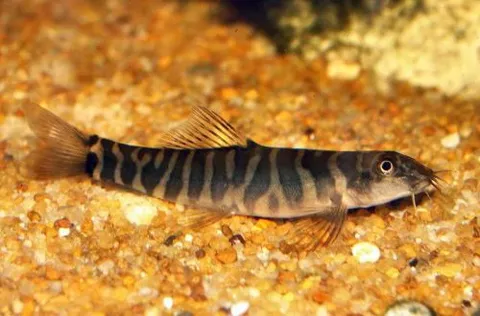
Mustura maepaiensis
The fish, known scientifically as Mustura maepaiensis, belongs to the family Nemacheilidae and is called Schistura Mae Hong Son. This name comes from the mountainous province of Mae Hong Son in north-western Thailand,…
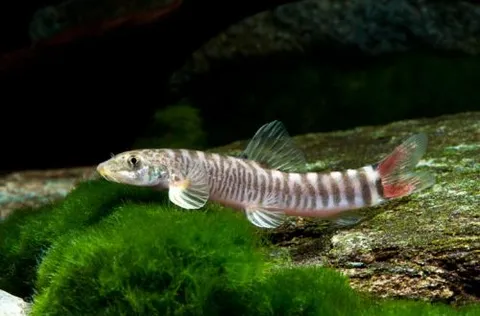
Schistura vinciguerrae
Schistura vinciguerrae, also known as Vinciguerra's loach, belongs to the family Nemacheilidae. It was named after the zoologist Decio Vinciguerra, who made significant contributions to the study of fish species…