Nemacheilidae

Schistura vinciguerrae

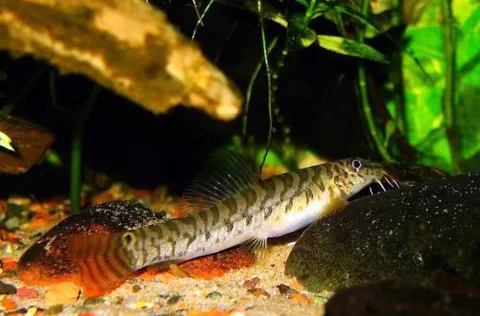
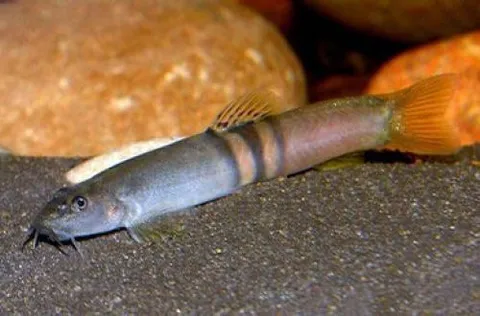
Schistura vinciguerrae, also known as Vinciguerra's loach, belongs to the family Nemacheilidae. It was named after the zoologist Decio Vinciguerra, who made significant contributions to the study of fish species inhabiting Burma. In aquaristics, this loach is quite common, standing out among other representatives of its family. It is undemanding to keep, coexists well with non-aggressive fish of comparable size, and attracts attention with its beautiful coloration.

Tank
from 80 L (21 gal)
Temperature
20 – 26 °C (68 – 79 °F)
Size in aquarium
6 – 7 cm (2.4 – 2.8 in)
Acidity
pH 6–7.5
Natural rangeRange on the map
  • Northern Myanmar area
  • Manipur area
  • China
  • India
  • Myanmar
  • Thailand

Tank conditions

Plan the tank stocking
Temperature
20 – 26 °C (68 – 79 °F)
Water pH
Slightly acidic (6) – Neutral (7.5)
Water dH
Very soft (2) – Hard (12)
Water salinity
no salt (freshwater)
Size in aquarium
6 – 7 cm (2.4 – 2.8 in)
Lifespan
5 years
Temperament
Peaceful (regular)
Toward small fish
not a predator
Required aquarium volume
from 80 L (21 gal)
Lighting
dimmed or moderate
Substrate
rocky rock formations, boulders, etc.
Water flow
moderate or strong
Feeding
Sinking (any)
Keeping
Both solitary and in group flexible
  • Lifespan. A lifespan to expect under good care, not a measured value: it depends heavily on tank volume, water quality and diet — and for selectively bred forms, on their origin as well.
  • Toward small fish. Based on the Predators category in the catalog or the temperament in the species parameters. “A risk to small fish” means the species is not a predator by habit, yet will swallow any fish that fits in its mouth.
  • Required aquarium volume. This is a husbandry recommendation, not a measured value: the volume depends on the keeping mode (both solitary and in group (flexible)), footprint, decor and tank mates.

Care and keeping

Description

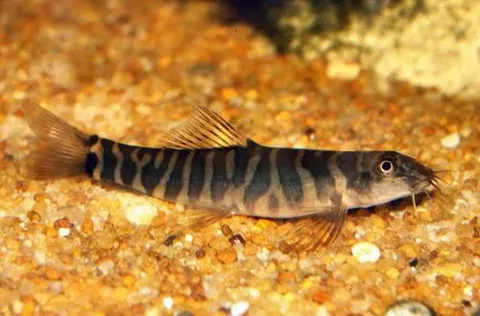
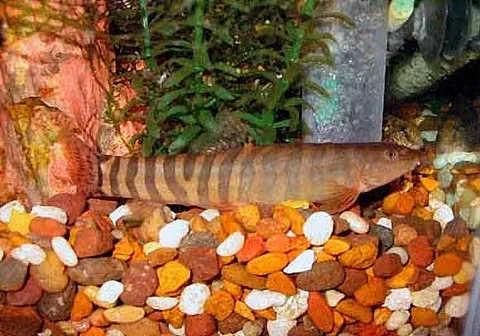
Adult Schistura reach 6–7 cm (2.4–2.8 inches) in length and have an elongated, cylindrical body. Their fins are short; the pelvic and pectoral fins are positioned low, closer to the ventral side. The body coloration varies from yellowish-brown to brown, with vertical dark stripes that become noticeably wider towards the tail. The tail itself has a red tint, adorned with a pattern of black speckles. Sexual dimorphism in these fish is weakly expressed; it is quite difficult to distinguish males from females by external characteristics.

Habitat

The natural habitat of this species covers Southeast Asia, specifically the northern regions of Myanmar (formerly Burma) and the adjacent Indian states of Manipur and Nagaland. Schistura vinciguerrae inhabits the upper reaches of the Salween River basin, which originates in the mountains. These fish prefer areas with strong, and sometimes turbulent currents, where numerous rapids and cascades are found. The bottom in such places is usually rocky, abundant with rock fragments. Aquatic plants predominantly grow along the banks. The speed of the water flow and its transparency can vary significantly depending on the season.

Behavior and Compatibility

This species is not considered the most sociable; however, unlike many other loaches, it does not show aggression towards its conspecifics and can be kept in a group. Schistura are also peaceful towards other fish. Nevertheless, due to the specific habitat requirements for strong currents, the choice of suitable tank mates is quite limited.

Care and Maintenance

For a small group of these fish, the optimal aquarium volume starts from 80 liters (21 US gallons). Their maintenance will not cause particular difficulties, provided a suitable environment is created: clean, flowing water saturated with dissolved oxygen, and a moderate or even strong current. To ensure such conditions, an internal filter system combined with an aerator can be used. Maintaining high water quality also requires regular (weekly) water changes of 30–50% of the volume and the removal of organic waste – food remnants and excrement. The aquarium decor can be quite simple. It is sufficient to cover the bottom with stones and coarse sand, adding a few large boulders and snags. If desired, artificial plants or undemanding live species capable of growing in strong current conditions, such as Anubias, Bucephalandra, Crinum, as well as some aquatic mosses and ferns, can be used.
Diet

In natural conditions, these fish feed on small invertebrates such as worms, larvae, aquatic insects, and crustaceans. In a home aquarium, Schistura readily accept most popular foods, whether dry, frozen, or live. There is no need to worry about the current scattering food throughout the tank, as the fish are perfectly adapted to catching food directly from the water flow.

Breeding and Reproduction

At the time of writing this article, the authors could not find reliable information about the successful breeding of Schistura vinciguerrae in home aquariums.

Diseases

Health problems in these fish arise only in the presence of injuries or keeping in unsuitable conditions, which leads to a weakening of the immune system and the subsequent occurrence of various diseases. At the first signs of illness, it is necessary first to check the water parameters for exceeding permissible values or the presence of toxic substances (such as nitrites, nitrates, ammonia). If deviations are found, all indicators should be normalized, and then treatment should begin.

How to choose

When choosing Schistura vinciguerrae, attention should be paid to the fish's activity and the condition of its skin. Healthy specimens should be active, show interest in their surroundings, and have no visible damage, ulcers, or film on their bodies. Avoid specimens with signs of emaciation, such as a sunken belly, or fish that constantly stay at the water's surface, which may indicate breathing problems or poor water quality in the retail aquarium. Since this species is benthic and territorial, it is important to assess the behavior of the fish in a group at the store. Aggressive skirmishes between individuals in overcrowded conditions are common, but the fish should not have torn fins or bite marks. It is recommended to acquire specimens that actively explore the substrate or stones, as this indicates normal feeding behavior. Given the species' specific requirements for water purity and oxygen saturation, it is worth asking the seller about the keeping conditions and ensuring that the fish have not been kept in overcrowded or poorly filtered tanks.

Compatibility

There are no pair reviews for this species yet — check tankmates in the matcher.

All tankmates

Plants and this fish

Matching water does not mean the plant will stay intact.

Frequently asked questions

The essentials: size, tank volume, water parameters and care

How big does Schistura vinciguerrae get?

An adult reaches 6–7 cm in length. Plan the tank around the maximum size: the fish quickly outgrows a cramped setup.

What size aquarium does Schistura vinciguerrae need?

The recommended volume is 80 L. A smaller tank speeds up nitrate build-up and raises stress levels.

What water parameters does Schistura vinciguerrae need?

Temperature 20–26 °C, pH 6–7.5, hardness 2–12 dGH. Stability matters more than exact values: sudden swings are harder on the fish than a small deviation from the ideal.

How long does Schistura vinciguerrae live?

Around 5 years when kept properly. Lifespan depends directly on tank volume, water quality and a varied diet.

Is Schistura vinciguerrae aggressive?

Temperament: peaceful (regular). Keep this in mind when choosing tank mates.

How many Schistura vinciguerrae should be kept together?

Recommended setup: both solitary and in group (flexible). Ignoring this is a common cause of stress and disease.

What does Schistura vinciguerrae eat?

Diet type: sinking (any). Feed small portions that are finished within a couple of minutes — overfeeding does more harm than underfeeding.

What is the scientific name of Schistura vinciguerrae?

The scientific name of the species is Schistura vinciguerrae, family Nemacheilidae. It also appears in the literature as: Nemacheilus putaoensis, Nemacheilus vinciguerrae, Nemachilus vinciguerrae.

Similar fishes

Matched by family, categories and overlapping keeping conditions

Schistura Mae Hong Son

Schistura Mae Hong Son

Mustura maepaiensis

Nemacheilidae

The fish, known scientifically as Mustura maepaiensis, belongs to the family Nemacheilidae and is called Schistura Mae Hong Son. This name comes from the mountainous province of Mae Hong Son in north-western Thailand,…

Schistura scaturigina

Schistura scaturigina

Schistura scaturigina

Nemacheilidae

The fish, known scientifically as Schistura scaturigina and belonging to the family Nemacheilidae (loaches), originates from South Asia. Its natural habitats are the upper reaches of the Ganges River basin, which spans…

Spotted Loach

Spotted Loach

Acanthocobitis botia

Nemacheilidae

Acanthocobitis botia, also known as the Spotted Loach, belongs to the family Nemacheilidae. These peaceful fish coexist easily with many tropical species. They are undemanding in care and do not entail significant…

Schistura balteata

Schistura balteata

Schistura balteata

Nemacheilidae

The fish scientifically known as Schistura balteata, belonging to the family Nemacheilidae, is commonly referred to as the Schistura balteata. This species is relatively easy to keep and coexists well with many common…

Other scientific names and conservation status

Other scientific names
Nemacheilus putaoensis, Nemacheilus vinciguerrae, Nemachilus vinciguerrae, Noemacheilus vinciguerrae
Categories
Loaches
Conservation status
Least concernLC