Temperature22 – 26 °C
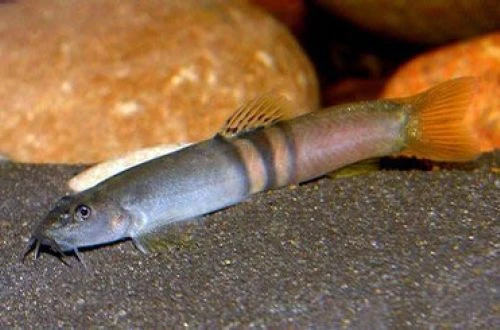
The fish scientifically known as Schistura balteata, belonging to the family Nemacheilidae, is commonly referred to as the Schistura balteata. This species is relatively easy to keep and coexists well with many common aquarium inhabitants. However, its preference for moderate water flow might make maintenance slightly more challenging for beginner aquarists and limit the choice of compatible species.
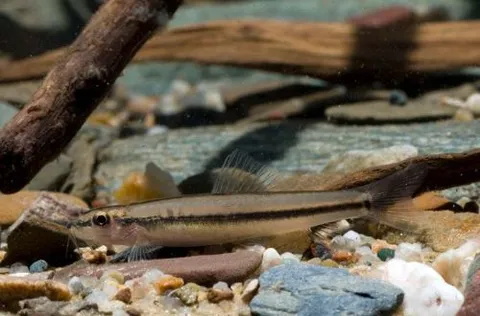
Adults of this fish can reach 7–8 cm in length. Their body is elongated and slender, with a relatively small head and high-set eyes. Near the mouth are barbels, which help them locate food. Their fins are translucent and quite short. A distinctive feature of the species is two black encircling bands running along the middle of the body. At the base of the dorsal fin, there are 3–5 dark spots. The posterior part of the body (and sometimes the entire body), as well as the space between the black bands, may have a pink or yellow hue. Often, a closely related species, very similar to Schistura balteata, known as Schistura cf. Balteata, can be found for sale. The prefix "cf." indicates that the scientific description of this species has not yet been completed by biologists. Although these two fish are often confused, their similar requirements for keeping conditions will not create problems for aquarists.
Its homeland is Southeast Asia, specifically southern Myanmar, Tanintharyi Region. These fish inhabit the Tenasserim River basin, which also covers border areas of western Thailand, including Ratchaburi and Kanchanaburi provinces. They are found in the upper reaches of rivers originating in the mountains. Their typical biotope is characterized by fast currents, numerous rapids, and cascades. Along the banks, dense thickets of plants, mosses, and ferns can be seen. The water there is clean and well-oxygenated, and the substrates are predominantly rocky. Usually, such rivers and streams flow through dense tropical forests, where the closed canopy of trees almost completely blocks sunlight from the water surface.
Unlike most loaches, Schistura balteata exhibits a rather peaceful nature. Although it zealously guards its territory on the aquarium bottom, it avoids direct clashes with its conspecifics. Nevertheless, it is recommended to avoid other bottom-dwelling species in the same aquarium. This species is compatible with fish adapted to turbulent conditions, such as danios, barbs, and other cyprinids. Accordingly, species that prefer calm waters should not be considered as their neighbors.
For a small group of these fish, aquariums of 80 liters or more will be optimal. The setup should mimic a mountain riverbed, including a rocky substrate with several large boulders and the addition of driftwood. Shelters should be created using decor elements, one for each fish. Schistura balteata typically occupies such refuges and subsequently actively defends its "home" from conspecifics. It is critically important to provide moderate to strong internal current to simulate the fast-flowing waters of their natural habitats. Lighting should be subdued. Live aquatic plants are usually not used due to the specific conditions (substrate, current, lack of light), but there are undemanding species that can attach to the surfaces of driftwood and other decorative elements. As inhabitants of flowing waters, these fish are very sensitive to the accumulation of polluting organic waste and low oxygen concentrations. For successful long-term keeping, the uninterrupted operation of filtration and aeration systems is of paramount importance. Internal filters will be an excellent choice, as, in addition to their primary function of water purification, they will also provide the necessary internal current. Besides equipment, regular maintenance procedures contribute significantly to maintaining biological balance: weekly replacement of 30–50% of the water volume with fresh water and timely removal of organic waste (food remnants, excrement).
This species is omnivorous. In their natural environment, they feed on small invertebrates and some plant matter. In a home aquarium, they can be fed sinking dry foods, such as flakes and granules, enriched with protein. It is also recommended to regularly include live or frozen foods in their diet, such as bloodworms, brine shrimp, large daphnia, and similar products.
At the time of writing this article, successful breeding cases of this species in artificial conditions in home aquariums have not been recorded.
Health problems in these fish arise only in the presence of injuries or keeping in unsuitable conditions, which leads to a weakening of the immune system and the subsequent occurrence of various diseases. At the first signs of illness, it is necessary first to check the water parameters for exceeding permissible values or the presence of toxic substances (such as nitrites, nitrates, ammonia). If deviations are found, all indicators should be normalized, and then treatment should begin.
When purchasing, choose active individuals that show interest in food and have no visible damage to fins or skin. A healthy fish should have a clean coloration without whitish film, ulcers, or unnatural spots. It is important to avoid specimens with sunken bellies, which may indicate emaciation or internal diseases, as well as fish that appear apathetic and constantly lie on the bottom without attempting to hide in a shelter. — inspect the fish for signs of emaciation or body deformities — check the integrity of the fins, ensuring no torn edges or white spots — ask the seller about the keeping conditions and the fish's adaptation to the offered diet Keep in mind that similar species, which may differ in color intensity and size, are often sold under this name. Since these fish have very fine scales, they are sensitive to transport and stress, so during inspection at the store, it is important to ensure there are no signs of bacterial infections, which often arise due to poor water quality in crowded tanks.
The essentials: size, tank volume, water parameters and care
An adult reaches 7–8 cm in length. Plan the tank around the maximum size: the fish quickly outgrows a cramped setup.
The recommended volume is 80 L. A smaller tank speeds up nitrate build-up and raises stress levels.
Temperature 22–26 °C, pH 6–7.5, hardness 2–12 dGH. Stability matters more than exact values: sudden swings are harder on the fish than a small deviation from the ideal.
Around 5 years when kept properly. Lifespan depends directly on tank volume, water quality and a varied diet.
Temperament: peaceful (regular). Keep this in mind when choosing tank mates.
Recommended setup: small group (5–6 individuals). Ignoring this is a common cause of stress and disease.
Diet type: sinking (any). Feed small portions that are finished within a couple of minutes — overfeeding does more harm than underfeeding.
The scientific name of the species is Schistura balteata, family Nemacheilidae. It also appears in the literature as: Nemacheilus balteatus.
The water suits 197 of 208 plants in the catalogue — the easiest ones are shown first.
Afzelius's AnubiasAnacharisAnubiasBrazilian PennywortDwarf CloverDwarf CloverDwarf HygrophilaDwarf SagittariaDwarf ValGuppy GrassHornwortJava FernJava MossMoneywortMud SwordNair's LagenandraNarrow Leaf AnacharisNarrow-leaf CloverStringy MossSüsswassertangTaiwan MossTape GrassTemple PlantUssuri Watermilfoil
Matched by family, categories and overlapping keeping conditions
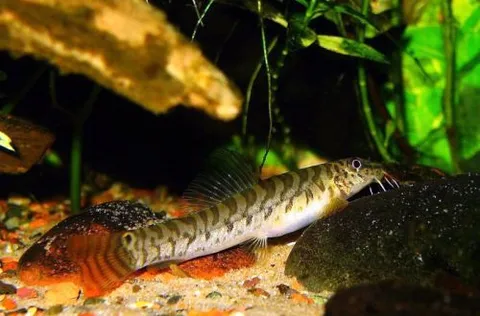
Acanthocobitis botia
Acanthocobitis botia, also known as the Spotted Loach, belongs to the family Nemacheilidae. These peaceful fish coexist easily with many tropical species. They are undemanding in care and do not entail significant…
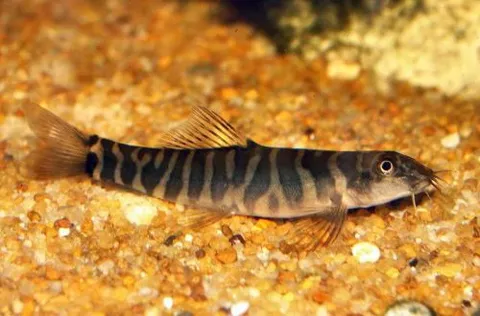
Mustura maepaiensis
The fish, known scientifically as Mustura maepaiensis, belongs to the family Nemacheilidae and is called Schistura Mae Hong Son. This name comes from the mountainous province of Mae Hong Son in north-western Thailand,…
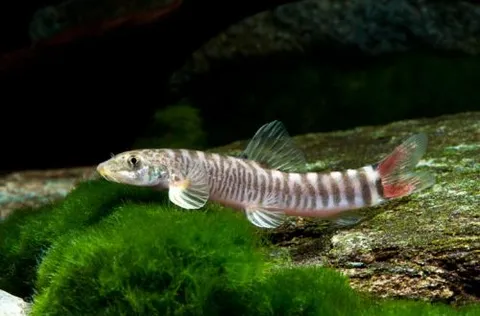
Schistura vinciguerrae
Schistura vinciguerrae, also known as Vinciguerra's loach, belongs to the family Nemacheilidae. It was named after the zoologist Decio Vinciguerra, who made significant contributions to the study of fish species…
Nemacheilus binotatus
A member of the Nemacheilidae family (stone loaches), the striped loach, known scientifically as Nemacheilus binotatus, originates from Southeast Asia. These fish are found in the waters of Thailand, particularly in the…