Temperature22 – 26 °C
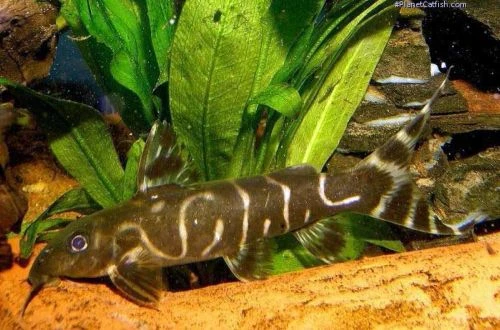
The scientific name Synodontis brichardi belongs to the family Mochokidae, known as upside-down catfish. This catfish is named after Pierre Brichard, a Belgian ichthyologist who made significant contributions to the study of African fish.
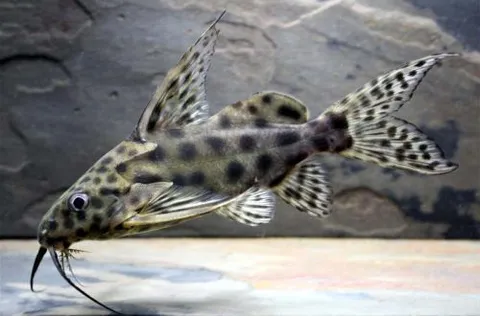
Adults can reach up to 15 cm in length. Life in strong currents has influenced their appearance: their bodies have become more flattened. They have a well-developed suckermouth, and their fins are short and rigid. The anterior rays have transformed into sharp, serrated spines, serving as protection against predators. Their coloration varies from brown to dark blue, with a pattern of beige stripes. In young individuals, the stripes are vertical and encircle the body, but with age, they acquire a more curved shape.
This catfish is native to Africa. It is found in the lower Congo River basin, inhabiting areas characterized by numerous rapids and waterfalls. These places are distinguished by turbulent water currents rich in oxygen.
This fish is distinguished by its peaceful and calm disposition. It coexists well with its conspecifics and with other species capable of adapting to similar turbulent conditions. It is recommended to avoid keeping them with territorial and aggressive fish.
For a small group of these fish, an aquarium of at least 100 liters will be optimal. The decor should include a gravel substrate, supplemented with large stones, boulders, and rock fragments that can be used to create shelters mimicking gorges. Various snags can also be added. Aquatic plants are not mandatory, but aquatic mosses and ferns attached to the surface of stones and snags are permissible. Strong current and a high concentration of dissolved oxygen are critically important for successful keeping. Additional pumps and an aeration system may be required. Water composition is not strict: Synodontis brichardi successfully adapts to a wide range of pH and GH values.
In their natural habitat, this species feeds on filamentous algae and microorganisms living on them. Therefore, the daily diet should include foods rich in fresh live components (e.g., bloodworms), as well as vegetable additives (flakes, spirulina tablets). Information.
Currently, there are no reliable reports of successful breeding of Synodontis brichardi in home aquariums. In natural conditions, spawning is presumed to occur during the rainy season, accompanied by river flooding. In commercial fish farms, hormonal injections are used to obtain offspring of this species.
The species has a strong immune system when water parameters are maintained, but it is sensitive to low levels of dissolved oxygen and the accumulation of organic waste. No characteristic species-specific diseases have been identified, but like other catfish, the fish can be susceptible to typical infections under stress or poor keeping conditions. It is important to avoid using aggressive chemical preparations, as catfish are extremely sensitive to their composition, and to monitor filtration quality to prevent skin lesions.
When purchasing, pay attention to the fish's activity in the evening, as the species is primarily nocturnal. A healthy individual should have clean fins without signs of erosion, intact barbels, and no white spots or ulcers on the body. Avoid purchasing fish with sunken bellies, which may indicate chronic emaciation or parasitic infestations. It is advisable to inquire at the store about the type of food the individual is accustomed to.
The essentials: size, tank volume, water parameters and care
An adult reaches 15 cm in length. Plan the tank around the maximum size: the fish quickly outgrows a cramped setup.
The recommended volume is 100 L. A smaller tank speeds up nitrate build-up and raises stress levels.
Temperature 22–26 °C, pH 6–8, hardness 5–20 dGH. Stability matters more than exact values: sudden swings are harder on the fish than a small deviation from the ideal.
Around 8 years when kept properly. Lifespan depends directly on tank volume, water quality and a varied diet.
Temperament: peaceful (regular). Keep this in mind when choosing tank mates.
Recommended setup: both solitary and in group (flexible). Ignoring this is a common cause of stress and disease.
Diet type: mixed diet (meat + plant-based). Feed small portions that are finished within a couple of minutes — overfeeding does more harm than underfeeding.
The scientific name of the species is Synodontis brichardi, family Mochokidae.
The water suits 197 of 208 plants in the catalogue — the easiest ones are shown first.
Afzelius's AnubiasAnacharisAnubiasBrazilian PennywortDwarf CloverDwarf CloverDwarf HygrophilaDwarf SagittariaDwarf ValGuppy GrassHornwortJava FernJava MossMoneywortMud SwordNair's LagenandraNarrow Leaf AnacharisNarrow-leaf CloverStringy MossSüsswassertangTaiwan MossTape GrassTemple PlantUssuri Watermilfoil
Matched by family, categories and overlapping keeping conditions
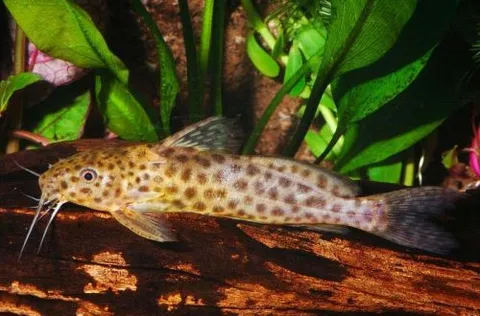
Synodontis camelopardalis
The Leopard Synodontis, scientifically known as Synodontis camelopardalis, belongs to the family Mochokidae, or upside-down catfishes. Its native habitat is the waters of Central Africa. This species is endemic to the…
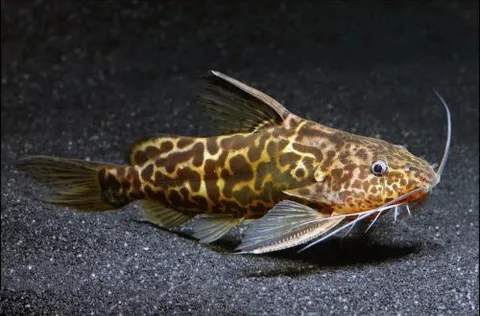
Synodontis schoutedeni
The Marbled Synodontis, or Synodontis schoutedeni, also known as Schouteden's Synodontis, belongs to the family Mochokidae. This catfish is popular due to its peaceful nature and unusual body pattern, as well as being…
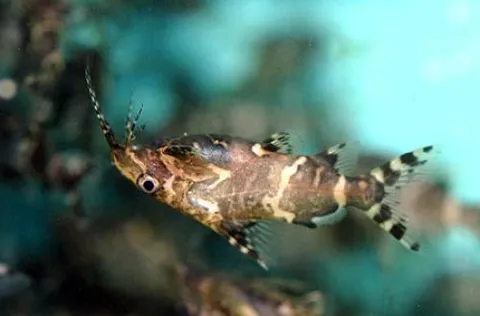
Synodontis nigriventris
The Upside-down Catfish, scientifically known as Synodontis nigriventris, belongs to the family Mochokidae. Its name accurately reflects the main characteristic of this species: it constantly swims upside down. It is…
Synodontis velifer
The scientific name Synodontis velifer is used to refer to the Synodontis velifer catfish, also known as the Sailfin Synodontis, a member of the family Mochokidae (Squeaker Catfishes). Native to West Africa, this fish…