Temperature18 – 22 °C
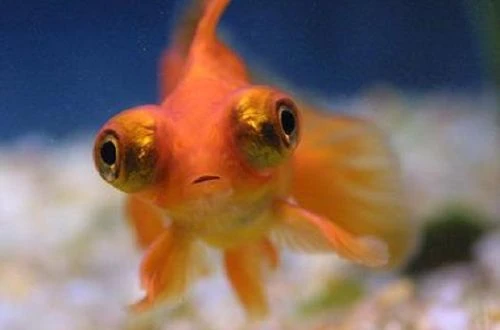
Without a doubt, the eyes are the most captivating feature of the Telescope Goldfish. These visual organs are prominently positioned on the sides of the head, protruding a significant distance on conical stalks. Notably, young fish do not possess such eyes; the characteristic protrusion only begins to develop around six months of age and reaches its final form in adult fish. Some collector specimens can boast eyes that protrude up to two centimeters! Otherwise, the "Telescope" can be characterized as a typical representative of a selective breeding form of Goldfish: it has a shortened, rounded body and a rather large head. The caudal fin is usually of moderate length and slightly forked. As for coloration, there is a great variety: red, chocolate, white, and even blue colors are found, as well as combined options where the body is adorned with an abundance of speckles of various colors and shades. Among these, the Black Moor (Black Telescope) is especially well-known, being one of the most popular color variations.
The Telescope Goldfish is a selectively bred form of goldfish, distinguished by its characteristic large, protruding eyes, resembling binoculars or a telescope. The body has a short, rounded, ovoid shape. The fins are well-developed, often veiled, and the caudal fin is usually double. Coloration can be diverse: black, red, orange, white, or calico. Sexual dimorphism is weakly expressed: during spawning, males develop small white tubercles on their gill covers and pectoral fins, while females become more rounded in the abdominal area.
This species is the result of centuries of artificial selection and does not occur in natural conditions. The ancestor of all goldfish is the wild crucian carp, which inhabits water bodies of East Asia. In aquarium conditions, Telescope Goldfish require cool water and stable environmental parameters, as their physiological characteristics, including eye and body shape, make them vulnerable to sudden changes in conditions.
These are calm and peaceful fish with a rather slow temperament. Due to the specific structure of their eyes, Telescope Goldfish have extremely poor vision, which makes them vulnerable in a community tank. They are incompatible with active, aggressive, or fin-nipping fish species. It is recommended to keep them in a group in a species-specific aquarium or with other slow-moving varieties of goldfish.
To keep Telescope Goldfish, a spacious rectangular aquarium with powerful filtration and aeration is necessary, as these fish produce a lot of organic waste. It is important to avoid sharp decorations, stones, and plants with stiff leaves, which could injure the fish's eyes. Fine, rounded sand or smooth gravel is preferred as substrate. The optimal water temperature is 18–23°C, pH 6.0–8.0, and hardness 5–19 dGH.
Telescope Goldfish are omnivorous and prone to overeating, so it is important to strictly control the amount of food. The diet should include a significant proportion of plant-based components. It is recommended to use special sinking pellets for goldfish to minimize air swallowing when feeding from the surface, which reduces the risk of swim bladder problems.
Spawning is paired or group, usually stimulated by increasing water temperature and frequent water changes. For breeding, a separate spawning tank of at least 50 L is required, with fine-leaved plants or an egg-laying substrate. After spawning is complete, the parents should be removed, as they are prone to eating their own clutch. Fry develop under standard water parameters.
The species is prone to diseases caused by poor water quality, including bacterial infections, fin rot, and eye lesions. Due to their body structure, these fish are susceptible to swim bladder disorders. Prevention involves maintaining cleanliness in the aquarium, regular water changes, and eliminating hazardous objects in the decor.
When purchasing, choose active individuals with clear, symmetrical eyes free of cloudiness, film, or mechanical damage. It is important to inspect the body for the absence of white spots, ulcers, or an unnaturally bloated abdomen. Avoid fish that stay at the surface or appear sluggish, as this may indicate health problems or improper keeping conditions at the store.
The essentials: size, tank volume, water parameters and care
An adult reaches 10–20 cm in length. Plan the tank around the maximum size: the fish quickly outgrows a cramped setup.
The recommended volume is 150 L. A smaller tank speeds up nitrate build-up and raises stress levels.
Temperature 18–22 °C, pH 6–8, hardness 5–19 dGH. Stability matters more than exact values: sudden swings are harder on the fish than a small deviation from the ideal.
Around 15 years when kept properly. Lifespan depends directly on tank volume, water quality and a varied diet.
Temperament: semi-peaceful (dangerous to smaller ones). Not a predatory species, but small fish that fit in its mouth will eventually be eaten.
Recommended setup: small group (3–4 individuals). Ignoring this is a common cause of stress and disease.
Diet type: any (universal). Feed small portions that are finished within a couple of minutes — overfeeding does more harm than underfeeding.
The scientific name of the species is Carassius auratus, family Cyprinids (Cyprinidae). It also appears in the literature as: Carasius auratus, Carassius buergeri, Carassius burgeri.
The water suits 196 of 208 plants in the catalogue — the easiest ones are shown first.
Afzelius's AnubiasAnacharisAnubiasBrazilian PennywortDwarf CloverDwarf CloverDwarf HygrophilaDwarf SagittariaDwarf ValGuppy GrassHornwortJava FernJava MossMoneywortMud SwordNarrow Leaf AnacharisNarrow-leaf CloverStringy MossSüsswassertangTaiwan MossTape GrassTemple PlantUssuri WatermilfoilWater Wisteria
Matched by family, categories and overlapping keeping conditions
Carassius auratus
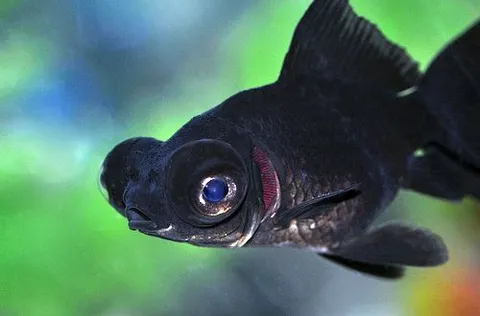
Among the varieties of Telescope Goldfish, the Black Moor stands out, known as the Black Moor Goldfish. This fish is easily recognized by its short, rounded or egg-shaped body and characteristic large eyes that…
Carassius auratus
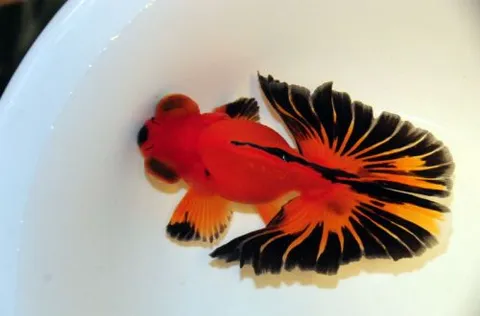
This relatively young goldfish breed only became widespread in the 1980s. It originated in China, although nowadays its main supplies come from Japan. This breed is the result of further selective breeding of the…
Carassius auratus
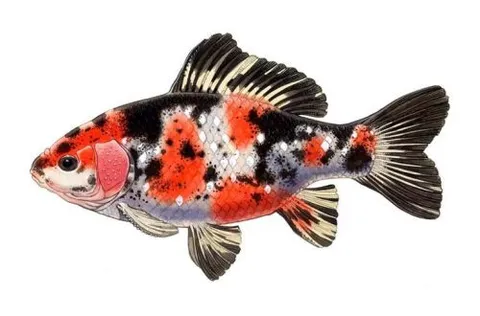
London Shubunkin is the trade name for this variety of fish. It originated from selective breeding between the common Goldfish and a short-tailed form of Shubunkin. A notable distinguishing feature of this breed is…
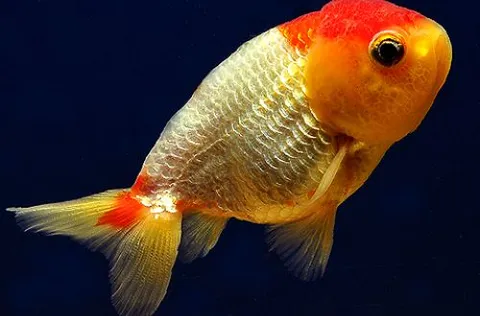
Carassius auratus
The Lionhead Goldfish attracts attention due to the unique growths forming a mane-like structure on its head. These growths are individual to each fish, and their presence is not a strict rule. Some individuals may…