Temperature18 – 22 °C
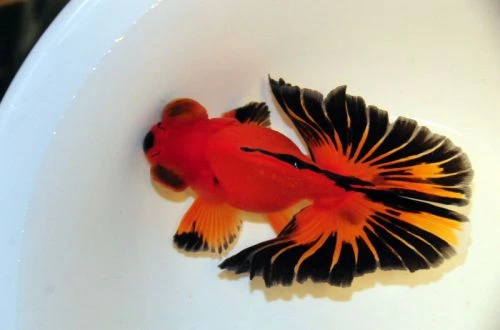
This relatively young goldfish breed only became widespread in the 1980s. It originated in China, although nowadays its main supplies come from Japan. This breed is the result of further selective breeding of the Telescope goldfish, inheriting many common features from it, such as the characteristic protruding eyes on the sides of the head.
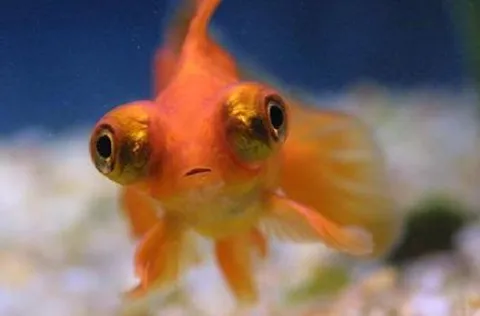
The Butterfly is a variety of the Telescope goldfish, and what sets it apart from other goldfish is the shape of its tail, which should be judged from above: the widely spread lobes of the double caudal fin genuinely resemble butterfly wings. In show specimens the tail spread approaches 180°, and viewed from above at rest it should open to at least 120°. The second defining feature is the telescope eyes on protruding stalks, which must always form a symmetrical pair. Juveniles have normal eyes; the protrusion develops gradually with age. The body is rounded and shortened, and the dorsal fin stands upright. Colours are varied: red, red-and-white, white, black, chocolate, blue, calico, and the popular panda pattern in black and white. Adults usually reach 12–20 cm, and individual fish grow larger in spacious tanks.
This fish has no natural range: the Butterfly is a man-made breed and does not occur in the wild. Its ancestor is the silver crucian carp, domesticated in China more than a thousand years ago. The variety itself took shape in China and reached Japan in the early 1980s, where breeders refined the tail shape and fixed new colours; most stock on the market comes from there. It is worth noting that the exact origin of the line is poorly documented — it began to be described systematically as a distinct breed only in the 1990s.
The Butterfly has a peaceful, unhurried temperament. It is a social fish best kept in a group of at least two, and over time it learns to take food from its keeper's hand. Two traits of the breed matter when choosing tank mates: the short, rounded body makes the fish slow and clumsy, while the structure of the telescope eyes impairs its vision. Suitable companions are therefore only equally placid short-bodied goldfish — veiltails, ryukins, orandas, ranchus, lionheads and other telescopes. Fast comets, shubunkins and common goldfish are not appropriate: they take the food before the Butterfly manages to find it. It should never be housed with fin-nipping species, cichlids, or tropical fish that require warmer water. Small shrimp and snails will sooner or later be eaten.
The most common mistake in goldfish keeping is insufficient volume, and it is the leading cause of premature death. A single fish needs from 75–115 litres, with about 40 litres added for each additional fish. The shape of the tank matters as much as its volume: an elongated, low aquarium with a large surface area is required, while tall 'tower' tanks are unsuitable for short-bodied breeds. A comfortable water level is around 30 cm. Temperature is kept between 18 and 23 °C, ideally 20–22 °C. Formally this is a cold-water fish and a heater is usually unnecessary, yet short-bodied breeds tolerate cold and fluctuations noticeably worse than common goldfish, which makes them unsuitable for cold ponds with overwintering. Sudden temperature swings during water changes directly trigger swim bladder problems. Because of the heavy waste load, powerful biological filtration turning over at least four tank volumes per hour is needed, while the current itself must stay gentle. Change 20–30% of the water weekly. Decor should be chosen with the vulnerable eyes in mind: fine sand or rounded gravel, no sharp rocks, driftwood or stiff artificial plants, and filter intakes should be covered.
The Butterfly is omnivorous. The diet is based on quality sinking pellets for goldfish, supplemented with live or frozen bloodworms, brine shrimp and daphnia, along with vegetable foods — blanched shelled green peas, courgette, spinach and lettuce. How the food is served is crucial. Snatching floating flakes from the surface makes the fish swallow air, which disrupts the swim bladder, so sinking foods are preferable, or dry pellets soaked in water for 10–15 minutes. Feed 2–3 times a day in small portions eaten within 2–3 minutes, and keep one fasting day per week. Excess protein leads to bloating and buoyancy problems. Because of the poor eyesight, food should remain available longer than other fish would need.
Butterflies are egg scatterers that release adhesive eggs; fertilisation is external and there is no parental care. Spawning is triggered by a gradual temperature rise imitating the shift from winter to spring: raise the water by 1–2 °C per day up to 20–23 °C while increasing protein-rich feeding. Use a spawning tank of 50–75 litres or more with a water level of about 30 cm, and be sure to add spawning mops of acrylic yarn or fine-leaved plants such as java moss, hornwort or elodea. The optimal ratio is one male to two or three females. Readiness is signalled by the characteristic white tubercles on the males' gill covers and pectoral fins as they begin chasing the female and nudging her flanks. Fecundity runs into hundreds and thousands of eggs. The breeders are removed immediately after spawning, otherwise they will eat the clutch. Incubation takes from two to seven days depending on temperature. The first food for the fry is brine shrimp nauplii. The telescope eyes and the characteristic tail shape appear gradually, and the final colouration develops over roughly two years.
The main breed-specific problem is impaired buoyancy and swim bladder function. The cause is anatomical: the shortened, rounded body deforms and compresses the swim bladder. The situation is aggravated by constipation from a lack of plant matter, air swallowed with floating food, overfeeding and abrupt temperature changes. Prevention is simple: sinking or pre-soaked food, vegetables in the diet, a weekly fasting day, a stable 20–23 °C and small portions. The second typical problem is injury to the protruding eyes on sharp decor, rocks, driftwood or a filter intake, as well as from attacks by unsuitable tank mates. A damaged eye, or one weakened by poor water, easily develops a secondary infection: popeye and cloudy cornea, potentially ending in loss of the eye. Remember that in telescopes the normal eye protrusion is symmetrical, so one-sided swelling is always a sign of pathology that calls for isolating the fish and, first of all, checking water quality. Among general ailments, ich, bacterial infections, fin rot and fungal lesions occur; nearly all are prevented by adequate volume, clean water and quarantine for new arrivals.
When choosing a fish, examine the eyes first: they should match in shape and size, be clear, free of cloudiness, corneal scratches and one-sided swelling. At rest the tail should open widely, with lobes that are not stuck together and show no tears or reddening along the edges; some drooping of a heavy tail is normal. Be sure to watch how the fish sits in the water: a healthy specimen swims level, does not list to one side, does not stick to the bottom and does not float belly-up — the quickest way to screen for swim bladder problems. The dorsal fin should stand upright and the body should look symmetrical from above, without spinal curvature. Bear in mind that shops usually stock juveniles of 2.5–3 cm in which neither the telescope eyes nor the tail shape have developed yet. Beginners are better off with the traditional colours — red, red-and-white and black — as such fish are generally hardier than rare colour forms.
The essentials: size, tank volume, water parameters and care
An adult reaches 12–20 cm in length. Plan the tank around the maximum size: the fish quickly outgrows a cramped setup.
The recommended volume is 100 L. A smaller tank speeds up nitrate build-up and raises stress levels.
Temperature 18–22 °C, pH 6–8, hardness 5–19 dGH. Stability matters more than exact values: sudden swings are harder on the fish than a small deviation from the ideal.
Around 15 years when kept properly. Lifespan depends directly on tank volume, water quality and a varied diet.
Temperament: semi-peaceful (dangerous to smaller ones). Not a predatory species, but small fish that fit in its mouth will eventually be eaten.
Recommended setup: both solitary and in group (flexible). Ignoring this is a common cause of stress and disease.
Diet type: any (universal). Feed small portions that are finished within a couple of minutes — overfeeding does more harm than underfeeding.
The scientific name of the species is Carassius auratus, family Cyprinids (Cyprinidae). It also appears in the literature as: Pantodon buchholtzi.
The water suits 196 of 208 plants in the catalogue — the easiest ones are shown first.
Afzelius's AnubiasAnacharisAnubiasBrazilian PennywortDwarf CloverDwarf CloverDwarf HygrophilaDwarf SagittariaDwarf ValGuppy GrassHornwortJava FernJava MossMoneywortMud SwordNarrow Leaf AnacharisNarrow-leaf CloverStringy MossSüsswassertangTaiwan MossTape GrassTemple PlantUssuri WatermilfoilWater Wisteria
Matched by family, categories and overlapping keeping conditions
Carassius auratus
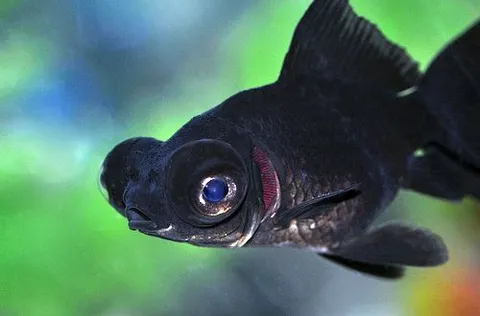
Among the varieties of Telescope Goldfish, the Black Moor stands out, known as the Black Moor Goldfish. This fish is easily recognized by its short, rounded or egg-shaped body and characteristic large eyes that…
Carassius auratus
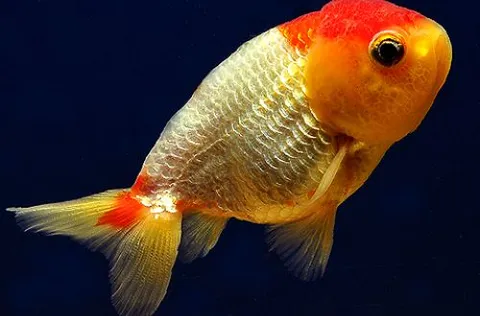
The Lionhead Goldfish attracts attention due to the unique growths forming a mane-like structure on its head. These growths are individual to each fish, and their presence is not a strict rule. Some individuals may…
Carassius auratus
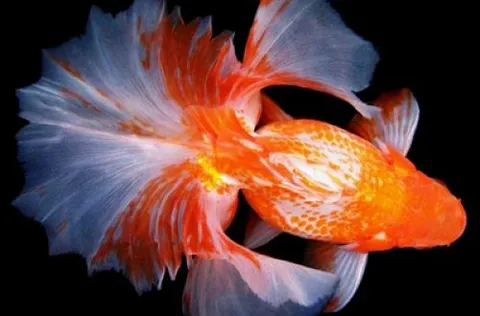
Among the many goldfish varieties, the Tosakin Goldfish stands out for its unique originality. Its main asset is a luxurious fan-shaped caudal fin, which reaches its maximum spread in the horizontal plane. Therefore,…
Carassius auratus
Without a doubt, the eyes are the most captivating feature of the Telescope Goldfish. These visual organs are prominently positioned on the sides of the head, protruding a significant distance on conical stalks.…