Temperature22 – 28 °C
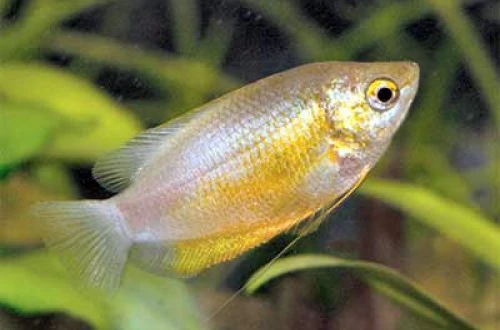
Trichogaster labiosa, more commonly known as the Thick-lipped Gourami or Labiosa, belongs to the family Osphronemidae. This fish will be a wonderful addition to any aquarium. Thanks to its modest size and natural, attractive coloration, it resembles the Gold Gourami or some varieties of Dwarf Gourami. There is not only an external resemblance between the listed species but also a close kinship, even to the point of producing hybrid offspring, which often causes confusion. It is common in pet stores to find similar species, as well as their hybrids, sold under the name "Thick-lipped Gourami."
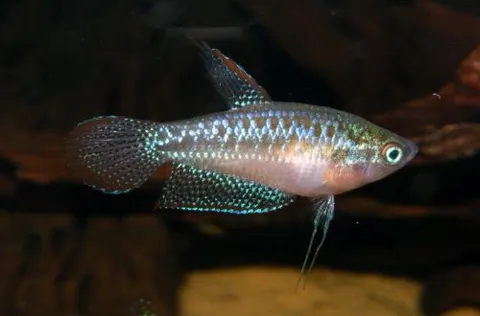
The fish has an oval body, pointed and somewhat compressed laterally. The dorsal and anal fins start approximately from the middle of the body and extend towards the caudal fin, gradually widening towards the end. The pelvic fins, which are thin filaments, are very sensitive and serve the fish for sensing its surroundings. Like other labyrinth fish, the Labiosa has a unique organ that allows it to absorb atmospheric oxygen by gulping air bubbles from the water's surface. This labyrinth organ is located in the oral cavity and looks like a small sac permeated with many capillaries, resembling a miniature labyrinth. The main body coloration is orange or yellowish-brown in the front part. Males are distinguished by turquoise stripes running vertically across the entire body from head to caudal fin, and during spawning, their coloration becomes brighter. Females typically have an olive color, and their stripes are almost indistinguishable. There are also artificially bred variations with more pronounced coloration, featuring red, orange, and yellow hues.
Initially the range of this species was limited to southern Myanmar (Burma) in Southeast Asia; it was first scientifically described in 1877. Over time, the Thick-lipped Gourami was introduced to South America, where it became particularly widespread in Colombia. These fish can be found in various bodies of water: rivers, ponds, irrigation canals, and even rice paddies. They prefer areas with slow currents and an abundance of both rooted and floating plants. In their natural environment, their diet consists of small invertebrates, various insects, and other zooplankton.
Gourami are peaceful fish that may exhibit extreme shyness in a new aquarium, sometimes even losing their vibrant coloration initially. When choosing tank mates, it's important to consider the temperament and size of these fish. Ideal companions will be calm and peaceful species of similar size. Overly active or aggressive fish can easily frighten Gourami, forcing them to constantly seek refuge, experience stress, and even refuse food. It is also not recommended to keep this species with territorial fish or those prone to nipping the fins of other aquarium inhabitants, such as Barbs. In such conditions, the Thick-lipped Gourami will quickly become an easy target. Although Gourami exhibit a weakly expressed intraspecific hierarchy, it is significantly less aggressive than some of their relatives. These fish thrive in groups of 5 or more individuals without significant conflicts.
For a small group of two or three individuals of this species, an aquarium of 60 to 70 liters will suffice. It is important to equip the aquarium with a lid. This is necessary not only to prevent accidental foreign objects from entering the water but also to create a warm air layer above the surface. This significantly reduces the risk of damage to the fish's labyrinth organ when they gulp air, due to temperature contrast. The essential equipment set includes a filter, heater, lighting system, and aerator. The filter should be powerful enough but minimize water movement, as Labiosa poorly tolerate even weak currents within the aquarium. It is recommended to refresh 25% of the water weekly and carefully monitor pH and dH parameters. Unlike some of its relatives, the Thick-lipped Gourami requires a narrower range for these indicators. The aquarium decor should include many rooted and floating plants, arranged in groups to leave open swimming areas. It is important that floating plants do not prevent the fish from freely rising to the surface for another gulp of air. Shelters such as driftwood, caves, or tree roots should also be provided; their number should correspond to the number of fish in the aquarium. A dark substrate will help to highlight and enhance the fish's coloration.
Although the Thick-lipped Gourami prefers meaty foods, in a home aquarium, it easily adapts to dry commercial foods, provided they are of high quality. To maintain a complete diet, it is recommended to combine dry foods (e.g., flakes or granules) with live food, such as bloodworms. Additionally, it is advisable to offer vegetable supplements once or twice a week, for example, in the form of dried flakes or special vegetable tablets available in pet stores.
The Thick-lipped Gourami is one of the easiest species to breed, however, a separate aquarium will be required for successful spawning, as parents tend to eat their offspring. The spawning aquarium, with a volume of 20 liters, should only be filled with water to a depth of 15 cm, while other water parameters should match those of the main aquarium. Equipment will be limited to a simple sponge filter combined with an aerator, a heater, and a lighting system, such as a desk lamp. It is important to provide a sufficient number of plants, including floating ones, preferably with large leaves. Spawning can be stimulated by including meaty foods in the daily diet and maintaining the water temperature between 26–29°C. During this period, the pair should be separated: the male is placed in the spawning aquarium, while the female remains in the community tank. Within a few weeks, the female will begin to develop eggs, and the male will start building a nest. The nest can reach impressive sizes, occupying up to half of the water surface. After the nest is completed, the pair is reunited, and the courtship process begins. The male will swim back and forth next to the female, with fins and tail raised, then they approach each other, and the male seems to wrap his body around the female. At one time, the female releases several eggs, which are immediately fertilized and transferred to the nest. Adults can lay up to 500 eggs. After spawning, the female is returned to the community tank, and the male remains to guard the clutch until the fry appear. After this, the male should also be returned, otherwise, he may eat the fry. Fry should be fed micro-foods and infusoria.
The Thick-lipped Gourami is a very hardy and undemanding fish. In a balanced aquarium with an established biological system, health problems usually do not arise. Disease outbreaks only occur with significant deterioration of keeping conditions, poor nutrition, or contact with sick fish.
When selecting healthy individuals, pay attention to the fish's activity and the cleanliness of their skin. Absence of visible damage, ulcers, film, or signs of emaciation is a mandatory condition. It is important to observe their behavior: healthy gourami show curiosity, swim in the water column, and do not constantly hide in the corners of the aquarium. Avoid purchasing fish that appear lethargic, stay near the water surface with labored breathing, or have clamped fins. There is a risk of acquiring hybrid forms, as the species often interbreeds with closely related members of the family. When purchasing, it is recommended to inquire about the keeping conditions at the store and carefully inspect neighboring aquariums for signs of disease, as infectious lesions can quickly spread in shared filtration systems.
The essentials: size, tank volume, water parameters and care
An adult reaches 10 cm in length. Plan the tank around the maximum size: the fish quickly outgrows a cramped setup.
The recommended volume is 60 L. A smaller tank speeds up nitrate build-up and raises stress levels.
Temperature 22–28 °C, pH 6–7.5, hardness 4–10 dGH. Stability matters more than exact values: sudden swings are harder on the fish than a small deviation from the ideal.
Around 7 years when kept properly. Lifespan depends directly on tank volume, water quality and a varied diet.
Temperament: peaceful (regular). Keep this in mind when choosing tank mates.
Recommended setup: mixed (solitary / pair / group). Ignoring this is a common cause of stress and disease.
Diet type: any (universal). Feed small portions that are finished within a couple of minutes — overfeeding does more harm than underfeeding.
The scientific name of the species is Trichogaster labiosa, family Osphronemidae. It also appears in the literature as: Colisa labiosus.
The water suits 197 of 208 plants in the catalogue — the easiest ones are shown first.
Afzelius's AnubiasAnacharisAnubiasBrazilian PennywortDwarf CloverDwarf CloverDwarf HygrophilaDwarf SagittariaDwarf ValGuppy GrassHornwortJava FernJava MossMoneywortMud SwordNair's LagenandraNarrow Leaf AnacharisNarrow-leaf CloverStringy MossSüsswassertangTaiwan MossTape GrassTemple PlantUssuri Watermilfoil
Matched by family, categories and overlapping keeping conditions
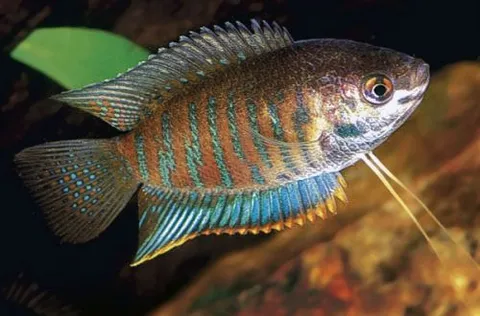
Trichogaster fasciata
Trichogaster fasciata, also known as the Banded Gourami or Striped Gourami, belongs to the family Osphronemidae. This fish possesses a range of qualities that make it an excellent choice for beginner aquarists: it is…
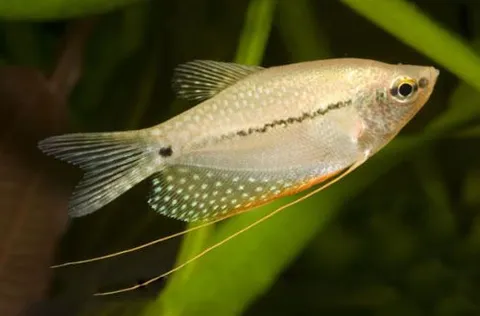
Trichopodus leerii
The Pearl Gourami, known scientifically as Trichopodus leerii, is a member of the Osphronemidae family. This fish is rightfully considered one of the most attractive among freshwater aquarium inhabitants. Its name is…
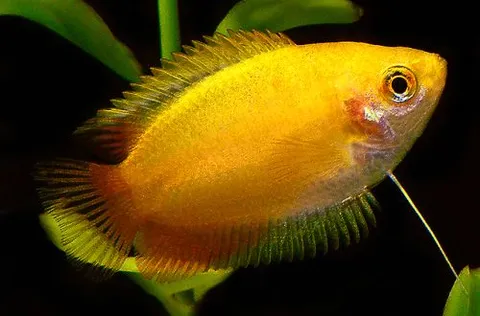
Trichogaster chuna
Trichogaster chuna, more commonly known as the Honey Gourami, is a member of the Osphronemidae family. This small, graceful fish is characterized by its soft coloration, ranging from silvery-gray to delicate yellow.…
Trichopsis pumila
The Dwarf Gourami, or Pumila, known scientifically as Trichopsis pumila, is a member of the Osphronemidae family. This aquarium fish is popular due to its interesting coloration, as well as its ease of care and…