Temperature23 – 26 °C
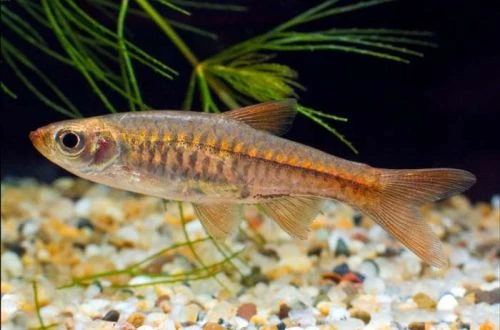
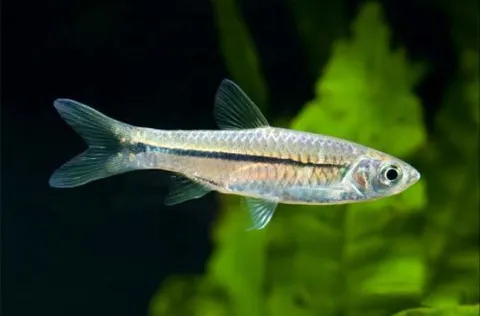
The scientific name Rasbora vulcanus belongs to the Volcano Rasbora, a member of the family Cyprinidae, or carps. Its name is quite remarkable and has a simple explanation: dominant males display a bright orange-red coloration, reminiscent of molten lava. A story that the fish was found at the foot of an active volcano also circulates, but the type specimens were collected in western Sumatra, almost two hundred kilometres from the nearest volcano.
Adult specimens of this fish reach a length of about 4 cm. The coloration of non-dominant males is less vibrant, appearing in golden, orange, or even pinkish tones, the intensity of which depends on the lighting. Large scales have a faintly discernible dark outline. Outwardly, they resemble a slightly larger species from the same genus — the Reticulated Rasbora. Females appear larger, their coloration is silvery, and a distinct dark stripe is visible along the lateral line.
The species is endemic to the western part of Sumatra Island, Indonesia. In nature, it inhabits clean flowing waters, preferably small rivers and streams. Optimal living conditions are characterized by soft to moderately hard water with neutral to slightly acidic pH values and a temperature range of 23–26°C.
The Volcano Rasbora can be an excellent addition to a community of peaceful fish of similar size, thanks to its calm temperament and adaptability to a wide range of conditions. These fish prefer to stay in schools, so a group of 8–10 individuals is recommended for them.
For a small school of these fish, the optimal aquarium volume starts from 60–70 liters. The aquascape can be chosen arbitrarily, but it will be better if the keeping conditions are close to their natural habitat. Dim lighting is recommended, which can be achieved with floating plants that create additional shade. Dark substrate is preferred. The presence of shelters, such as snags and dense thickets of rooted plants, is highly desirable. The fish can jump out of the aquarium, so a lid is essential. They adapt well to various hydrochemical parameters, which simplifies water preparation during aquarium maintenance. It is important to weekly replace a portion of the water with fresh water and remove accumulated organic waste for long-term well-being. This is an omnivorous species that readily accepts most popular aquarium foods of appropriate size.
This omnivorous species readily consumes most popular aquarium foods of appropriate size.
Spawning of these fish often occurs in a favorable environment. After a brief courtship period, they lay their eggs among plant thickets. There is no parental care, so the eggs and fry can become prey for adult fish. The incubation period lasts up to 2 days, its duration depending on water temperature. After another 1–2 days, the hatched fry begin to swim freely, actively searching for food. Feeding is done with specialized powdered foods, suspensions, and, if possible, Artemia nauplii.
No specific species-specific diseases have been identified. Like other cyprinids, these fish are sensitive to sharp fluctuations in water hydrochemical parameters and the accumulation of organic waste, which can lead to reduced immunity and the development of bacterial infections. An important aspect of prevention is maintaining a stable biological environment in the aquarium and regular water changes.
When purchasing, choose active individuals with clean fins and no visible damage to their scales. Healthy fish should exhibit schooling behavior. It is recommended to avoid acquiring individuals that appear apathetic, emaciated, or show signs of atypical coloration, as this may indicate stress or hidden diseases. It should be noted that bright males are more often available for sale, while females may appear duller.
The essentials: size, tank volume, water parameters and care
An adult reaches 4 cm in length. Plan the tank around the maximum size: the fish quickly outgrows a cramped setup.
The recommended volume is 60 L. A smaller tank speeds up nitrate build-up and raises stress levels.
Temperature 23–26 °C, pH 6.5–7.5, hardness 1–15 dGH. Stability matters more than exact values: sudden swings are harder on the fish than a small deviation from the ideal.
Around 4 years when kept properly. Lifespan depends directly on tank volume, water quality and a varied diet.
Temperament: peaceful (regular). Keep this in mind when choosing tank mates.
Recommended setup: group (8–10 individuals). Ignoring this is a common cause of stress and disease.
Diet type: any (universal). Feed small portions that are finished within a couple of minutes — overfeeding does more harm than underfeeding.
The scientific name of the species is Rasbora vulcanus, family Cyprinids (Cyprinidae).
The water suits 197 of 208 plants in the catalogue — the easiest ones are shown first.
Afzelius's AnubiasAnacharisAnubiasBrazilian PennywortDwarf CloverDwarf CloverDwarf HygrophilaDwarf SagittariaDwarf ValGuppy GrassHornwortJava FernJava MossMoneywortMud SwordNair's LagenandraNarrow Leaf AnacharisNarrow-leaf CloverStringy MossSüsswassertangTaiwan MossTape GrassTemple PlantUssuri Watermilfoil
Matched by family, categories and overlapping keeping conditions
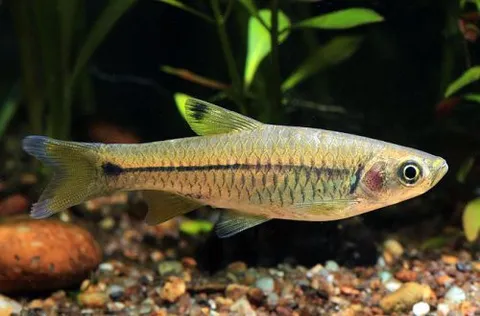
Rasbora dorsinotata
Rasbora dorsinotata, also known by its scientific name Rasbora dorsinotata, belongs to the Cyprinidae family. It is quite rare in aquariums, which is most often explained by its somewhat less striking coloration…
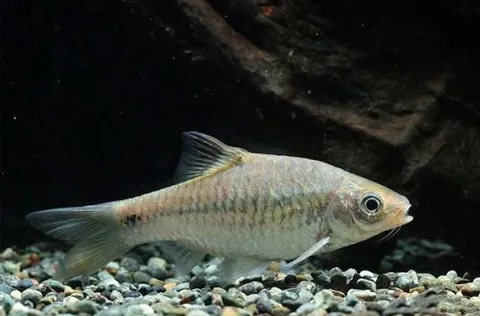
Barbodes binotatus
Barbodes binotatus, known as the Spotted Barb, belongs to the family Cyprinidae, or carps. This species, a typical inhabitant of Southeast Asian waters, is also called the Common Barb.
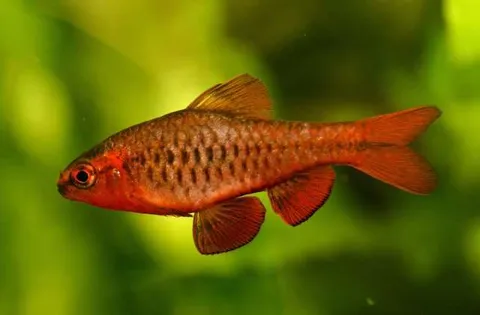
Puntius titteya
This species, the Cherry Barb, or Cherry Puntius (Puntius titteya), belongs to the Cyprinidae family. Thanks to its vibrant red coloration, this fish can brighten up any aquarium. It easily becomes a true pet due to its…
Rasbora paviana
The scientific name Rasbora paviana belongs to the family Cyprinidae, or carps. It is quite common to encounter the mistaken assumption that the name "Paviana" is associated with primates. However, this is not the case:…