Temperature24 – 28 °C
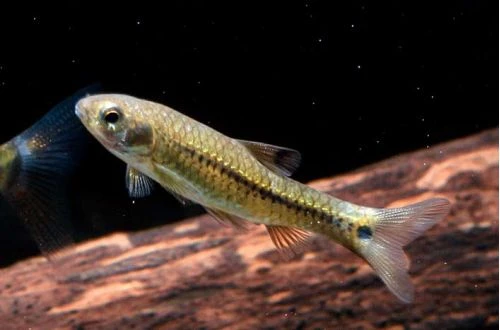
The fish known as the African barb (scientific name Enteromius pobeguini) was previously classified as Puntius pleurops. It is a member of the carp family (Cyprinidae) and originates from the equatorial regions of West Africa. It can be found virtually everywhere in most river systems of this region.
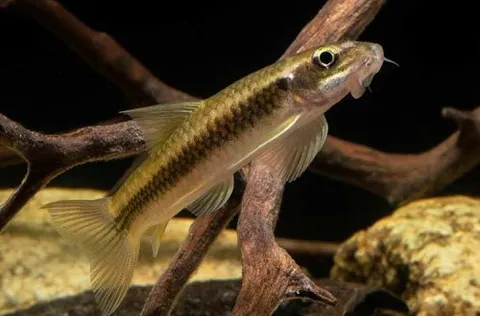
An adult barb typically reaches a length of approximately 5 cm. Its coloration is quite subdued: the body is grey, and the fins appear translucent. A characteristic pattern includes a thin black stripe that starts from the center of the body and continues to the tail, ending in a small spot. Additionally, a dark speckle is noticeable on the dorsal fin. Overall, it is a calm and inconspicuous fish.
The African barb inhabits the equatorial part of West Africa. It is found in many river systems of the region, populating diverse biotopes – from mountain streams to swampy areas. In nature, the species adapts to a wide range of conditions, preferring places with cover and a soft substrate.
This is a peaceful schooling fish that coexists well with its own kind and with other non-aggressive species of comparable size. Its unpretentiousness to environmental conditions significantly expands the circle of potential tank mates.
Thanks to its extensive natural range, which covers many biotopes – from mountain streams to swamps, the African barb demonstrates excellent adaptability to significant fluctuations in water hydrochemical parameters. This feature significantly simplifies the tasks of water preparation in the aquarium. The fish is also not demanding regarding aquascape style, but if kept with larger species, it is recommended to provide shelters made of driftwood and dense plant thickets. Since the barb likes to rummage in the substrate, it is advisable to arrange a soft substrate. Otherwise, the choice of decorations remains at the discretion of the aquarist, based on their preferences and capabilities. Keeping barbs is not difficult and includes standard care: weekly partial water changes with fresh water, cleaning of organic waste, and maintenance of aquarium equipment.
African barbs spend most of their time near the bottom, so when choosing food, preference should be given to products that quickly sink to the bottom.
The African barb reproduces by spawning. Spawning can occur both in pairs and in groups, for which a separate aquarium with a bottom area of at least 50 by 50 cm is required, equipped with a separator mesh at the bottom to protect the eggs. The optimal water temperature to stimulate spawning is about 25°C. During spawning, the fish actively seek support among plants. After the process is complete, the parents should be removed, and the eggs are recommended to be treated with methylene blue to prevent fungal infection. Fry grow quickly with intensive feeding and reach about one centimeter in size by three weeks of age.
No specific diseases for this species have been identified. Like other cyprinids, fish can be susceptible to typical aquarium fish diseases if living conditions are violated, water quality is poor, or stress is caused by improper selection of tank mates. Prevention involves maintaining stable water parameters and regular aquarium maintenance.
When purchasing, choose active fish with clean fins and no visible damage, ulcers, or film on the body. It is recommended to avoid individuals with signs of emaciation, sluggish behavior, or an unnaturally bloated abdomen. Since this is a schooling species, a group of 6–8 individuals should be acquired to reduce stress levels.
The essentials: size, tank volume, water parameters and care
An adult reaches 5 cm in length. Plan the tank around the maximum size: the fish quickly outgrows a cramped setup.
The recommended volume is 100 L. A smaller tank speeds up nitrate build-up and raises stress levels.
Temperature 24–28 °C, pH 6.5–7.5, hardness 5–15 dGH. Stability matters more than exact values: sudden swings are harder on the fish than a small deviation from the ideal.
Around 3 years when kept properly. Lifespan depends directly on tank volume, water quality and a varied diet.
Temperament: peaceful, calm/shy/inactive. Keep this in mind when choosing tank mates.
Recommended setup: medium group (6–8 individuals). Ignoring this is a common cause of stress and disease.
Diet type: sinking (any). Feed small portions that are finished within a couple of minutes — overfeeding does more harm than underfeeding.
The scientific name of the species is Enteromius pobeguini, family Cyprinids (Cyprinidae). It also appears in the literature as: Afropuntio pobeguini, Barbus mirei, Barbus pobeguini.
The water suits 196 of 208 plants in the catalogue — the easiest ones are shown first.
Afzelius's AnubiasAnacharisAnubiasBrazilian PennywortDwarf CloverDwarf CloverDwarf HygrophilaDwarf SagittariaDwarf ValGuppy GrassHornwortJava FernJava MossMoneywortMud SwordNair's LagenandraNarrow Leaf AnacharisNarrow-leaf CloverStringy MossSüsswassertangTaiwan MossTape GrassTemple PlantUssuri Watermilfoil
Matched by family, categories and overlapping keeping conditions
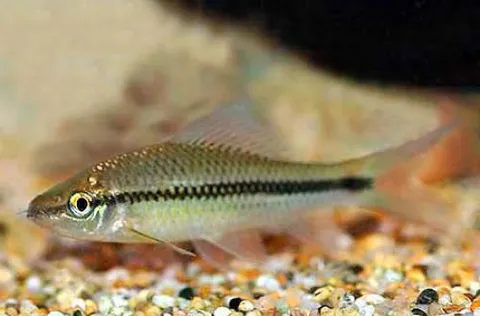
Osteochilus microcephalus
The fish, known in the scientific world as Osteochilus microcephalus, belongs to the family Cyprinidae. Its homeland is Southeast Asia, with its natural habitat covering significant territories, stretching from Thailand…
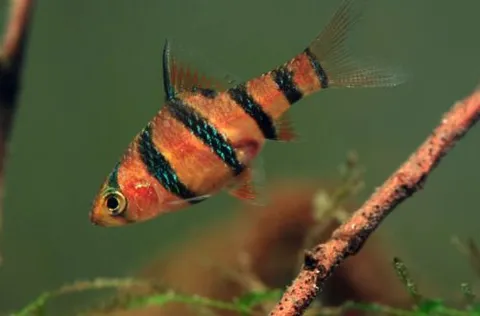
Desmopuntius pentazona
The Five-banded Barb, scientifically known as Desmopuntius pentazona, belongs to the carp family (Cyprinidae). This active and attractive fish is not overly demanding to keep, provided the aquarium is set up according…
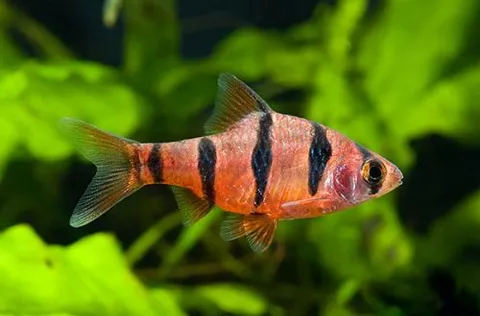
Desmopuntius hexazona
The Six-banded Barb, scientifically known as Desmopuntius hexazona, belongs to the family Cyprinidae. This peaceful, energetic, and vibrant fish will perfectly complement the inhabitants of your freshwater aquarium.
Garra ceylonensis
The Ceylon Garra, known scientifically as Garra ceylonensis, belongs to the carp family (Cyprinidae). As its name suggests, this species is endemic to Sri Lanka, formerly known as Ceylon, an island located in the Indian…