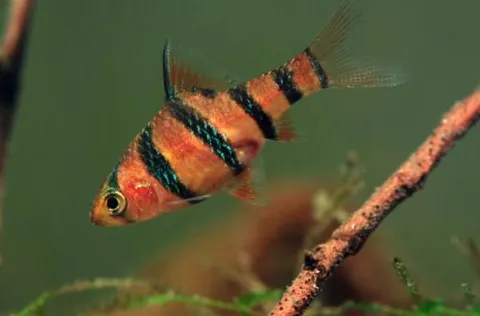
Outwardly, this species is practically indistinguishable from its close relative, the Five-banded Barb. One might assume that the key difference lies in the number of dark stripes, but this is not the case. Both species have the same number of stripes — five distinct ones and a sixth one, located at the base of the tail, which is not always visible. This discrepancy in the number of stripes even led to a slight mishap in their scientific names. The main difference of the Six-banded Barb is the absence of a small black spot on the posterior part of the dorsal fin, which is characteristic of the Five-banded Barb. Adult specimens grow to approximately 5 cm in length. Their coloration is light, with delicate pink, orange, or red iridescence, and the pattern consists of 5–6 vertical dark stripes. Sexual dimorphism is quite weakly expressed; females are usually slightly larger than males, but their coloration is less vibrant.