Temperature21 – 26 °C
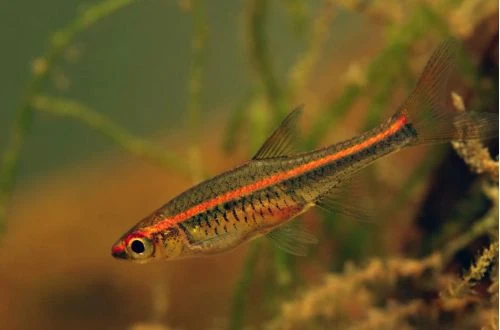
The Red-striped Rasbora (Trigonopoma pauciperforatum), belonging to the family Cyprinidae, is a beautiful, calm, and peaceful schooling fish, notable for its unpretentiousness. These qualities make it a very popular choice among aquarists, especially when favorable conditions are created to avoid problems with its keeping.
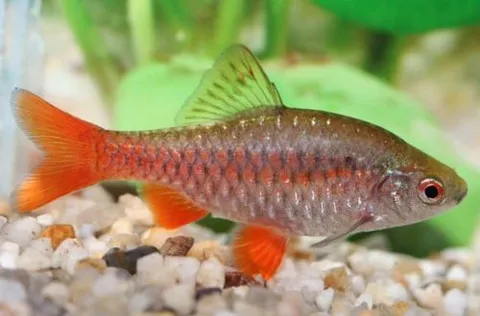
Adults reach up to 6 cm in length. Their coloration is gray with a faint greenish tint, and they have large scales with a distinct dark outline, which gives the fish a characteristic reticulated pattern. A distinctive feature of this species is a bright red horizontal stripe running from head to tail. The color of this stripe can vary from dark orange to golden, depending on the fish's origin. Interestingly, in females during spawning, when the abdomen is filled with eggs, the stripe becomes curved, whereas in males it always remains straight.
The homeland of this species is Southeast Asia, specifically the territories of modern Malaysia, including the islands of Borneo and Sumatra. There is also data indicating its presence in the southern parts of Thailand and Cambodia. The Red-striped Rasbora inhabits small rivers and streams located under the canopy of tropical forests, which are often associated with ancient peat bogs. This gives the water a rich tea-like hue. The bottom in such places is usually covered with fallen leaves, as well as various snags, branches, and tree roots.
This is a calm schooling species, and it is recommended to keep them in a group of at least 8–10 individuals. The Red-striped Rasbora will fit perfectly into a peaceful community tank with fish from the same habitat, coexisting well with species of similar size and temperament. It is important to avoid overly active or large fish that may push smaller neighbors away in the struggle for food.
Optimal aquarium decoration for these fish involves using a soft dark substrate and dense plantings of aquatic plants such as Microsorum pteropus, Java Fern, Cryptocorynes, and Anubias. It is also recommended to place several snags in such a way that they create many shaded areas. To enhance the natural look, dried tree leaves are often used, which are pre-soaked so they do not float. To give the water a characteristic “tea” color and achieve slightly acidic pH values, a bag of alder cones can be placed at the bottom. A similar effect is achieved using a filter containing alder cone filter material. The filtration system, in addition to its primary function, also creates water movement in the aquarium, which in this case should be minimized, as the Red-striped Rasbora tolerates even weak currents poorly. The hydrochemical composition of the water with acidic pH values and low carbonate hardness is important. Water quality is key: fish are very sensitive to the accumulation of organic waste, so weekly replacement of 15–20% of the water with fresh water and regular substrate cleaning are mandatory measures.
In a home aquarium, these fish readily accept a variety of foods: dry, frozen, and live, of appropriate size. A diet predominantly consisting of meaty products, such as bloodworms, insect larvae, and large daphnia, can provide the fish with essential micronutrients and promote their best coloration.
The Red-striped Rasbora belongs to the egg-laying species; females scatter their eggs in the water column, and males immediately fertilize them. However, their parental instincts are poorly developed: after spawning, the fish may eat their own eggs and newly hatched fry. For successful breeding, it is recommended to use a separate spawning aquarium to ensure the safety of the offspring. The setup of the spawning tank is quite simple, but special attention is paid to the substrate: it should consist of sufficiently large particles, such as pebbles or decorative glass beads, which do not fit tightly together, creating voids. When the eggs sink to the bottom, most of them fall into these voids, becoming inaccessible to adult fish. A similar effect can be achieved by using a fine-mesh net fixed to the bottom. Another way to protect the eggs is to use low-growing, small-leaved plants or mosses, such as Riccia fluitans and Java moss, which are planted over most of the substrate (in this case, any substrate can be used). Dense thickets of plants create a reliable hiding place for the eggs just as well as a special substrate. The volume of the spawning aquarium is usually 30–40 liters. Equipment required includes an aerator, a heater, and a low-power sponge filter to avoid accidentally sucking in eggs and fry. Spawning occurs in dim light, so a light source is not needed at the initial stage. The stimulus for spawning is setting the water temperature at the upper permissible limits with a slightly acidic pH value, as well as daily feeding with protein-rich food (live or frozen). After some time, the females become noticeably rounded, and the males begin to actively show attention to their chosen mates. By this point, a separate tank should be prepared, filled with water from the main aquarium, and several females and the brightest males should be moved there. Spawning can be initiated by adding cool water every few hours to lower the temperature by 2–3 degrees. Spawning can last 4–5 days, as females lay eggs in portions. Its end can be determined by the slimness of the females. After this, the fish are returned to the main aquarium. Fry will hatch in 24–48 hours, and after another 3–4 days, they will begin to swim freely. They should be fed with specialized micro-food for aquarium fish fry.
Balanced nutrition and properly selected keeping conditions are the best prevention of diseases in freshwater fish. If the first signs of illness appear, such as changes in coloration or behavior, the first step should be to check the water parameters and quality. If necessary, all values should be brought back to normal, and only then should treatment begin.
When choosing Red-striped Rasboras, attention should be paid to the overall activity and behavior of the school in the display tank. Healthy individuals should be active, constantly moving, and show no signs of apathy or attempts to hide in corners. Avoid purchasing fish with visible scale damage, film on the body, signs of emaciation, or an unnaturally bloated abdomen. Given the species' natural shyness, fish may temporarily pale in the store due to stress, but their coloration should quickly recover in a calm environment. It is recommended to acquire a group of 8–10 individuals at once, as when alone or in too small a group, these fish experience severe stress, which negatively affects their immunity and adaptation to new conditions after transportation.
The essentials: size, tank volume, water parameters and care
An adult reaches 6 cm in length. Plan the tank around the maximum size: the fish quickly outgrows a cramped setup.
The recommended volume is 80 L. A smaller tank speeds up nitrate build-up and raises stress levels.
Temperature 21–26 °C, pH 4–7.5, hardness 1–12 dGH. Stability matters more than exact values: sudden swings are harder on the fish than a small deviation from the ideal.
Around 4 years when kept properly. Lifespan depends directly on tank volume, water quality and a varied diet.
Temperament: peaceful, calm/shy/inactive. Keep this in mind when choosing tank mates.
Recommended setup: group (8–10 individuals). Ignoring this is a common cause of stress and disease.
Diet type: any (universal). Feed small portions that are finished within a couple of minutes — overfeeding does more harm than underfeeding.
The scientific name of the species is Trigonopoma pauciperforatum, family Cyprinids (Cyprinidae). It also appears in the literature as: Rasbora agilis, Rasbora pauciperforata.
The water suits 198 of 208 plants in the catalogue — the easiest ones are shown first.
Afzelius's AnubiasAnacharisAnubiasBrazilian PennywortDwarf CloverDwarf CloverDwarf HygrophilaDwarf SagittariaDwarf ValGuppy GrassHornwortJava FernJava MossMoneywortMud SwordNair's LagenandraNarrow Leaf AnacharisNarrow-leaf CloverStringy MossSüsswassertangTaiwan MossTape GrassTemple PlantUssuri Watermilfoil
Matched by family, categories and overlapping keeping conditions
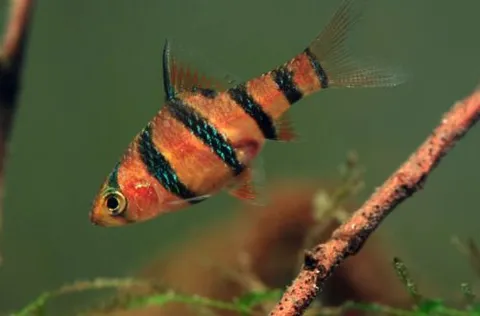
Desmopuntius pentazona
The Five-banded Barb, scientifically known as Desmopuntius pentazona, belongs to the carp family (Cyprinidae). This active and attractive fish is not overly demanding to keep, provided the aquarium is set up according…
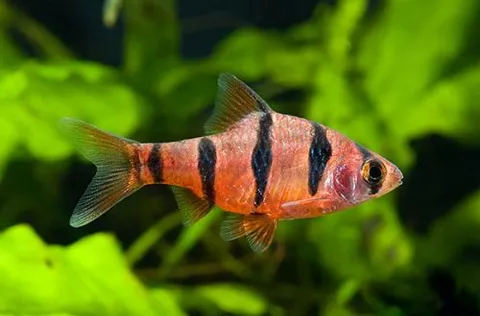
Desmopuntius hexazona
The Six-banded Barb, scientifically known as Desmopuntius hexazona, belongs to the family Cyprinidae. This peaceful, energetic, and vibrant fish will perfectly complement the inhabitants of your freshwater aquarium.
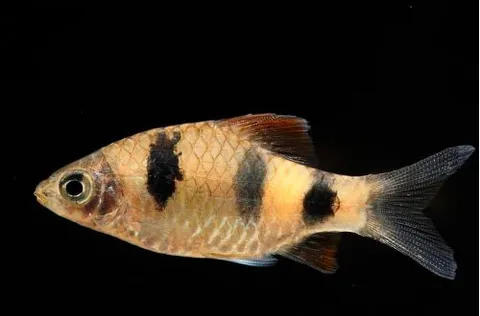
Pethia setnai
Pethia setnai, known as the Setnai Barb, belongs to the family Cyprinidae. This species of barb was named after the Indian ichthyologist Setna, who was involved in its classification. This fish is easy to keep and…
Pethia manipurensis
The fish, known scientifically as Pethia manipurensis, belongs to the Carp family (Cyprinidae) and is called the Manipur Barb. Its only natural habitat is located in the Indian state of Manipur, in Loktak Lake, which is…