Temperature24 – 31 °C
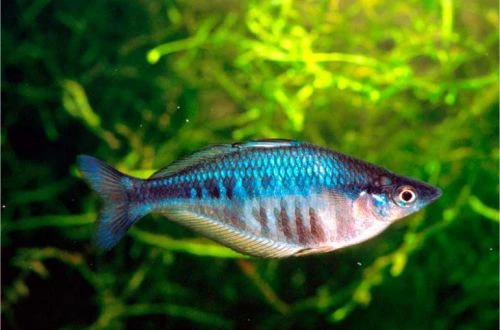
Axelrod's Rainbowfish, scientifically known as Chilatherina axelrodi, is a member of the Melanotaeniidae family, or Rainbowfishes. Its first description occurred in 1979 when a group of international scientists discovered this species during an expedition. The purpose of this scientific mission was to study the diversity of river systems on the island of New Guinea. The name was given in honor of Herbert R. Axelrod, who provided financial support for the expedition.
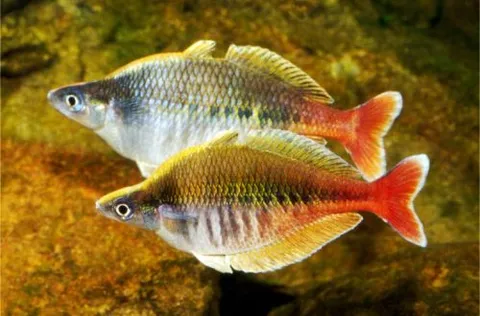
Adult males can reach approximately 10 cm in length, while females remain slightly smaller, growing up to 8 cm. The body coloration varies: the upper part can be bluish-gray or greenish-brown. The lower part of the body is usually lighter, acquiring a silvery hue. Along the lateral line, 6 to 10 dark spots can be observed, which, starting from the middle of the caudal peduncle, merge into a distinct black stripe. On the lower half of the body, 6–10 faint dark vertical stripes are also visible. The upper part of the body shows slight bluish iridescence. The dorsal, pelvic, and caudal fins are yellow, while the others remain translucent. The aforementioned coloration features are most characteristic of males; females appear less vibrant, their coloration being closer to monochromatic.
The natural habitat of these fish is on the island of New Guinea, located in the western Pacific Ocean, north of Australia. They are mainly found within the Sanduan Province, belonging to the state of Papua New Guinea. They prefer sections of rivers with weak currents and backwaters, inhabiting among thickets of aquatic plants and submerged snags.
These peaceful and active fish prefer to live in small groups of 6–8 individuals. They get along well with many other non-aggressive species of similar size.
For keeping a group of 6–8 fish, an aquarium with a volume of at least 150 L will be optimal. Inside the aquarium, it is advisable to create both open swimming areas and hiding places. Natural snags and dense plant thickets, including floating plants, are suitable as such shelters. Chilatherina axelrodi prefers water with medium hardness and a pH above neutral. An important condition is maintaining a high temperature in the range of 24–29°C. For example, wild specimens discovered in 1979 were found in a tropical stream with a temperature of 28°C. However, in aquarium conditions, such a temperature regime can increase the risk of hypoxia. Therefore, it is extremely important to ensure good water aeration and regularly remove organic waste, as its decomposition actively consumes oxygen. This species is omnivorous. The fish are easily accustomed to dry foods. The diet can include dry flakes, granules, as well as frozen or live brine shrimp, daphnia, and bloodworms.
This species is omnivorous and readily adapts to dry foods. Their diet can include flakes, granules, as well as live or frozen foods such as brine shrimp, daphnia, and bloodworms.
For breeding, a separate spawning tank of at least 40 L with fine-leaved plants or synthetic substrates is necessary. A rise in water temperature and abundant feeding of the breeders serve as a stimulus. Spawning is protracted, with fish laying a small number of eggs daily, which should be transferred to a separate container. The incubation period lasts up to 12 days, after which the fry begin to feed on infusoria and brine shrimp nauplii.
The species has a strong immune system when kept under proper conditions. The main threat comes from bacterial and fungal infections that arise from poor water quality, accumulation of organic matter, or stress from overcrowding. To prevent diseases, it is necessary to maintain stable environmental parameters and perform regular water changes. The fish are sensitive to sharp fluctuations in hydrochemical indicators.
When purchasing, choose active, mobile individuals with bright coloration and clean fins without signs of damage or film. Avoid fish with sunken bellies, signs of emaciation, or unusual behavior, such as passively hovering in the corner of the aquarium. It is advisable to acquire a group of 6 or more individuals to reduce stress levels and ensure better adaptation in the new aquarium.
The essentials: size, tank volume, water parameters and care
An adult reaches 10 cm in length. Plan the tank around the maximum size: the fish quickly outgrows a cramped setup.
The recommended volume is 150 L. A smaller tank speeds up nitrate build-up and raises stress levels.
Temperature 24–31 °C, pH 7–8.4, hardness 15–20 dGH. Stability matters more than exact values: sudden swings are harder on the fish than a small deviation from the ideal.
Around 5 years when kept properly. Lifespan depends directly on tank volume, water quality and a varied diet.
Temperament: peaceful (regular). Keep this in mind when choosing tank mates.
Recommended setup: medium group (6–8 individuals). Ignoring this is a common cause of stress and disease.
Diet type: any (universal). Feed small portions that are finished within a couple of minutes — overfeeding does more harm than underfeeding.
The scientific name of the species is Chilatherina axelrodi, family Rainbowfishes (Melanotaeniidae).
The water suits 113 of 208 plants in the catalogue — the easiest ones are shown first.
African Onion PlantAfzelius's AnubiasAmazon FrogbitAmazon SwordAnacharisAnubiasArrowhead CryptDwarf CloverDwarf CloverDwarf HygrophilaDwarf SagittariaDwarf ValGuppy GrassHornwortJava MossMoneywortMud SwordNair's LagenandraNarrow Leaf AnacharisNarrow-leaf CloverStringy MossTaiwan MossTape GrassUssuri Watermilfoil
Matched by family, categories and overlapping keeping conditions
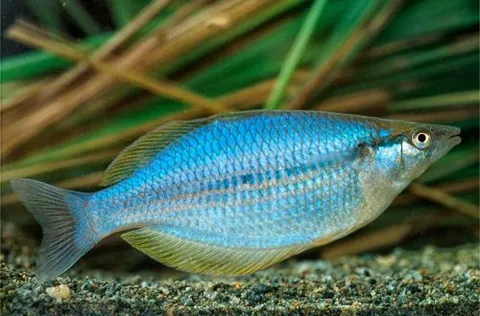
Chilatherina lorentzii
The Chilatherina rainbowfish, scientifically known as Chilatherina lorentzii, belongs to the family Melanotaeniidae. It became known as an aquarium fish in 2012. Its habitat is the island of New Guinea, located north of…
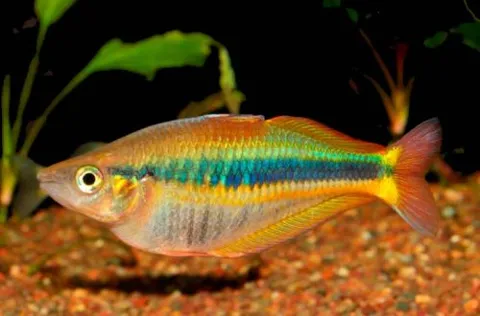
Chilatherina alleni
The fish known as Chilatherina or Allen's Rainbowfish, scientifically designated Chilatherina alleni, belongs to the family Melanotaeniidae, or Rainbowfishes. Its natural habitat is the western part of New Guinea…
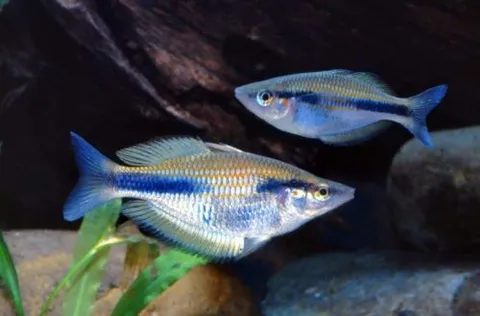
Melanotaenia goldiei
The Goldie River Rainbowfish, also known by its scientific name Melanotaenia goldiei, belongs to the family Melanotaeniidae, or Rainbowfishes. This fish was named after the Goldie River in Papua New Guinea, where it was…
Chilatherina bleheri
Bleher's Rainbowfish, scientifically known as Chilatherina bleheri, belongs to the family Melanotaeniidae. Its first specimens were collected in 1982 by the famous naturalist Heiko Bleher. At that time, these fish were…