Temperature22 – 33 °C
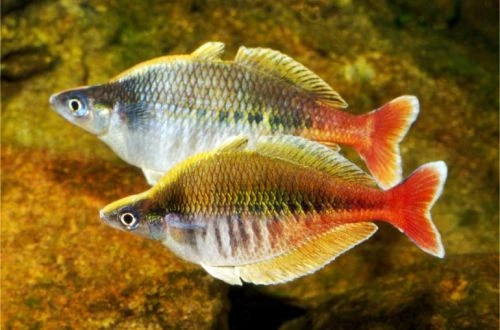
Bleher's Rainbowfish, scientifically known as Chilatherina bleheri, belongs to the family Melanotaeniidae. Its first specimens were collected in 1982 by the famous naturalist Heiko Bleher. At that time, these fish were classified as Chilatherina fasciata, but in 1985, Gerald Allen identified them as a separate species, naming it in honor of its discoverer, Heiko Bleher.
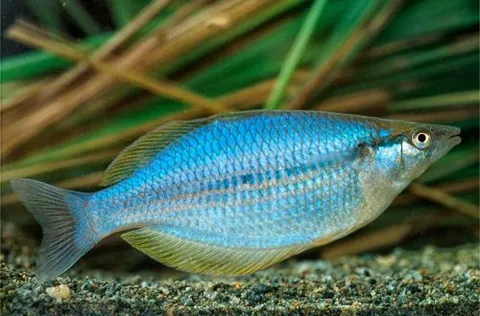
Chilatherina bleheri is closely related to the Fasciata Rainbowfish (Chilatherina fasciata), which is reflected in their similar appearance. These fish are characterized by a high body with a distinctively raised, arched back. Their body is adorned with dark vertical stripes in the abdominal region. The coloration is a combination of yellow, blue, and red hues, with the back typically being yellow. Males generally display more vibrant colors. The differences between Chilatherina bleheri and Chilatherina fasciata include a slightly smaller size (reaching approximately 10 cm) and the presence of red tones in the posterior part of the body closer to the caudal fin.
This species inhabits the Indonesian part of New Guinea, in the Papua province. Its distribution is limited to the Lake Holmes region, which is part of the Mamberamo River basin in West Papua. Lake Holmes is a complex system of three interconnected bodies of water. The fish prefers highly indented shorelines, including tributaries. Its natural habitat is characterized by calm waters, rocky substrates, and abundant coastal vegetation.
These fish are highly active, which may be uncomfortable for slower tank mates, but overall, the species is peaceful and cohabits well. Males often compete with each other for the attention of females. It is recommended to keep them in a group where the number of females exceeds the number of males.
For comfortable keeping of Bleher's Rainbowfish, a spacious aquarium of 150–200 L for a group of 6–8 individuals would be optimal. Its design should include both hiding places and open areas for free swimming. Branched driftwood and dense thickets of plants, including floating ones, will serve as good shelters. Floating plants will also help prevent fish from jumping out of the water. An important condition is maintaining warm, slightly alkaline water, as well as preventing the accumulation of organic matter, such as food remnants or excrement. Aquarium care is standard and includes regular weekly partial water changes, substrate cleaning, and equipment maintenance.
In natural conditions, the diet of rainbowfish includes insects, both terrestrial and aquatic, as well as their larvae, small crustaceans, algae, and various plants. Due to their omnivorous nature, in aquarium conditions, these fish readily accept a wide range of foods, whether dry pellets, frozen, or live foods popular among aquarists.
Under favorable conditions, spawning occurs regularly. Since seasonality is usually absent in aquarium conditions, fry can appear throughout the year. Spawning occurs among dense plant thickets or on a suitable spawning substrate. Rainbowfish do not tend to eat their offspring, but to increase the survival rate, it is advisable to move the fry to a separate tank. In the initial stage of development, fry should be fed specialized foods for aquarium fry, such as powders and suspensions.
Under favorable conditions, cases of disease in these fish are rare. If the first symptoms of an ailment appear, such as lethargy, body deformation, or the appearance of spots, it is first necessary to check the water quality. Often, bringing all environmental parameters back to normal allows the fish's body to cope with the disease on its own. Otherwise, medication may be required.
When choosing Bleher's Rainbowfish in a store, preference should be given to the most active and mobile individuals who show interest in food. A healthy fish should have clean fins without signs of erosion, intact scales without spots or ulcers, and clear eyes without cloudiness. Avoid specimens with sunken bellies or signs of emaciation, as this may indicate the presence of internal parasites or chronic stress. Before purchasing, it is recommended to ask the seller to feed the fish to ensure there are no appetite problems and that their group behavior is normal.
The essentials: size, tank volume, water parameters and care
An adult reaches 10 cm in length. Plan the tank around the maximum size: the fish quickly outgrows a cramped setup.
The recommended volume is 150 L. A smaller tank speeds up nitrate build-up and raises stress levels.
Temperature 22–33 °C, pH 6.8–8, hardness 8–15 dGH. Stability matters more than exact values: sudden swings are harder on the fish than a small deviation from the ideal.
Around 6 years when kept properly. Lifespan depends directly on tank volume, water quality and a varied diet.
Temperament: peaceful (regular). Keep this in mind when choosing tank mates.
Recommended setup: medium group (6–8 individuals). Ignoring this is a common cause of stress and disease.
Diet type: any (universal). Feed small portions that are finished within a couple of minutes — overfeeding does more harm than underfeeding.
The scientific name of the species is Chilatherina bleheri, family Rainbowfishes (Melanotaeniidae).
The water suits 114 of 208 plants in the catalogue — the easiest ones are shown first.
African Onion PlantAfzelius's AnubiasAmazon FrogbitAmazon SwordAnacharisAnubiasArrowhead CryptDwarf CloverDwarf CloverDwarf HygrophilaDwarf SagittariaDwarf ValGuppy GrassHornwortJava MossMoneywortMud SwordNair's LagenandraNarrow Leaf AnacharisNarrow-leaf CloverStringy MossTaiwan MossTape GrassUssuri Watermilfoil
Matched by family, categories and overlapping keeping conditions
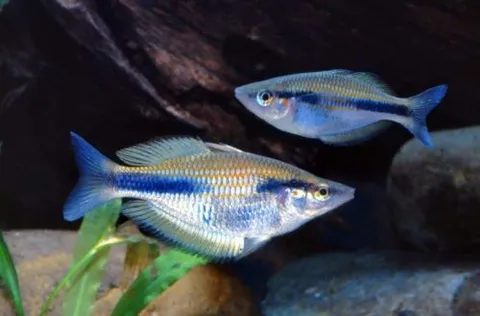
Melanotaenia goldiei
The Goldie River Rainbowfish, also known by its scientific name Melanotaenia goldiei, belongs to the family Melanotaeniidae, or Rainbowfishes. This fish was named after the Goldie River in Papua New Guinea, where it was…
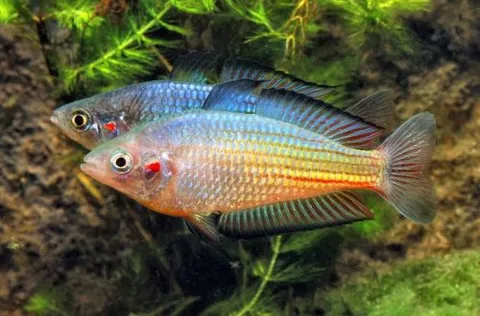
Melanotaenia duboulayi
Duboulay's Rainbowfish, scientifically known as Melanotaenia duboulayi, belongs to the family Melanotaeniidae. This name was given in honor of biologist du Boulay, who first discovered this species in the Richmond River…
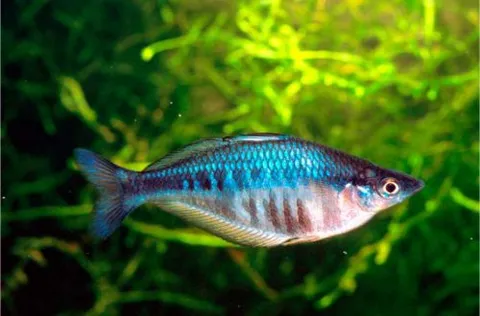
Chilatherina axelrodi
Axelrod's Rainbowfish, scientifically known as Chilatherina axelrodi, is a member of the Melanotaeniidae family, or Rainbowfishes. Its first description occurred in 1979 when a group of international scientists…
Chilatherina lorentzii
The Chilatherina rainbowfish, scientifically known as Chilatherina lorentzii, belongs to the family Melanotaeniidae. It became known as an aquarium fish in 2012. Its habitat is the island of New Guinea, located north of…