Temperature18 – 30 °C
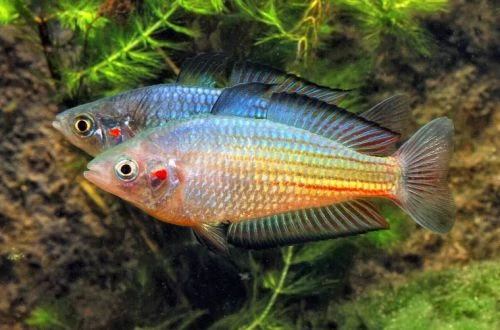
Duboulay's Rainbowfish, scientifically known as Melanotaenia duboulayi, belongs to the family Melanotaeniidae. This name was given in honor of biologist du Boulay, who first discovered this species in the Richmond River in northern New South Wales in the 1870s. This bright and peaceful fish requires minimal care and adapts well to its living conditions, making it an excellent addition to a freshwater community aquarium. Thus, it is well-suited for aquarists, especially beginners.
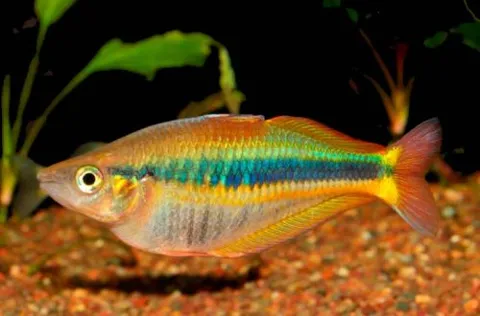
Adults of this fish reach a maximum length of about 12 cm, although in aquarium conditions they are usually slightly smaller, up to 10 cm. Their body is characterized by lateral compression and a slender structure. The anal fin extends from the middle of the belly to the caudal fin, and the dorsal fin is divided into two parts, with the first part being noticeably shorter than the second. The coloration of Melanotaenia duboulayi can vary depending on its region of origin, but generally, the body has a silvery hue with splashes of blue, green, and yellow tones. A distinct crimson spot can be seen on the gill cover, and the fins are colored red or blue with a noticeable black edge. Males differ from females by their more intense coloration and have pointed tips on their dorsal and anal fins, while females have more rounded ones.
Its origin is linked to the eastern coast of Australia, where it inhabits a subtropical climate zone. Melanotaenia can be found everywhere: in rivers, streams, swamps, and lakes abundant with aquatic vegetation. The natural habitat of this species constantly changes due to seasonal fluctuations in temperature, water level, and hydrochemical parameters. It should be noted that outside Australia the species is known chiefly as an aquarium fish — it has been kept since the early twentieth century — but no established wild populations are recorded on other continents.
These fish prefer to stay in groups where females predominate. Males, on the other hand, tend to stay alone or slightly apart. They show peaceful behavior towards other species and get along well with fish of similar size and temperament.
For a comfortable existence of a group of 6–8 fish, aquariums with a volume of 150–200 L are recommended. In their natural habitats, Duboulay's Rainbowfish spend a lot of time swimming around dense thickets of plants, driftwood, and other underwater objects that serve as shelter in case of danger. Therefore, when decorating an aquarium, it is important to consider a combination of open swimming areas with a sufficient number of hiding places, for example, from the same plants. These fish have evolutionarily adapted to life in diverse conditions, tolerating a wide range of temperatures, pH values, and water hardness (dGH). Thanks to such unpretentiousness, they are considered easy to keep. It is sufficient to maintain clean, warm water and regularly service the aquarium, including equipment maintenance.
In natural conditions, the diet of these fish consists mainly of plant material and small invertebrates. In a home aquarium, Duboulay's Rainbowfish can feed on both dry and freeze-dried foods, available as flakes or granules.
In their natural habitat, the spawning period occurs from September to December, coinciding with the onset of summer rains (which corresponds to the warm months in the Southern Hemisphere). In aquarium conditions, the seasonality of spawning is not pronounced. Eggs are laid in semi-darkness among plants, attaching to the surface of leaves. Females lay only a few eggs daily, so the entire spawning process can extend over several weeks. The incubation period is 5–9 days at a water temperature of 24 to 29°C. The hatched fry immediately gather in a group and stay near the water surface. After 12 hours, they begin to feed. In the first days, their diet should consist exclusively of micro-foods, such as infusoria. As they grow, they transition to larger food. Fry of different ages can cause feeding difficulties. Although adult fish are not prone to predatory instincts towards their offspring, it is still recommended to transfer the fry to a separate tank to facilitate care.
Under favorable conditions, cases of disease in these fish are rare. If the first symptoms of an ailment appear, such as lethargy, body deformation, or the appearance of spots, it is first necessary to check the water quality. Often, bringing all environmental parameters back to normal allows the fish's body to cope with the disease on its own. Otherwise, medication may be required.
When choosing individuals, preference should be given to active fish with clean scales, without visible damage, spots, or signs of emaciation. Healthy representatives of this species display pronounced coloration and show curiosity towards their surroundings. Avoid purchasing fish that stay isolated, are constantly at the surface or bottom, or have sunken bellies, which may indicate the presence of parasites or chronic stress. In the store, fish should exhibit schooling behavior and an adequate reaction to feeding.
The essentials: size, tank volume, water parameters and care
An adult reaches 10 cm in length. Plan the tank around the maximum size: the fish quickly outgrows a cramped setup.
The recommended volume is 150 L. A smaller tank speeds up nitrate build-up and raises stress levels.
Temperature 18–30 °C, pH 6.5–8, hardness 10–20 dGH. Stability matters more than exact values: sudden swings are harder on the fish than a small deviation from the ideal.
Around 4 years when kept properly. Lifespan depends directly on tank volume, water quality and a varied diet.
Temperament: peaceful (regular). Keep this in mind when choosing tank mates.
Recommended setup: medium group (6–8 individuals). Ignoring this is a common cause of stress and disease.
Diet type: any (universal). Feed small portions that are finished within a couple of minutes — overfeeding does more harm than underfeeding.
The scientific name of the species is Melanotaenia duboulayi, family Rainbowfishes (Melanotaeniidae). It also appears in the literature as: Atherinichthys duboulayi.
The water suits 197 of 208 plants in the catalogue — the easiest ones are shown first.
Afzelius's AnubiasAnacharisAnubiasBrazilian PennywortDwarf CloverDwarf CloverDwarf HygrophilaDwarf SagittariaDwarf ValGuppy GrassHornwortJava FernJava MossMoneywortMud SwordNair's LagenandraNarrow Leaf AnacharisNarrow-leaf CloverStringy MossSüsswassertangTaiwan MossTape GrassTemple PlantUssuri Watermilfoil
Matched by family, categories and overlapping keeping conditions
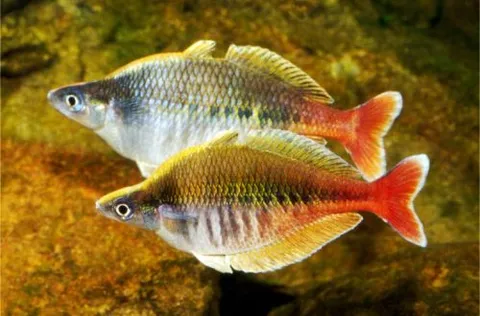
Chilatherina bleheri
Bleher's Rainbowfish, scientifically known as Chilatherina bleheri, belongs to the family Melanotaeniidae. Its first specimens were collected in 1982 by the famous naturalist Heiko Bleher. At that time, these fish were…
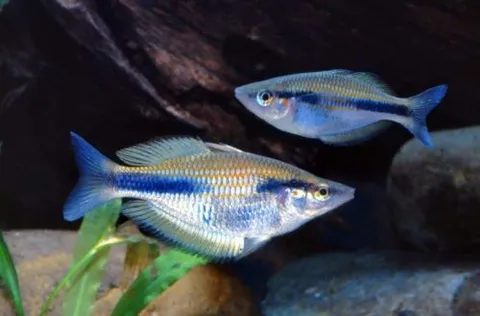
Melanotaenia goldiei
The Goldie River Rainbowfish, also known by its scientific name Melanotaenia goldiei, belongs to the family Melanotaeniidae, or Rainbowfishes. This fish was named after the Goldie River in Papua New Guinea, where it was…
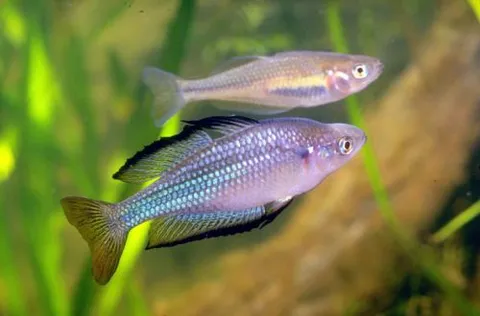
Melanotaenia fluviatilis
The Murray River Rainbowfish, also known as the River Rainbowfish, bears the scientific name Melanotaenia fluviatilis and belongs to the family Melanotaeniidae. This fish is characterized by its unpretentiousness, ease…
Chilatherina alleni
The fish known as Chilatherina or Allen's Rainbowfish, scientifically designated Chilatherina alleni, belongs to the family Melanotaeniidae, or Rainbowfishes. Its natural habitat is the western part of New Guinea…