Temperature22 – 33 °C
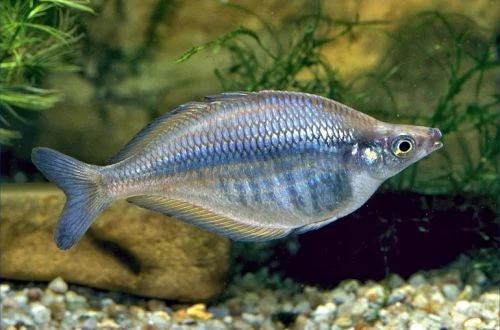
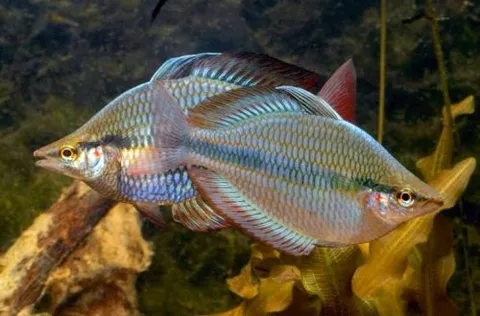
Chilatherina fasciata, known as the Fasciated Rainbowfish, is a member of the family Melanotaeniidae. This fish is distinguished by its brightness and active behavior, and its coloration can vary significantly. A single species can exhibit considerable differences in color nuances. Its peaceful nature, as well as its relative ease of care and breeding, make it an excellent addition to a freshwater community aquarium.
The Fasciated Rainbowfish, like many other rainbowfish species, exhibits noticeable variations in body coloration and pattern. These differences depend on the specific region of origin. In New Guinea, numerous natural barriers isolate different populations, contributing to the formation of diverse color forms. Typically, the upper part of the fish's body varies from brownish to bluish hues, while the lower part can be silvery or golden. Dark vertical stripes are often visible on the belly. Males are usually brighter than females, and their dorsal and anal fins are often colored in reddish or yellowish tones. During spawning, the top of the male's head may acquire a bronze tint. Due to similarities, this species is sometimes confused with the closely related Bleher's Rainbowfish. Additionally, hybrid forms derived from both species are found on the market.
Its natural habitat is on the island of New Guinea, where it inhabits the basin of one of the region's largest rivers — the Mamberamo. The fish prefer shallow areas of streams and rivers, especially those well-lit by sunlight. A typical biotope for this fish is a body of water with a bottom covered with rocky substrates, fallen leaves, snags, and other decaying plant organic matter.
Although Fasciated Rainbowfish are active and peaceful fish, their high mobility may not be to the liking of slower or more timid species. Males show some intolerance towards each other, so for smaller aquariums, it is better to choose groups with a predominance of females.
For successful long-term keeping of Fasciated Rainbowfish in an aquarium, it is necessary to approximate conditions to their natural habitat. These fish require warm, slightly alkaline water, sufficient space for swimming, and hiding places, which can be created with dense plant thickets or other decorative elements. They are prone to jumping out of the water, so it is important to place floating plants on the surface or equip the aquarium with a lid. To maintain biological balance, weekly partial water changes are recommended, which should be combined with siphoning the substrate to remove organic waste such as food remnants and excrement. The uninterrupted operation of the filtration system plays a key role in ensuring high water quality.
In their natural environment, the diet of these fish includes filamentous algae, small crustaceans, as well as various terrestrial and aquatic insects — in particular, ants, tiny beetles, and larvae. Due to their omnivorous nature, Fasciated Rainbowfish in home aquariums successfully feed on most common foods offered in dry, frozen, or live forms.
Under conditions that fully meet their needs, Fasciated Rainbowfish can breed year-round. In aquarium keeping, no distinct seasonality in spawning is observed. Fish reach sexual maturity when they grow to 4–5 cm. Spawning occurs in dense thickets of aquatic vegetation. It should be noted that the female lays eggs gradually, only a small portion is released at a time, so the spawning process can last up to 7 days. The incubation period for the eggs is 8 to 12 days, its duration depends on the temperature regime. It is preferable to allocate a separate container for fry, which will simplify their feeding and also provide protection from adult individuals, who may be predatory towards their offspring.
Under favorable conditions, cases of disease in these fish are rare. If the first symptoms of an ailment appear, such as lethargy, body deformation, or the appearance of spots, it is first necessary to check the water quality. Often, bringing all environmental parameters back to normal allows the fish's body to cope with the disease on its own. Otherwise, medication may be required.
When selecting individuals, pay attention to their activity and the absence of visible damage. A healthy fish should show curiosity, have clean fins, even scales, and a firm body without signs of emaciation or a bloated belly. Avoid specimens that keep to themselves, breathe heavily, or exhibit sluggish behavior, as this may indicate stress or hidden diseases. — give preference to individuals with bright, species-characteristic coloration — check for the absence of white spots, ulcers, or cloudy patches on the body and eyes — choose fish from schools where all individuals appear equally active and healthy.
The essentials: size, tank volume, water parameters and care
An adult reaches 10–12 cm in length. Plan the tank around the maximum size: the fish quickly outgrows a cramped setup.
The recommended volume is 150 L. A smaller tank speeds up nitrate build-up and raises stress levels.
Temperature 22–33 °C, pH 6.8–8, hardness 8–15 dGH. Stability matters more than exact values: sudden swings are harder on the fish than a small deviation from the ideal.
Around 8 years when kept properly. Lifespan depends directly on tank volume, water quality and a varied diet.
Temperament: peaceful (regular). Keep this in mind when choosing tank mates.
Recommended setup: medium group (6–8 individuals). Ignoring this is a common cause of stress and disease.
Diet type: any (universal). Feed small portions that are finished within a couple of minutes — overfeeding does more harm than underfeeding.
The scientific name of the species is Chilatherina fasciata, family Rainbowfishes (Melanotaeniidae). It also appears in the literature as: Rhombatractus fasciatus.
The water suits 114 of 208 plants in the catalogue — the easiest ones are shown first.
African Onion PlantAfzelius's AnubiasAmazon FrogbitAmazon SwordAnacharisAnubiasArrowhead CryptDwarf CloverDwarf CloverDwarf HygrophilaDwarf SagittariaDwarf ValGuppy GrassHornwortJava MossMoneywortMud SwordNair's LagenandraNarrow Leaf AnacharisNarrow-leaf CloverStringy MossTaiwan MossTape GrassUssuri Watermilfoil
Matched by family, categories and overlapping keeping conditions
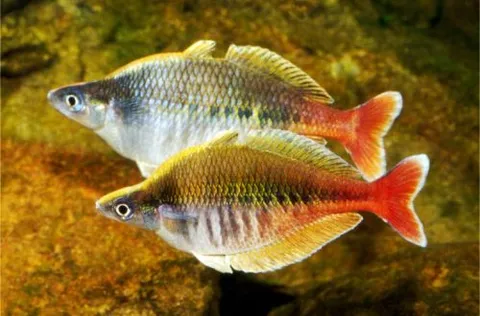
Chilatherina bleheri
Bleher's Rainbowfish, scientifically known as Chilatherina bleheri, belongs to the family Melanotaeniidae. Its first specimens were collected in 1982 by the famous naturalist Heiko Bleher. At that time, these fish were…
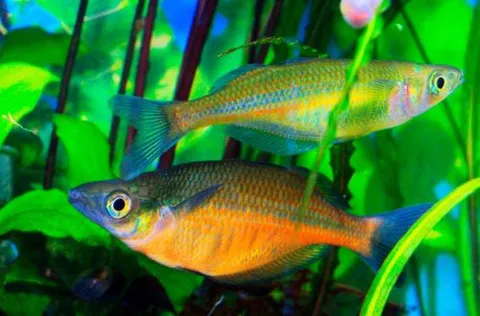
Chilatherina sentaniensis
The scientific name for this fish is Chilatherina sentaniensis, and it belongs to the family Melanotaeniidae, known as Rainbowfishes. This species is found exclusively in Lake Sentani, located in the Indonesian province…
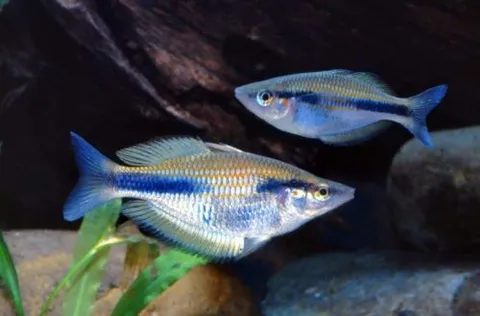
Melanotaenia goldiei
The Goldie River Rainbowfish, also known by its scientific name Melanotaenia goldiei, belongs to the family Melanotaeniidae, or Rainbowfishes. This fish was named after the Goldie River in Papua New Guinea, where it was…
Melanotaenia trifasciata
The three-striped rainbowfish, scientifically known as Melanotaenia trifasciata, belongs to the family Melanotaeniidae. This species was first discovered by Norwegian zoologist Knut Dahl in June 1895. The description…