Temperature22 – 25 °C
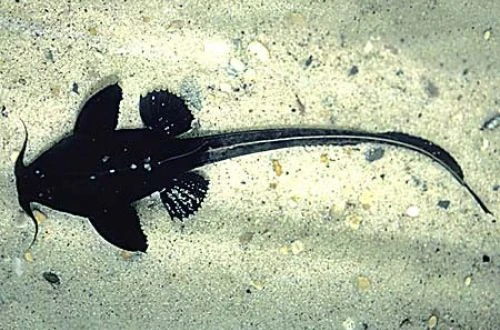
Platystacus cotylephorus, known as the banded banjo catfish, belongs to the family Aspredinidae. This species is found in South America, specifically along the eastern coast of the continent in the waters of French Guiana, Guyana, Suriname, Venezuela, Brazil, and also near the island nation of Trinidad and Tobago. The catfish inhabits river estuaries and deltas, as well as coastal brackish zones where rivers flow into the ocean. It is often found in mangrove thickets, where it prefers to hide by burying itself in the mud.
This catfish is quite large, its length can exceed 30 cm. Its name, “banjo,” is inspired by the resemblance of the fish's body shape to the musical instrument of the same name, which has a wide body and a thin, long neck. The catfish's body is flattened and oval, while its tail is thin and elongated. Wide, fan-shaped pectoral and pelvic fins are located along the narrow body and make the fish appear visually larger when viewed from above. The tail is short, resembling a brush, and the dorsal fin is small and triangular. The entire body is protected by bony plates, which serve as a barrier against predators. In addition, the first rays of the fins have transformed into sharp spines. The catfish's eyes are very small, located on the top of its head, and are not used for foraging. Their primary purpose is to detect predators, with the catfish relying on its sense of smell and touch for orientation. The body coloration is almost entirely black, with a single light, narrow stripe running along it.
The species' range covers the coastal areas of South America from Venezuela to Brazil, including French Guiana, Guyana, Suriname, and Trinidad and Tobago. These fish inhabit estuaries, river deltas, and coastal zones, preferring areas with murky water and soft, silty or sandy bottoms. The species can adapt to both fresh and brackish water and is often found in mangrove thickets, where it leads a secretive lifestyle, burying itself in the substrate during daylight hours.
This species is distinguished by its peaceful and calm temperament. It coexists well with its own kind and with other fish of similar size. For example, livebearers, Central American cichlids, and rainbowfish can be suitable tankmates in a freshwater aquarium. The catfish also gets along successfully with many brackish water inhabitants, including even demanding neighbors like gobies. However, due to its omnivorous nature, it is worth considering that it may eat small fish or fry if the opportunity arises. The catfish leads a secretive lifestyle, being active primarily at night. During the day, it prefers to hide in shelters or, if possible, bury itself in soft, silty substrate. It often remains almost motionless, camouflaging itself as a fallen leaf or driftwood. For slow movement, it uses an unusual method: it pushes water through its gills, creating jet propulsion, which resembles a piece of driftwood or a leaf tumbling along the bottom under the influence of currents or waves.
Optimal aquarium dimensions for the banded banjo catfish suggest a width or length of about one meter with a low height, as bottom area is more important than depth for this species. The minimum aquarium volume can be around 150 L, which is sufficient given its sedentary nature. The aquascape should include several appropriately sized shelters, such as branches, driftwood, or large leaves, for example, beech. A soft sandy substrate is preferred. If only one banded banjo catfish is kept in the aquarium, dim lighting can be used. The catfish does not tolerate soft, acidic water very well. It is recommended to maintain water parameters with medium hardness and a pH close to neutral or slightly alkaline. The addition of salt is not mandatory, but if desired, brackish conditions can be provided.
The catfish prefers protein-rich foods such as bloodworms or earthworms, which can be fresh, frozen, or live. The diet can be diversified with dry sinking flakes or pellets. The fish should be fed in the evening, before the lights are turned off.
Reproduction in captivity is poorly understood and occurs extremely rarely. In nature, spawning likely takes place in brackish waters. A unique feature of the species is its form of parental care: during spawning, special outgrowths called cotylephores form on the female's abdomen, to which the eggs attach. The female carries the eggs until the fry hatch, which provides protection and effective oxygenation of the clutch in conditions of oxygen deficiency in the bottom layers.
The species does not have specific diseases but is sensitive to abrupt changes in water parameters and environmental quality. Like other members of the family, the fish may periodically shed its skin, which is a natural physiological process and not a sign of illness. An important condition for prevention is the use of a soft sandy substrate without sharp particles, as skin damage during burrowing can lead to the development of secondary bacterial or fungal infections.
When selecting specimens, attention should be paid to the integrity of the skin and fins, the absence of visible ulcers, spots, or signs of emaciation. A healthy fish should exhibit a natural reaction to approaching a shelter, although it may be sluggish during the daytime. It is recommended to avoid specimens with damaged barbels or signs of body trauma sustained during transport or capture, as such injuries heal slowly and increase the risk of infection.
The essentials: size, tank volume, water parameters and care
An adult reaches 32 cm in length. Plan the tank around the maximum size: the fish quickly outgrows a cramped setup.
The recommended volume is 150 L. A smaller tank speeds up nitrate build-up and raises stress levels.
Temperature 22–25 °C, pH 6–8.2, hardness 12–30 dGH. Stability matters more than exact values: sudden swings are harder on the fish than a small deviation from the ideal.
Around 10 years when kept properly. Lifespan depends directly on tank volume, water quality and a varied diet.
Temperament: semi-peaceful (dangerous to smaller ones). Not a predatory species, but small fish that fit in its mouth will eventually be eaten.
Recommended setup: mixed (solitary / pair / group). Ignoring this is a common cause of stress and disease.
Diet type: high protein (predominantly meat). Feed small portions that are finished within a couple of minutes — overfeeding does more harm than underfeeding.
The scientific name of the species is Platystacus cotylephorus, family Aspredinidae. It also appears in the literature as: Aspredo cotylephorus, Aspredo sexcirrhis, Aspredo spectrum.
The water suits 196 of 208 plants in the catalogue — the easiest ones are shown first.
Afzelius's AnubiasAnacharisAnubiasBrazilian PennywortDwarf CloverDwarf CloverDwarf HygrophilaDwarf SagittariaDwarf ValGuppy GrassHornwortJava FernJava MossMoneywortMud SwordNarrow Leaf AnacharisNarrow-leaf CloverStringy MossSüsswassertangTaiwan MossTape GrassTemple PlantUssuri WatermilfoilWater Wisteria
Matched by family, categories and overlapping keeping conditions
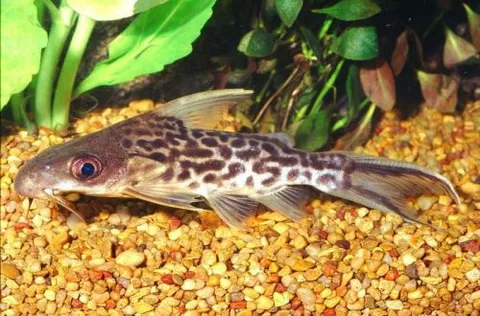
Synodontis pleurops
The scientific name Synodontis pleurops belongs to the family Mochokidae, known as upside-down catfish, and the species itself is known as Synodontis pleurops. Its homeland is Central Africa, although, contrary to its…
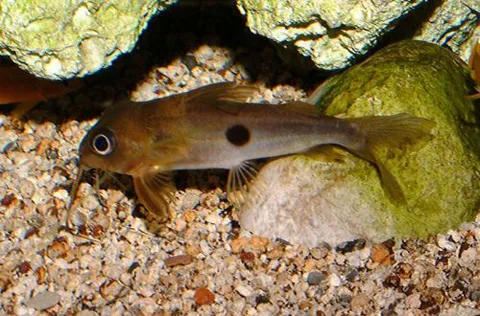
Synodontis notatus
Synodontis notatus, known as the Domino Synodontis or One-Spot Synodontis, belongs to the family Mochokidae. Interestingly, despite the name "one-spot" in one of its common names, the fish can have up to 6 round spots…
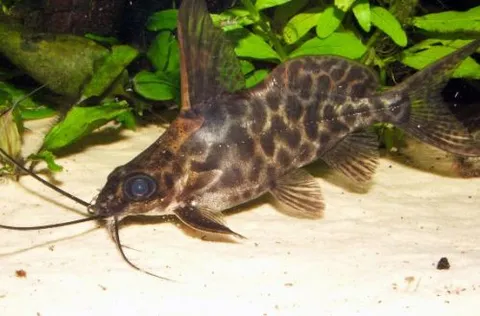
Synodontis alberti
The scientific name Synodontis alberti belongs to the family Mochokidae, and this fish is also known as Albert's Synodontis, High-fin Synodontis, or Big-eyed Synodontis. Since it is most active in the dark, during the…
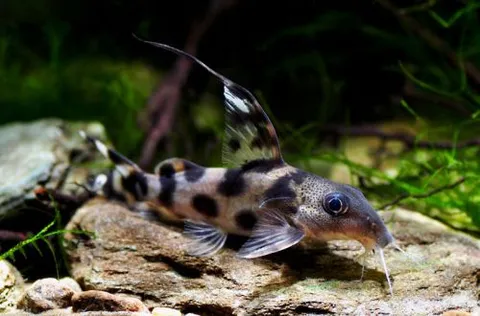
Synodontis decorus
Synodontis decorus, known as the Flag Synodontis or Clown Synodontis, belongs to the family Mochokidae. This species is one of the most striking representatives of the Synodontis genus and can adorn almost any large…