Temperature18 – 22 °C
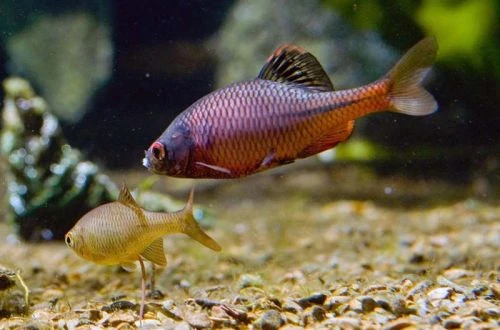
The Bitterling fish, known scientifically as Rhodeus amarus, belongs to the Carp family (Cyprinidae). This representative of European aquatic fauna is found primarily in lakes and slow-moving rivers with abundant aquatic vegetation. Its natural distribution is closely linked to the presence of freshwater bivalve mollusks of the Unionidae family, the interrelationship with which will be discussed below.
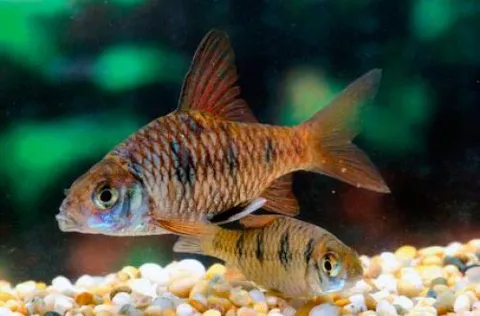
These fish reach a length of up to 9 cm. They have a high and robust body with short fins. Their silvery body coloration is complemented by a dark back with a greenish sheen and a lighter belly. A blue stripe runs from the middle of the body to the tail. Males become particularly striking during the spawning period, when their coloration intensifies with iridescent, red, and pink hues, and characteristic tubercles appear on their heads. At the same time, females develop a long ovipositor extending from the base of the anal fin.
The European bitterling inhabits freshwaters of Central and Eastern Europe, as well as the northern part of Asia Minor. Typical habitats include slow-moving rivers, lakes, ponds, and oxbow lakes, where the fish prefer coastal areas with dense vegetation. An important condition for the species' existence in nature is the presence of bivalve molluscs of the family Unionidae — the eggs develop inside them and nowhere else. Zebra mussels are not hosts; by fouling unionid shells they in fact hinder spawning. They prefer areas with sandy, silty, or stony substrates at moderate water temperatures.
This fish is distinguished by its peaceful and calm disposition. When choosing tank mates for the Bitterling, it's important to consider its specific requirements: only species that can thrive in unheated aquariums are suitable, such as Goldfish.
These fish are considered hardy and undemanding, successfully adapting to life in both outdoor ponds and home aquariums. A key condition for their successful keeping is maintaining stable water chemistry at relatively low temperatures. Overheating poses the greatest danger: prolonged exposure to temperatures above 22°C is unacceptable, so a heater is usually not required in the aquarium. In terms of aquarium decor, it is desirable to create sheltered areas with dense aquatic vegetation, using, for example, Vallisneria, pondweeds, Elodea, or water lilies. Driftwood or rock formations can also be added. Any substrate can be used, but for successful breeding, a soft substrate suitable for bivalve mollusks is recommended. Aquarium maintenance is standard: it includes regular removal of accumulated waste, weekly partial water changes with fresh water, and preventative maintenance of equipment, especially the filtration system. In nature, the diet of Bitterlings is based on algae and aquatic plants. In a home aquarium, they can be accustomed to popular dry foods in the form of flakes and pellets, provided these foods are rich in plant components.
In natural conditions, these fish primarily feed on algae and various aquatic plants. In an aquarium, they can be accustomed to popular dry foods, such as flakes and pellets, if these foods are enriched with plant components. Bitterlings demonstrate a unique reproductive strategy that evolved to protect their offspring.
Bitterlings have developed a unique reproductive strategy. Through evolution, to protect their offspring, they have learned to lay their eggs in the mantle cavity of bivalve mollusks. During the breeding season, which in natural conditions begins in late winter or early spring, females develop a long ovipositor, resembling a thin tube. With its help, the female carefully places a portion of eggs between the open valves of the mollusk, while the male simultaneously releases a cloud of milt. The female lays up to 5 eggs at a time. The spawning process can continue for several weeks. The entire incubation period for the eggs takes place inside the mollusk's shell. Notably, this has no negative consequences for the mollusk; on the contrary, the hatched fry, upon leaving the shell, contribute to the dispersal of its larvae, thereby expanding the mollusks' habitat.
The species has a strong immune system but is sensitive to high temperatures, which weaken the body and make it vulnerable to infections. The main danger is water overheating above 22–24°C, which causes stress and reduces disease resistance. Disease prevention includes maintaining stable water chemistry, regular filtration, aeration, and avoiding sudden changes in environmental parameters. With poor care, typical carp diseases, including bacterial infections and parasitic infestations, can occur due to the accumulation of organic waste.
When purchasing, choose active individuals with clean fins and no visible skin damage. Healthy fish should have a natural silvery coloration and exhibit the caution characteristic of this species. It is recommended to avoid specimens with signs of emaciation, sunken bellies, or unnatural spots on the body. It is important to note that bitterlings are schooling fish, so acquiring a group of several individuals is preferable to keeping them alone to reduce stress levels for the fish in a new aquarium.
The essentials: size, tank volume, water parameters and care
An adult reaches 9 cm in length. Plan the tank around the maximum size: the fish quickly outgrows a cramped setup.
The recommended volume is 100 L. A smaller tank speeds up nitrate build-up and raises stress levels.
Temperature 18–22 °C, pH 7–7.4, hardness 8–20 dGH. Stability matters more than exact values: sudden swings are harder on the fish than a small deviation from the ideal.
Around 5 years when kept properly. Lifespan depends directly on tank volume, water quality and a varied diet.
Temperament: peaceful (regular). Keep this in mind when choosing tank mates.
Recommended setup: mixed (solitary / pair / group). Ignoring this is a common cause of stress and disease.
Diet type: plant-based with meat additives. Feed small portions that are finished within a couple of minutes — overfeeding does more harm than underfeeding.
The scientific name of the species is Rhodeus amarus, family Cyprinids (Cyprinidae). It also appears in the literature as: Cyprinus amarus, Rhodeus genitalis, Rhodeus lucinae.
The water suits 113 of 208 plants in the catalogue — the easiest ones are shown first.
African Onion PlantAfzelius's AnubiasAmazon FrogbitAmazon SwordAnacharisAnubiasArrowhead CryptAsian WatermossDwarf CloverDwarf CloverDwarf HygrophilaDwarf SagittariaDwarf ValGuppy GrassHornwortJava MossMoneywortMud SwordNarrow Leaf AnacharisNarrow-leaf CloverStringy MossTaiwan MossTape GrassUssuri Watermilfoil
Matched by family, categories and overlapping keeping conditions
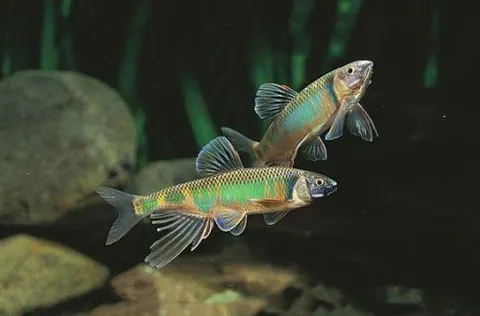
Zacco platypus
The scientific name Zacco platypus refers to the Common Zacco, a member of the family Cyprinidae, well-known as the carps. The habitat of this fish extends across East Asia, found in river systems from the northern…
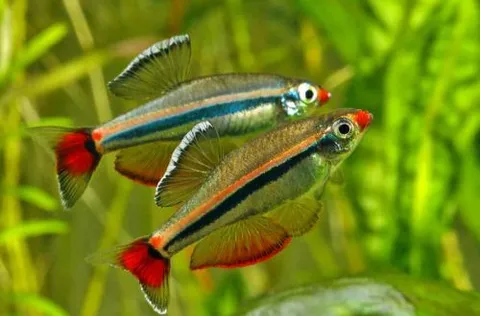
Tanichthys micagemmae
The Vietnamese Cardinal, or Tanichthys micagemmae by its scientific name, belongs to the family Cyprinidae (Carps). This fish was first discovered in 2001 and quickly found its place in home aquariums. It became a…
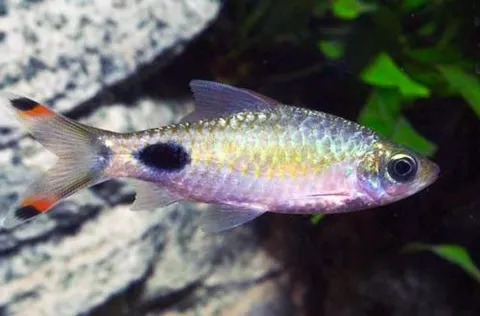
Puntius mahecola
The fish known as Mahecola Barb (scientific name Puntius mahecola) is classified within the family Cyprinidae. It is very popular in Asian countries, especially India, but outside of this region, in Europe and America,…
Puntius sahyadriensis
Puntius sahyadriensis, or Maharashtra Barb, is a member of the Cyprinidae family. Among various barb species, it stands out with its distinctive angular body shape, making it easily recognizable. This species is easy to…