Poeciliidae

Black Guppies

Poecilia reticulata

A form of:Common Guppy

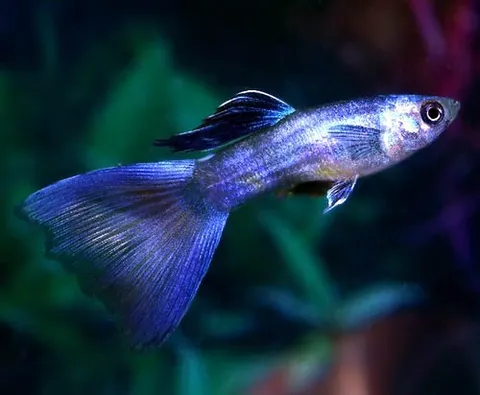
Black Monk Guppies, also known as Black Guppies, are a breed of Poecilia reticulata (Black strain) from the Poeciliidae family. One of the main features of this variety is the pronounced dark body coloration in males. It is not uncommon to notice lighter shades appearing in the head area. As a rule, the size of these fish remains within small to medium. It is rare to find large specimens with a completely uniform coloration, as maintaining a deep black color in the caudal fin proves to be a very difficult task for them.

Tank
from 40 L (11 gal)
Temperature
17 – 28 °C (63 – 82 °F)
Size in aquarium
3 – 6 cm (1.2 – 2.4 in)
Acidity
pH 7–8.5
Natural rangeRange on the map
  • Antigua Barbuda
  • Barbados
  • French Guiana
  • Guyana
  • Suriname
  • Trinidad and Tobago
  • Venezuela

Tank conditions

Plan the tank stocking
Temperature
17 – 28 °C (63 – 82 °F)
Water pH
Neutral (7) – Slightly alkaline (8.5)
Water dH
Medium hardness (10) – Very hard (30)
Water salinity
low (3–5 g/L)
Size in aquarium
3 – 6 cm (1.2 – 2.4 in)
Lifespan
3 years
Temperament
Peaceful (regular)
Toward small fish
not a predator
Required aquarium volume
from 40 L (11 gal)
Lighting
dimmed
Substrate
any (no restrictions)
Water flow
weak or moderate
Swimming level
near the surface
Feeding
Any (universal)
Keeping
Mixed solitary / pair / group
Jumping
noticeable a lid is needed
  • Lifespan. A lifespan to expect under good care, not a measured value: it depends heavily on tank volume, water quality and diet — and for selectively bred forms, on their origin as well.
  • Toward small fish. Based on the Predators category in the catalog or the temperament in the species parameters. “A risk to small fish” means the species is not a predator by habit, yet will swallow any fish that fits in its mouth.
  • Required aquarium volume. This is a husbandry recommendation, not a measured value: the volume depends on the keeping mode (mixed (solitary / pair / group)), footprint, decor and tank mates.

Care and keeping

Description

Black Guppies are a selective breeding form of Poecilia reticulata, distinguished by their rich dark body coloration. Males predominantly display a deep black pigment that can extend to the fins, although many individuals retain lighter areas around the head or on the tail. The fish are small, typically ranging from 3 to 6 cm. Sexual dimorphism is pronounced: males are more slender, have more elaborate fins, and more intense coloration, while females are larger, have a more rounded abdomen, and less saturated color.

Habitat

In nature, wild forms of Poecilia reticulata inhabit waters of Central and South America, preferring areas with slow currents and dense aquatic vegetation. Selectively bred Black Guppies are adapted to a wide range of water parameters, allowing them to thrive in aquariums with hardness from 10 to 30 dGH and pH within 7.0–8.5. The temperature range for the species varies from 17 to 28°C.

Behavior and Compatibility

These are peaceful and active fish, suitable for community tanks with other calm, small-sized species. It is recommended to keep them in small groups, as they exhibit social behavior. Due to their unpretentiousness and compact size, Black Guppies feel comfortable in aquariums from 40 liters, where the presence of live plants is desirable for creating shelters.

Care and Maintenance

Like many other breeds, Black Guppies are undemanding in care and easily bred in a home aquarium. They get along well with many fish species, making them an excellent choice for beginners in aquaristics. Due to their small size and modest requirements, these fish can feel comfortable even in nano-aquariums. Although they are not particularly demanding regarding decor elements, it is still recommended to provide several secluded spots in the aquarium, for example, dense thickets of live plants. In such shelters, fry can find protection, which will inevitably appear if sexually mature males and females are present in the aquarium. Black Monk Guppies adapt well to a wide range of pH and dGH values, allowing them to comfortably exist in soft, very hard, and even brackish water. This feature significantly simplifies the water preparation process: it is sufficient to let it stand before use. A minimal equipment set may include a lighting system and a simple air-driven filter, provided that the number of inhabitants in the tank is small. Aquarium maintenance is standard. It is extremely important to regularly remove accumulated organic waste (food remains, excrement) and weekly refresh part of the water with fresh.
Diet

The species is omnivorous and undemanding regarding its diet. In aquarium conditions, it is recommended to use high-quality dry foods in the form of flakes or granules, supplementing them with live or frozen foods such as brine shrimp, daphnia, or bloodworms. Feeding should be done 2–3 times a day in small portions that the fish can eat within a few minutes, to avoid water pollution.

Breeding and Reproduction

Guppies are livebearing fish, and their breeding in an aquarium is not difficult. Fertilization occurs within the female's body, after which fully formed fry are born 4–5 weeks later. For the survival of offspring in a community tank, dense plant thickets are necessary, where the young can hide from adult individuals. Infusoria, rotifers, or specialized dry foods for fry serve as initial food for the young.

Diseases

The species has strong immunity but is sensitive to sudden changes in water parameters and organic pollution. Common problems include bacterial infections and fungal lesions, often arising from improper keeping conditions. Prevention involves weekly partial water changes, regular substrate cleaning, and maintaining a stable temperature regime.

How to choose

When purchasing, choose active individuals with clean fins and no white spots or film on the body. Healthy fish should show curiosity and constantly move around the aquarium. It is recommended to acquire individuals aged 3–4 months, when their coloration is already fully formed. Avoid buying fish from overcrowded or visually unkempt aquariums with signs of lethargy in the inhabitants.

Compatibility

There are no pair reviews for this species yet — check tankmates in the matcher.

All tankmates

Plants and this fish

Matching water does not mean the plant will stay intact.

Frequently asked questions

The essentials: size, tank volume, water parameters and care

How big does Black Guppies get?

An adult reaches 3–6 cm in length. Plan the tank around the maximum size: the fish quickly outgrows a cramped setup.

What size aquarium does Black Guppies need?

The recommended volume is 40 L. A smaller tank speeds up nitrate build-up and raises stress levels.

What water parameters does Black Guppies need?

Temperature 17–28 °C, pH 7–8.5, hardness 10–30 dGH. Stability matters more than exact values: sudden swings are harder on the fish than a small deviation from the ideal.

How long does Black Guppies live?

Around 3 years when kept properly. Lifespan depends directly on tank volume, water quality and a varied diet.

Is Black Guppies aggressive?

Temperament: peaceful (regular). Keep this in mind when choosing tank mates.

How many Black Guppies should be kept together?

Recommended setup: mixed (solitary / pair / group). Ignoring this is a common cause of stress and disease.

What does Black Guppies eat?

Diet type: any (universal). Feed small portions that are finished within a couple of minutes — overfeeding does more harm than underfeeding.

What is the scientific name of Black Guppies?

The scientific name of the species is Poecilia reticulata, family Poeciliidae. It also appears in the literature as: Acanthophacelus guppii, Acanthophacelus reticulatus, Girardinus guppii.

Similar fishes

Matched by family, categories and overlapping keeping conditions

Albino Guppy

Albino Guppy

Poecilia reticulata

Poeciliidae

The Albino Guppy, belonging to the Poeciliidae family, is known by its scientific name Poecilia reticulata (Albino variety). A distinctive feature of this fish is the congenital absence of melanin – the black pigment in…

Blue Guppies

Blue Guppies

Poecilia reticulata

Poeciliidae

Blue Guppies, known scientifically as Poecilia reticulata (Blue variety), belong to the Poeciliidae family. This name is a generalization and encompasses various breeds where blue is the dominant color. It is mainly…

Cobra Guppy

Cobra Guppy

Poecilia reticulata

Poeciliidae

The Cobra Guppy, scientifically known as Poecilia reticulata (Cobra variety), belongs to the family Poeciliidae. Its distinctive feature is a pattern of vertical stripes running along the posterior part of its body. The…

Common Guppy

Common Guppy

Poecilia reticulata

Poeciliidae

The Common Guppy, also known as the Wild Guppy (scientific name Poecilia reticulata), belongs to the family Poeciliidae. It is distinguished from the numerous selective breeding forms developed by humans by its more…

Other scientific names and conservation status

Other scientific names
Acanthophacelus guppii, Acanthophacelus reticulatus, Girardinus guppii, Girardinus reticulatus, Haridichthys reticulatus, Heterandria guppyi
Poecilia reticulata
strain Black
Conservation status
Least concernLC