Temperature22 – 28 °C
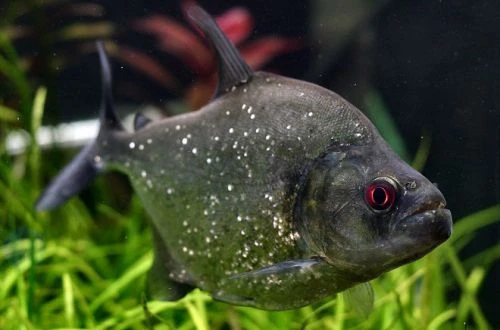
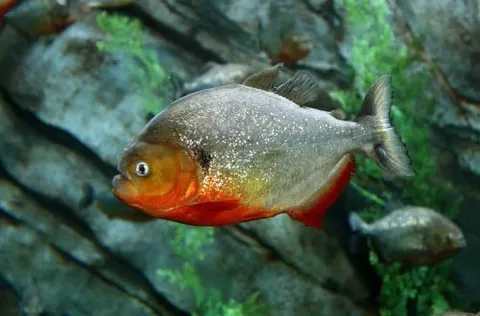
The Rhombic, or Black Piranha, also known as the Red-Eyed Piranha (scientific name Serrasalmus rhombeus), belongs to the subfamily Serrasalminae. This fish is one of the most recognizable. Although its reputation as a fierce predator is somewhat exaggerated, it is rarely found in home aquariums. Due to the complexities of its care, the Black Piranha is not recommended for beginner aquarists.
Adults of this fish can reach a length of 40–45 cm. Sexual dimorphism is weakly expressed, and it is quite difficult to distinguish males from females externally. The fish have a powerful, massive, rhomboid-shaped body. Their coloration can vary depending on the region of origin: specimens from areas with dark, brown water will have an almost black hue, while those living in murky waters acquire gray tones. A characteristic feature of this species is its red eyes.
This species is believed to be widely distributed across a significant territory of South America. Its range covers countries such as Venezuela, Guyana, Suriname, French Guiana, Colombia, Ecuador, Peru, Bolivia, and Brazil. However, biologists still debate the true boundaries of its habitat. The fish prefers to stay in large river systems, mainly in deep waters and regions with fast currents. Juveniles typically inhabit calmer, vegetation-rich waters.
A common misconception is that piranhas live in schools. However, in reality, this species leads a solitary lifestyle and is quite jealous of the presence of conspecifics. If kept together, the weakest individual may be killed. They only gather in schools during feeding, when large prey is involved. Despite their predatory nature, it is quite possible to select a few tank mates, for example, large armored catfish with good protection in the form of spines.
It is advisable to entrust the installation and maintenance of an aquarium for this species to professionals. Even with sufficient financial resources, it can be challenging for a beginner aquarist to keep such a large predatory fish, which also produces a lot of waste due to its diet. The minimum tank volume for a single specimen starts from 500 liters. The decor includes a sandy substrate and several snags that serve as shelters. Live plants are allowed, but are often uprooted, so artificial ones serve as a good alternative. To maintain high water quality, a powerful filtration system and regular removal of organic waste will be required. In addition, a mandatory procedure is to replace approximately 50% of the water volume. There are many nuances in keeping the Black Piranha, but this article does not intend to cover them in more detail, as such a fish is not considered suitable for amateur aquaristics.
These fish feed on both live and dead prey. In the wild, schools of Black Piranhas often attack injured fish and animals. In aquarium conditions, the diet depends on the fish's history. Recently caught specimens are quite finicky, and their diet should closely match their natural one. Acclimatized fish accept live or frozen foods such as pieces of mussels, shrimp, squid, and other fish. Young individuals can be offered earthworms, insects, and small crustaceans. The fish should be fed 2–3 times a week. It is periodically recommended to simulate fasting periods by limiting feeding. They must not be fed mammalian or avian meat: the lipids it contains cannot be properly metabolised by the fish and lead to excess fat deposits and even organ degeneration.
The first offspring of Black Piranhas were obtained in the 1970s at the Duisburg Zoo (Germany). Cases of successful breeding in an artificial aquarium environment are quite rare. Today, commercial fish farms are the main suppliers of juveniles.
Thanks to their diet, these fish have an excellent immune system. Health problems arise exclusively due to deteriorating living conditions.
When choosing a black piranha, it should be noted that it is a large and territorial predator requiring specific keeping conditions. A healthy specimen should be active, without visible scale damage, ulcers, or signs of fungal infections. It is important to pay attention to the fish's behavior in the aquarium: it should not appear apathetic or constantly hide, although timidity is a natural trait of the species. The eyes should be clear, without cloudiness. When purchasing, it is necessary to consider the risk of misidentification, as juveniles are often confused with other piranha species. In young Serrasalmus rhombeus, the characteristic red eye coloration only appears when they reach a size of about 12–15 cm. It is recommended to ask the seller about the fish's origin, as water parameters for comfortable adaptation can vary significantly depending on the region of capture. Avoid acquiring specimens with deformed fins or signs of emaciation, as the recovery of such fish in home conditions is difficult.
The essentials: size, tank volume, water parameters and care
An adult reaches 45 cm in length. Plan the tank around the maximum size: the fish quickly outgrows a cramped setup.
The recommended volume is 500 L. A smaller tank speeds up nitrate build-up and raises stress levels.
Temperature 22–28 °C, pH 4.5–7.5, hardness 1–20 dGH. Stability matters more than exact values: sudden swings are harder on the fish than a small deviation from the ideal.
Around 15 years when kept properly. Lifespan depends directly on tank volume, water quality and a varied diet.
Temperament: aggressive / incompatible / unfriendly. This is a predatory species — any fish small enough to fit in its mouth will eventually be eaten.
Recommended setup: solitary. Ignoring this is a common cause of stress and disease.
Diet type: meat / protein (live, frozen, fresh). Feed small portions that are finished within a couple of minutes — overfeeding does more harm than underfeeding.
The scientific name of the species is Serrasalmus rhombeus, family Piranhas (Serrasalmidae). It also appears in the literature as: Pygocentrus niger, Pygocentrus normani, Salmo rhombeus.
The water suits 33 of 208 plants in the catalogue — the easiest ones are shown first.
African Water FernAmazon FrogbitAnubiasAsian WatermossBlue BuceBuceChristmas MossDwarf African FernFloating CrystalwortFloating Water SpriteGiant VallisneriaGlobefruit LudwigiaGreater DuckweedJapanese RushJava FernJava MossJungle ValNair's LagenandraPelliaSchismatoglottisStringy MossSüsswassertangTaiwan MossWater Spangles
This fish digs through the substrate and pulls rooted plants out.
African Onion PlantAfzelius's AnubiasAmazon SwordAnacharisArrowhead CryptBalansa Water TrumpetBanana PlantBarth's SwordBeckett's Water TrumpetBladderwort CarpetBlyxaBog MossBoivin's AponogetonBolivian Chain SwordBrazilian PennywortBroad-leaf Water SpriteBrookweedBrown's LimnophilaCardinal PlantCaribbean MintCarolina Micro SwordCognac AmmanniaCongo AnubiasCreeping JennyCreeping RushCreeping SpotflowerCreeping StaurogyneCrinkled AponogetonCupheaCutleaf WatermilfoilCylindricfruit LudwigiaDark SwordDelta ArrowheadDense MayacaDitch StonecropDwarf AmbuliaDwarf Baby TearsDwarf CloverDwarf CloverDwarf Hairgrass
Matched by family, categories and overlapping keeping conditions
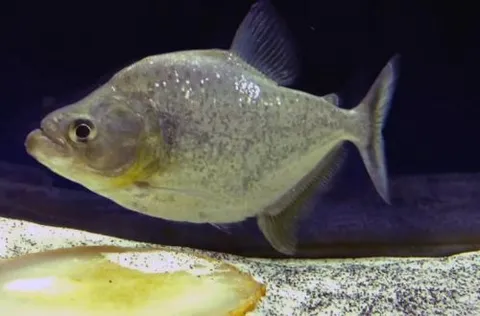
Serrasalmus brandtii
The White Piranha, also known as Brandt's Piranha (Serrasalmus brandtii), is a member of the family Serrasalmidae. Its name commemorates the German naturalist Johann Friedrich von Brandt (1802–1879); the species itself…
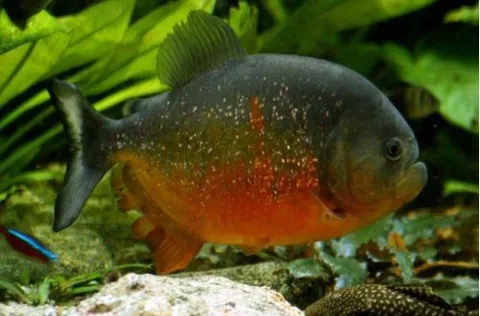
Pygocentrus piraya
Scientifically named Pygocentrus piraya, belonging to the family Serrasalmidae, this is the common piranha, also known as the São Francisco piranha. It's important to note that the name does not refer to the city of the…
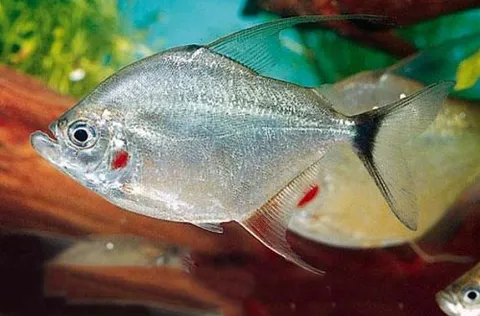
Catoprion mento
The Wimple Piranha, known scientifically as Catoprion mento, is classified in the family Serrasalmidae, or Piranhas. It is interesting to note that, despite its name, this species is not part of the group of classic…
Pygocentrus cariba
The Blackspot Piranha, scientifically known as Pygocentrus cariba, belongs to the Serrasalmidae family and is considered one of the most famous predators of river depths. Despite its widespread notoriety, few aquarists…