Temperature20 – 28 °C
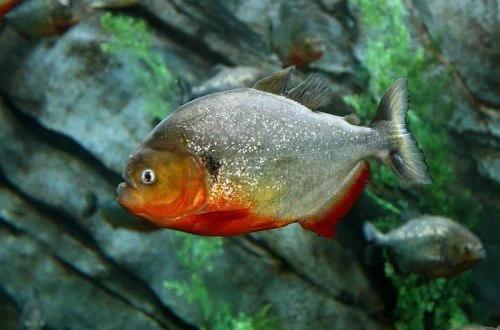
The Blackspot Piranha, scientifically known as Pygocentrus cariba, belongs to the Serrasalmidae family and is considered one of the most famous predators of river depths. Despite its widespread notoriety, few aquarists keep this fish due to its high acquisition cost and complex care requirements.
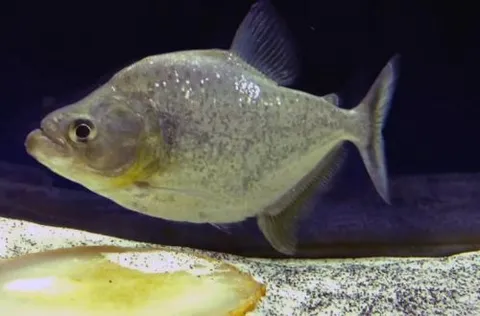
Adult Blackspot Piranhas reach a length of 25–35 cm, with females typically being somewhat larger. Their bodies are massive, oval-shaped, and strongly compressed laterally. Outwardly, they are almost indistinguishable from a related species, the Red-bellied Piranha. Their coloration is characterized by a gray hue and silvery scales; under certain lighting, the fish can appear almost entirely white. The belly, lower part of the head, and anal fin are red. A distinctive feature is a dark spot located behind the operculum.
The natural habitat of the black-spot piranha is the Orinoco basin in South America, a territory covering vast regions of Colombia and Venezuela. Its range extends over almost 600,000 square kilometres. The species is widespread in the main river channels and floodplain lakes, and when the annual rains begin these piranhas move into the flooded areas of the rainforest.
Significant difficulties will arise when selecting tank mates for the Blackspot Piranha. If the piranhas are consistently well-fed, other fish may be relatively safe, provided they are comparable in size or significantly larger. Any small fish will inevitably be perceived as a food source. Intraspecific relationships are also complex: although they live in large groups in nature, this is primarily a defense mechanism against other predators. In the confined space of aquariums, where there is no external danger, it is not uncommon for a stronger individual to kill a weaker one. As a result, only one individual from the entire group may survive. It is advisable to keep a single fish, but with a very large tank, it might be possible to increase the number to 5–6 individuals or more.
Keeping a Blackspot Piranha requires a tank with a base of at least 240 × 90 cm and a depth of 60 cm — about 1300 litres. If a small shoal is planned, the volumes increase significantly, which is due to their behavioral characteristics, as will be discussed below. The aquarium decor for the Blackspot Piranha is not of fundamental importance; on the contrary, it is recommended to exclude certain decorative elements. For example, live plants will likely be eaten or uprooted from the substrate. Water quality is critically important. Since these fish produce a lot of waste, the filtration system is under significant load. High-performance external filters are essential here. In addition, it is necessary to replace a portion of the water weekly with fresh water, at least 30–50% of the total volume. In large aquariums, connecting to an automatic water change system is advisable. It is worth noting that piranhas go beyond typical amateur aquaristics, so this article does not cover all the intricacies of their keeping. Often, specialized companies or invited experts handle the maintenance of aquariums with these fish, leaving the owner to simply enjoy their “predatory” pets.
Although the piranha is often portrayed as a ferocious predator, its diet is actually quite diverse and includes not only live fish but also aquatic invertebrates, insects, as well as nuts, seeds, and fruits. In nature, they may pursue and eat weakened or dying fish. Contrary to legends spread by movies, piranhas do not attack animals and humans in the water; biting incidents are extremely rare. In a home aquarium, young fish can be fed bloodworms and small earthworms. Adult individuals readily accept pieces of fish meat and mussels, whole shrimp, and large earthworms. They must not be fed mammalian or avian meat: the lipids it contains cannot be properly metabolised by the fish and lead to excess fat deposits and even organ degeneration.
As of the writing of this article, there have been no recorded cases of Blackspot Piranha breeding in home aquariums. In wild populations, two reproductive cycles are observed: one at the beginning of the rainy season, and another at the end of the year, in November or December. Spawning sites are dense thickets of aquatic plants.
This fish is distinguished by its hardiness and unpretentiousness. Health problems are most often associated with injuries, inadequate nutrition, or unsuitable water composition. When signs of illness appear, such as lethargy, changes in body shape, or loss of appetite, it is often enough to normalize the keeping conditions for the fish's body to cope with the ailment. However, in some cases, medication may be required.
When choosing a Blackspot Piranha, preference should be given to individuals with active behavior that show curiosity about their surroundings. A healthy fish should have clean, tightly adhering scales without signs of damage, ulcers, or white film, as well as clear eyes without cloudiness. It is important to ensure there are no jaw or fin deformities, as any injuries in an aquarium environment can lead to secondary infections. — avoid individuals that appear lethargic, constantly stay near the water surface, or, conversely, hide in the corners of the aquarium — pay attention to the overall condition of the shoal: if there are many fish in the aquarium with damaged fins or bite marks, this may indicate excessive aggression, stress, or poor keeping conditions — ask the seller about the fish's current diet, as a sudden change in accustomed food can provoke refusal to eat and weaken the immune system.
The essentials: size, tank volume, water parameters and care
An adult reaches 25–35 cm in length. Plan the tank around the maximum size: the fish quickly outgrows a cramped setup.
The recommended volume is 1300 L. A smaller tank speeds up nitrate build-up and raises stress levels.
Temperature 20–28 °C, pH 4–7, hardness 1–10 dGH. Stability matters more than exact values: sudden swings are harder on the fish than a small deviation from the ideal.
Around 10 years when kept properly. Lifespan depends directly on tank volume, water quality and a varied diet.
Temperament: aggressive / incompatible / unfriendly. This is a predatory species — any fish small enough to fit in its mouth will eventually be eaten.
Recommended setup: both solitary and in group (flexible). Ignoring this is a common cause of stress and disease.
Diet type: high protein (predominantly meat). Feed small portions that are finished within a couple of minutes — overfeeding does more harm than underfeeding.
The scientific name of the species is Pygocentrus cariba, family Piranhas (Serrasalmidae). It also appears in the literature as: Pygocentrus caribe, Pygocentrus notatus, Pygocentrus stigmaterythraeus.
The water suits 33 of 208 plants in the catalogue — the easiest ones are shown first.
African Water FernAmazon FrogbitAnubiasAsian WatermossBlue BuceBuceChristmas MossDwarf African FernFloating CrystalwortFloating Water SpriteGiant VallisneriaGlobefruit LudwigiaGreater DuckweedJapanese RushJava FernJava MossJungle ValNair's LagenandraPelliaSchismatoglottisStringy MossSüsswassertangTaiwan MossWater Spangles
This fish digs through the substrate and pulls rooted plants out.
African Onion PlantAfzelius's AnubiasAmazon SwordAnacharisArrowhead CryptBalansa Water TrumpetBanana PlantBarth's SwordBeckett's Water TrumpetBladderwort CarpetBlyxaBog MossBoivin's AponogetonBolivian Chain SwordBrazilian PennywortBroad-leaf Water SpriteBrookweedBrown's LimnophilaCardinal PlantCaribbean MintCarolina Micro SwordCognac AmmanniaCongo AnubiasCreeping JennyCreeping RushCreeping SpotflowerCreeping StaurogyneCrinkled AponogetonCupheaCutleaf WatermilfoilCylindricfruit LudwigiaDark SwordDelta ArrowheadDense MayacaDitch StonecropDwarf AmbuliaDwarf Baby TearsDwarf CloverDwarf CloverDwarf Hairgrass
Matched by family, categories and overlapping keeping conditions
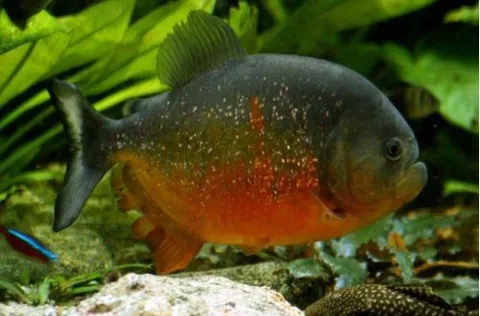
Pygocentrus piraya
Scientifically named Pygocentrus piraya, belonging to the family Serrasalmidae, this is the common piranha, also known as the São Francisco piranha. It's important to note that the name does not refer to the city of the…
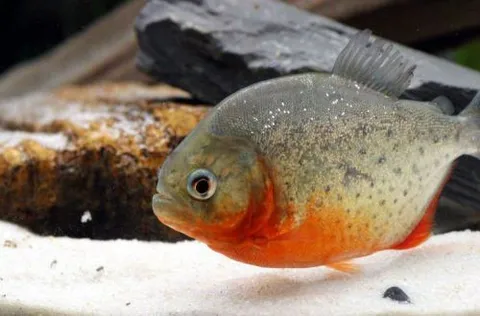
Pygocentrus nattereri
The Red-bellied Piranha, scientifically known as Pygocentrus nattereri, belongs to the family Serrasalmidae. This fish is frequently mentioned, and its notoriety has been significantly cemented by numerous Hollywood…
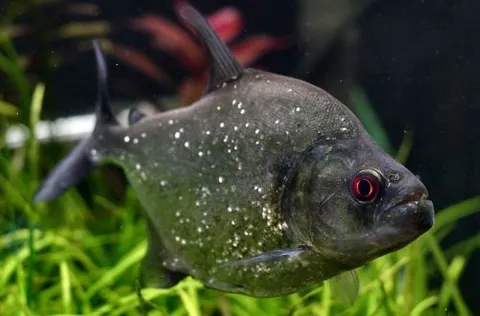
Serrasalmus rhombeus
The Rhombic, or Black Piranha, also known as the Red-Eyed Piranha (scientific name Serrasalmus rhombeus), belongs to the subfamily Serrasalminae. This fish is one of the most recognizable. Although its reputation as a…
Serrasalmus brandtii
The White Piranha, also known as Brandt's Piranha (Serrasalmus brandtii), is a member of the family Serrasalmidae. Its name commemorates the German naturalist Johann Friedrich von Brandt (1802–1879); the species itself…