Temperature20 – 24 °C
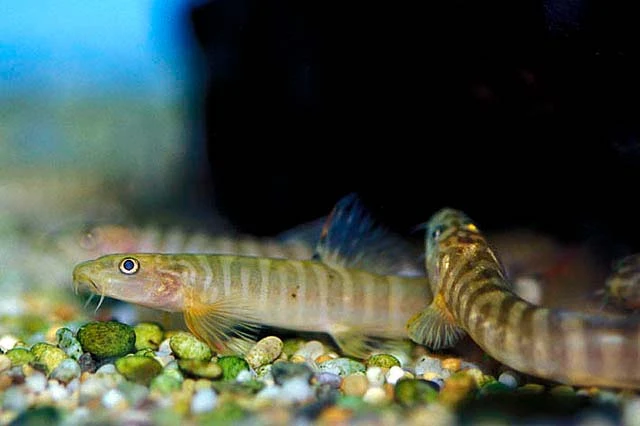
Schistura notostigma, commonly known as the Ceylon loach, belongs to the family Nemacheilidae (river loaches). This fish is endemic to the island of Sri Lanka, formerly known as Ceylon. Its natural habitat is fast-flowing mountain streams, where it prefers shallow areas with a stony bottom.
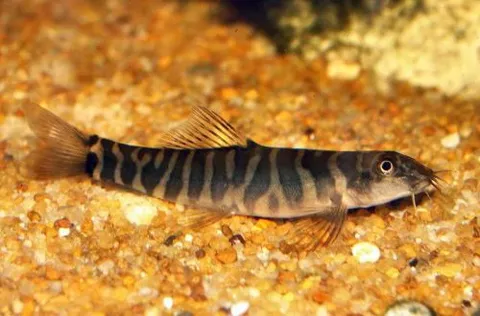
Adults of this species reach approximately 6 cm in length. The fish has an elongated, slightly cylindrical body, with a small head and short fins. The coloration consists of a series of dark vertical bands alternating with a gray or yellowish background on the back. A distinct, contrasting black band runs at the base of the tail.
The species is endemic to Sri Lanka. It inhabits fast-flowing mountain streams with a stony or gravel bottom. It prefers shallow waters with high dissolved oxygen content and strong currents. In nature, the fish are often found in areas with clean, clear water, where they move among stones and pebbles.
This fish has a rather temperamental and quarrelsome nature. In small aquariums, territorial skirmishes are inevitable and can be quite fierce. Despite this behavior, the Ceylon loach needs the presence of conspecifics. For small tanks (80–100 liters), it is recommended to keep a group of 2–3 individuals. Conflicts can arise not only between conspecifics but also with other species, especially bottom dwellers. Suitable tank mates include fish that inhabit the water column or surface, capable of tolerating moderate to strong currents.
The optimal aquarium volume for keeping a group of 2–3 fish starts from 80–100 liters. In terms of decor, attention should be paid to the bottom layer, as loaches are benthic. Coarse-grained sand combined with stones, boulders, and driftwood is suitable for the substrate. Among aquatic plants, unpretentious species that can attach to hard surfaces are preferred, such as Anubias, Bucephalandra, as well as various mosses and ferns, as they do not require rooting in the substrate. The Ceylon loach, originating from mountain rivers with strong currents, prefers similar conditions. Therefore, it is important to ensure sufficiently strong water circulation in the aquarium, using a separate pump or a high-performance filtration system. Long-term success largely depends on the aquarist's ability to maintain clean, oxygen-rich water and relatively low temperatures, not exceeding 24°C.
Fish can be accustomed to dry sinking foods, such as flakes or granules, although they show a clear preference for live food, such as bloodworms.
Reliable information on the breeding of Schistura notostigma in aquarium conditions is not available. Scientific literature notes that sexually mature individuals of this species require specific conditions, as close as possible to natural mountain streams, but successful cases of offspring production in captivity have not been described.
Specific diseases for this species have not been described. The main factor for health is maintaining high water quality and sufficient aeration. Fish are extremely sensitive to low oxygen levels and the accumulation of organic waste, which, under poor keeping conditions, quickly leads to a weakened immune system and the development of bacterial infections.
When choosing, pay attention to the fish's activity: healthy individuals are constantly moving, exploring the substrate, and have a robust physique without signs of emaciation. Avoid specimens with damaged fins, body film, or sunken bellies. Given that the species often comes into sale as bycatch with other loaches, it is important to ensure correct species identification.
The essentials: size, tank volume, water parameters and care
An adult reaches 6–6.3 cm in length. Plan the tank around the maximum size: the fish quickly outgrows a cramped setup.
The recommended volume is 80 L. A smaller tank speeds up nitrate build-up and raises stress levels.
Temperature 20–24 °C, pH 6–8, hardness 5–15 dGH. Stability matters more than exact values: sudden swings are harder on the fish than a small deviation from the ideal.
Around 4 years when kept properly. Lifespan depends directly on tank volume, water quality and a varied diet.
Temperament: aggressive / incompatible / unfriendly. Keep this in mind when choosing tank mates.
Recommended setup: small group (3–4 individuals). Ignoring this is a common cause of stress and disease.
Diet type: sinking (any). Feed small portions that are finished within a couple of minutes — overfeeding does more harm than underfeeding.
The scientific name of the species is Schistura notostigma, family Nemacheilidae. It also appears in the literature as: Nemacheilus notostigma, Nemachilus notostigma, Noemacheilus notostigma.
The water suits 196 of 208 plants in the catalogue — the easiest ones are shown first.
Afzelius's AnubiasAnacharisAnubiasBrazilian PennywortDwarf CloverDwarf CloverDwarf HygrophilaDwarf SagittariaDwarf ValGuppy GrassHornwortJava FernJava MossMoneywortMud SwordNarrow Leaf AnacharisNarrow-leaf CloverStringy MossSüsswassertangTaiwan MossTape GrassTemple PlantUssuri WatermilfoilWater Wisteria
Matched by family, categories and overlapping keeping conditions
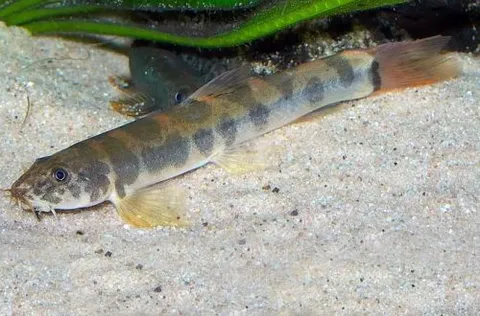
Schistura spilota
Schistura spilota, also known by its scientific name Schistura spilota, is a representative of the family Nemacheilidae. This fish is a rather rare guest among aquarium enthusiasts. Since 2016, it has been available on…
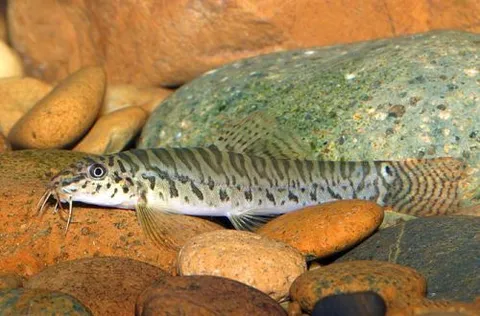
Paracanthocobitis pictilis
Paracanthocobitis pictilis, also known as the Burmese Border Loach, belongs to the family Nemacheilidae. Previously, this species was assigned to the genus Acanthocobitis, but the name "Acanthocobitis" was subsequently…
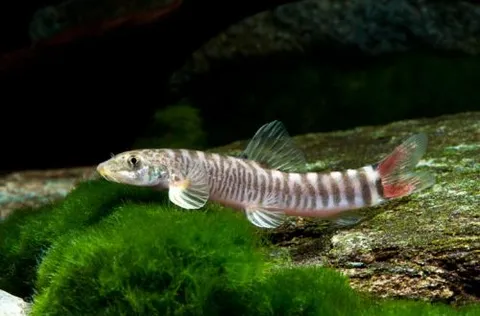
Schistura vinciguerrae
Schistura vinciguerrae, also known as Vinciguerra's loach, belongs to the family Nemacheilidae. It was named after the zoologist Decio Vinciguerra, who made significant contributions to the study of fish species…
Mustura maepaiensis
The fish, known scientifically as Mustura maepaiensis, belongs to the family Nemacheilidae and is called Schistura Mae Hong Son. This name comes from the mountainous province of Mae Hong Son in north-western Thailand,…