Temperature20 – 26 °C
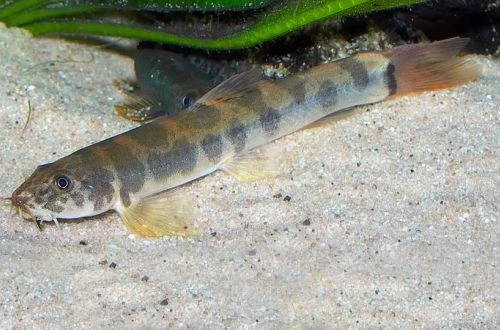
Schistura spilota, also known by its scientific name Schistura spilota, is a representative of the family Nemacheilidae. This fish is a rather rare guest among aquarium enthusiasts. Since 2016, it has been available on a regular basis, whereas previously it only occasionally appeared in shipments along with other loaches. Despite being easy to keep, Schistura is not known for its peaceful disposition, which limits the range of compatible species.
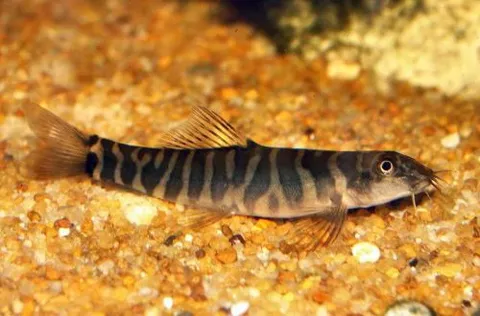
Adults of this fish reach 9–10 cm in length. Their body is elongated, resembling an eel. The head is small, and barbels are located around the mouth, helping them find food in rock crevices. All fins are short. The pelvic and pectoral fins, shifted downwards, have a pale yellow tint; they serve as a support on which the fish rests, pressing against the bottom. The caudal fin is also modest in size, red, with a black stripe at the base. The body is adorned with a pattern of large dark gray spots on a light background, with some spots on the sides of the body taking on a rounded shape. Sexual dimorphism is weakly expressed. Males can be distinguished by their enlarged “cheeks” when viewed from above.
The natural habitats of this fish are located in the northwestern part of Thailand, in Southeast Asia. Its range is limited to the Mae Nam Ping River basin (Ping River) in Chiang Mai Province. The river flows through mountainous terrain, where the current varies from calm to turbulent, abounding in cascades and rapids. The bottom here is covered with sand, stones, boulders, and snags. Aquatic vegetation is mainly concentrated along the banks.
These fish cannot be called peaceful. They exhibit pronounced territoriality and may conflict with other bottom-dwelling species. For tankmates, it is best to choose active fish that inhabit the water column or surface, such as danios, barbs, and similar species. To minimize skirmishes within the group, each individual needs sufficient space and hiding places.
For keeping 3–4 individuals of the Spotted Schistura, an aquarium of at least 100 liters will be required. Caring for this fish is not difficult if several key conditions are met: ensuring clean, oxygen-rich water and moderate current. These tasks are easily solved by installing powerful internal filters, regular partial water changes (30–50% of the total volume), and timely removal of organic waste. For aquarium decoration, it is sufficient to use sandy or rocky substrate, creating piles of stones and snags. If desired, artificial plants or undemanding live vegetation that can attach to driftwood and withstand strong currents can be added. Such species include, for example, Anubias, Bucephalandra, Crinum, as well as some types of aquatic mosses and ferns.
In their natural environment, these fish feed on small insects, worms, crustaceans, and other zooplankton. In a home aquarium, they readily accept dry foods of appropriate size. However, one should not be limited to these alone. Live or frozen Artemia, bloodworms, and similar products make a useful addition to their diet.
As of the preparation of this material, the authors have not found reliable information about successful cases of breeding Spotted Schistura in artificial conditions in home aquariums.
Health problems in these fish arise only in the presence of injuries or keeping in unsuitable conditions, which leads to a weakening of the immune system and the subsequent occurrence of various diseases. At the first signs of illness, it is necessary first to check the water parameters for exceeding permissible values or the presence of toxic substances (such as nitrites, nitrates, ammonia). If deviations are found, all indicators should be normalized, and then treatment should begin.
When choosing a spotted schistura, pay attention to the fish's activity and the condition of its skin. Healthy individuals should be active, curious, and actively explore the bottom, rather than constantly hiding in the corners of the aquarium. Avoid specimens with damaged fins, ulcers, whitish growths, or signs of emaciation, where the fish's abdomen appears severely sunken. Since this species exhibits pronounced territoriality, skirmishes between individuals can often be observed in the store. When purchasing a group of fish, it is recommended to choose specimens of similar size to minimize the risk of one fish dominating the others. It is also worth asking the seller what the fish are currently eating: healthy individuals should show interest in quality sinking foods or frozen products. Given the species' high sensitivity to water quality, it is best to refrain from purchasing fish if there are signs of unsatisfactory environmental conditions in the store's general aquarium.
The essentials: size, tank volume, water parameters and care
An adult reaches 9–10 cm in length. Plan the tank around the maximum size: the fish quickly outgrows a cramped setup.
The recommended volume is 100 L. A smaller tank speeds up nitrate build-up and raises stress levels.
Temperature 20–26 °C, pH 6–7.5, hardness 2–12 dGH. Stability matters more than exact values: sudden swings are harder on the fish than a small deviation from the ideal.
Around 6 years when kept properly. Lifespan depends directly on tank volume, water quality and a varied diet.
Temperament: aggressive / incompatible / unfriendly. Keep this in mind when choosing tank mates.
Recommended setup: both solitary and in group (flexible). Ignoring this is a common cause of stress and disease.
Diet type: sinking (any). Feed small portions that are finished within a couple of minutes — overfeeding does more harm than underfeeding.
The scientific name of the species is Schistura spilota, family Nemacheilidae. It also appears in the literature as: Nemacheilus spilotus, Noemacheilus spilotus.
The water suits 197 of 208 plants in the catalogue — the easiest ones are shown first.
Afzelius's AnubiasAnacharisAnubiasBrazilian PennywortDwarf CloverDwarf CloverDwarf HygrophilaDwarf SagittariaDwarf ValGuppy GrassHornwortJava FernJava MossMoneywortMud SwordNair's LagenandraNarrow Leaf AnacharisNarrow-leaf CloverStringy MossSüsswassertangTaiwan MossTape GrassTemple PlantUssuri Watermilfoil
Matched by family, categories and overlapping keeping conditions
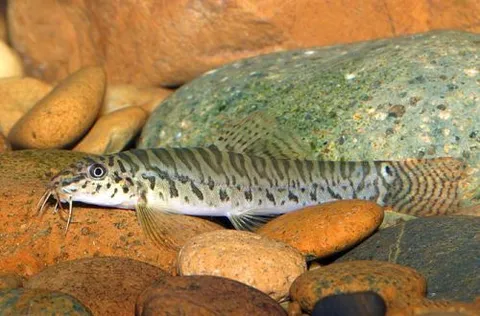
Paracanthocobitis pictilis
Paracanthocobitis pictilis, also known as the Burmese Border Loach, belongs to the family Nemacheilidae. Previously, this species was assigned to the genus Acanthocobitis, but the name "Acanthocobitis" was subsequently…
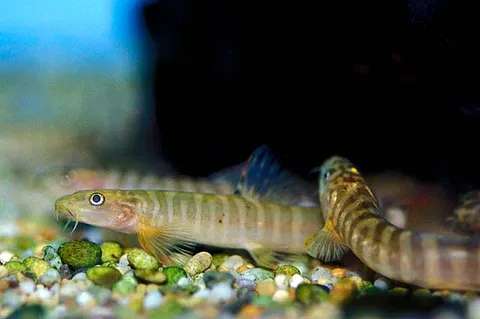
Schistura notostigma
Schistura notostigma, commonly known as the Ceylon loach, belongs to the family Nemacheilidae (river loaches). This fish is endemic to the island of Sri Lanka, formerly known as Ceylon. Its natural habitat is…
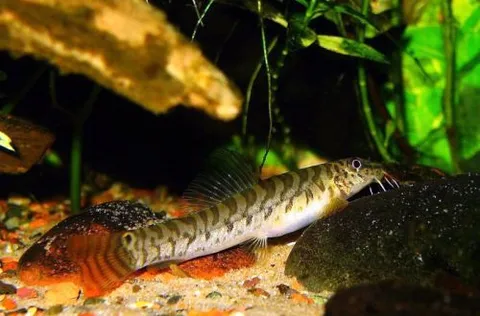
Acanthocobitis botia
Acanthocobitis botia, also known as the Spotted Loach, belongs to the family Nemacheilidae. These peaceful fish coexist easily with many tropical species. They are undemanding in care and do not entail significant…
Mustura maepaiensis
The fish, known scientifically as Mustura maepaiensis, belongs to the family Nemacheilidae and is called Schistura Mae Hong Son. This name comes from the mountainous province of Mae Hong Son in north-western Thailand,…