Temperature22 – 26 °C
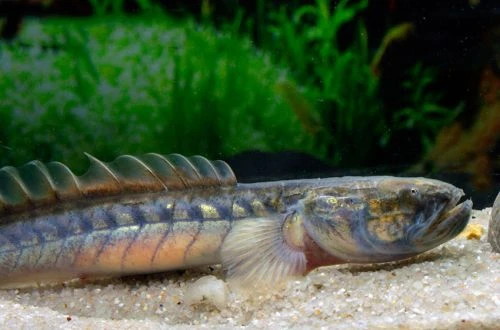
This fish, known by several names such as "Purple Goby," Peruvian Goby, or Dragon Goby, has the scientific name Gobioides broussonnetii and belongs to the family Gobiidae. Its appearance is quite bizarre, resembling the snake-like dragons of Chinese folklore. However, despite its formidable look, its behavior is peaceful and calm.
In their natural habitat, adults can reach lengths of 60 cm or more, but in aquarium conditions, their size is somewhat smaller. Sexual dimorphism in this species is weakly expressed; obvious external differences between male and female are practically absent. The fish has a long, snake-like body with a large head and a wide mouth. The dorsal fin, resembling a crest, extends along the entire length of the body. The coloration is usually gray with a bluish tint.
This species inhabits the American continents, occupying a vast range from the southern states of the USA to the northeastern part of South America, including the Caribbean islands. It can be found everywhere, most often in the estuaries and deltas of small rivers that have brackish water and flow into the ocean.
This species is characterized by a calm and non-aggressive nature. It is capable of both solitary existence and living in a group. Coexistence with other fish from brackish systems is quite possible, provided they are not overly active or too small. Although the Dragon Goby is herbivorous, there is a possibility of accidental consumption of very small tank mates.
For this not-too-active fish, the optimal aquarium volume starts from 450 liters. For decoration, a soft sand substrate at least 7–10 cm thick is recommended, as the Peruvian Goby tends to partially burrow into the substrate. It is also advisable to create several shelters, for example, from driftwood, grottoes, or crevices formed by rock formations. A simple solution can be using a hollow plastic pipe of suitable diameter. Any plants suitable for brackish water can be used, provided they are properly adapted. One of the key difficulties in keeping this species is maintaining stable water parameters with appropriate salinity. The salt concentration should be approximately one-quarter of marine water, which corresponds to a range of 5 to 15 grams per 1 liter of water. For this reason, it is recommended to purchase equipment and life support system components designed for marine aquariums.
Despite its impressive appearance, the Dragon Goby adheres to a plant-based diet. Its diet primarily consists of filamentous algae and detritus. In a home aquarium, it can be trained to eat dry sinking foods specifically formulated on a plant basis.
Breeding the Dragon Goby in aquarium conditions is extremely difficult and practically unheard of in amateur practice. In nature, this species inhabits estuaries, and the larvae develop in a marine environment, which requires a complex change in water salinity for successful reproduction. There is no reliable data on mass successful breeding in home aquariums.
Health problems in this species can arise from prolonged exposure to unfavorable conditions or an inadequate diet. In general, however, it is a fairly hardy fish.
When purchasing, attention should be paid to the fish's activity and the condition of its skin. Healthy individuals should show interest in foraging in the substrate, have no fin damage, ulcers, or signs of emaciation. Due to the specific keeping conditions, it is important to ensure that the fish does not appear lethargic or too thin, as Dragon Gobies often arrive for sale after long transportation and may have difficulty adapting to a typical aquarium diet.
The essentials: size, tank volume, water parameters and care
An adult reaches 30–60 cm in length. Plan the tank around the maximum size: the fish quickly outgrows a cramped setup.
The recommended volume is 450 L. A smaller tank speeds up nitrate build-up and raises stress levels.
Temperature 22–26 °C, pH 7.5–9, hardness 10–25 dGH. Stability matters more than exact values: sudden swings are harder on the fish than a small deviation from the ideal.
Around 10 years when kept properly. Lifespan depends directly on tank volume, water quality and a varied diet.
Temperament: semi-peaceful (dangerous to smaller ones). Not a predatory species, but small fish that fit in its mouth will eventually be eaten.
Recommended setup: both solitary and in group (flexible). Ignoring this is a common cause of stress and disease.
Diet type: plant-based with meat additives. Feed small portions that are finished within a couple of minutes — overfeeding does more harm than underfeeding.
The scientific name of the species is Gobioides broussonnetii, family Gobiidae. It also appears in the literature as: Amblyopus brasiliensis, Amblyopus broussonetii, Amblyopus mexicanus.
The water suits 114 of 208 plants in the catalogue — the easiest ones are shown first.
African Onion PlantAfzelius's AnubiasAmazon FrogbitAmazon SwordAnacharisAnubiasArrowhead CryptDwarf CloverDwarf CloverDwarf HygrophilaDwarf SagittariaDwarf ValGuppy GrassHornwortJava MossMoneywortMud SwordNair's LagenandraNarrow Leaf AnacharisNarrow-leaf CloverStringy MossTaiwan MossTape GrassUssuri Watermilfoil
Matched by family, categories and overlapping keeping conditions
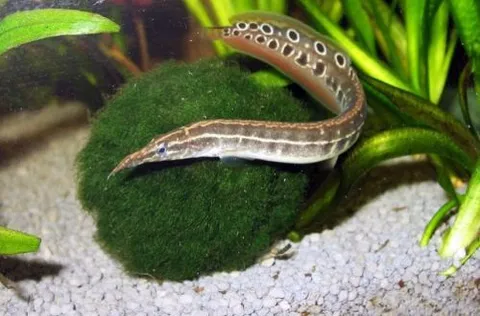
Macrognathus aculeatus
The Spiny Eel, also known as the Spotted Spiny Eel (scientific name Macrognathus aculeatus), belongs to the family Mastacembelidae. This species has a reclusive nature, making it one of the least conspicuous inhabitants…
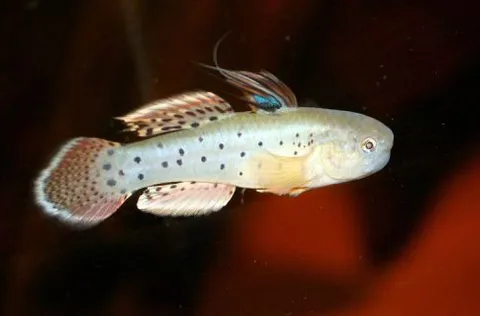
Stigmatogobius sadanundio
The Knight Goby, also known as the Spotted Goby (scientific name Stigmatogobius sadanundio), belongs to the family Gobiidae. Keeping them may not be the easiest, as they require brackish water and careful selection of…
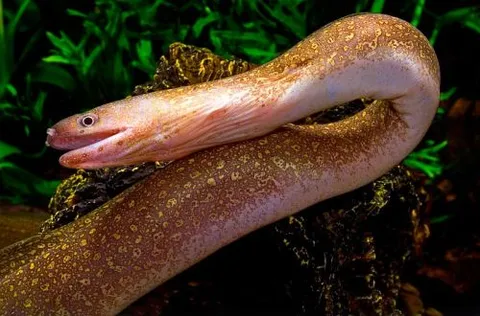
Gymnothorax tile
The scientific name Gymnothorax tile belongs to the Muraenidae family. This species is known as the freshwater or Indian mud moray eel. This exotic fish, although often considered an inhabitant of marine aquariums, is…
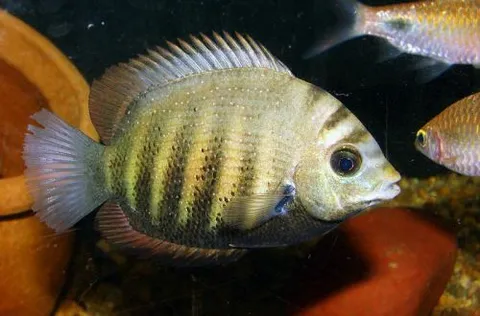
Etroplus suratensis
The scientific name for this cichlid species is Etroplus suratensis, but it is commonly known as the Banded Chromide or Green Chromide. Due to its significant size and rather subdued coloration, this species has not…