Temperature20 – 28 °C
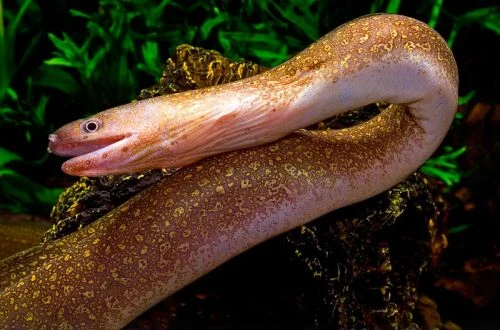
The scientific name Gymnothorax tile belongs to the Muraenidae family. This species is known as the freshwater or Indian mud moray eel. This exotic fish, although often considered an inhabitant of marine aquariums, is not a truly freshwater species. It requires brackish water for comfortable existence. Due to a number of difficulties in keeping them, these moray eels are not recommended for beginner aquarists, especially those planning to care for an aquarium independently.
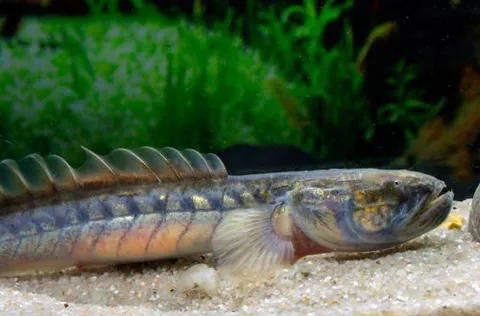
Adults of this moray eel can reach a length of 40 to 60 cm. The fish's appearance resembles an eel or a snake, due to its long body. The body is devoid of fins and covered with a layer of mucus, which serves as protection from damage when the moray eel navigates through various shelters. The coloration and pattern on the body can vary greatly, depending on the specific region of origin. Colors can range from pale gray or brownish to dark shades, often with numerous bright spots. The belly is usually light. These differences in coloration once caused confusion, and some researchers divided this species into several independent subspecies.
Its natural range covers the coastal areas of the eastern Indian Ocean, extending from India to Australia. The estuary of the Ganges River is considered a particularly characteristic habitat. The moray eel prefers to live in transitional zones where marine water mixes with fresh water. It inhabits the bottom, finding refuge in crevices, fissures, and among snags.
Due to its predatory behavior and specific requirements for keeping conditions, the choice of tank mates for an aquarium moray eel is extremely limited. It can coexist with individuals of its own species, as well as with other fish, but only if they are large enough not to become its prey.
For long-term keeping of a single freshwater moray eel, an aquarium of at least 400 liters will be required. The decorative arrangement of the environment does not play a decisive role. The determining condition is the presence of sufficient shelter, allowing the fish to hide completely. This can be either a decorative pile of stones with caves or a simple plastic pipe. Despite the adjective "freshwater" in its name, this moray eel actually lives in brackish waters. Therefore, when preparing the water, it is essential to add marine salt. The recommended concentration is 15 grams per 1 liter of water. It is important to ensure moderate current and maintain a high level of dissolved oxygen. The accumulation of organic waste is unacceptable; 30 to 50% of the water volume should be replaced with fresh water weekly. It is worth remembering that, although the moray eel is a bottom dweller, it is known for its ability to escape from aquariums, which makes a tight-fitting lid mandatory.
Being a predator, in the wild, this moray eel feeds on small fish and crustaceans. Specimens recently exported to aquariums may initially refuse new food. However, over time, they are successfully trained to eat fresh or frozen pieces of white fish meat, shrimp, mussels, as well as specialized foods intended for carnivorous species. Before purchasing the fish, it is extremely important to clarify with the seller what type of food it already accepts. They must not be fed mammalian or avian meat: the lipids it contains cannot be properly metabolised by the fish and lead to excess fat deposits and even organ degeneration.
This species does not breed in artificial conditions. All specimens offered for sale have been caught from the wild.
Like many wild fish, these moray eels are hardy and unpretentious, provided they are kept in suitable conditions. At the same time, if the fish is in an unsuitable environment for a long time, it will inevitably lead to health problems.
When choosing a freshwater moray eel, it is important to consider that this species is a marine inhabitant, mistakenly sold as freshwater. A healthy individual should be active at night, have clean skin without visible ulcers, spots, or film, and show interest in food. Avoid purchasing fish that appear emaciated, have fin damage, or constantly stay near the water surface, which may indicate water quality problems or diseases. Ask the seller if the fish is accustomed to frozen foods, as many wild specimens initially only accept live food. Since all individuals offered for sale are wild-caught, they often experience severe stress during transportation and changes in conditions. It is critically important to check whether the fish is in an aquarium using copper-containing preparations, to which this species is extremely sensitive and which can lead to death. Inspect the aquarium in the store for shelters: if the moray eel is kept without them, this increases the stress level and the risk of developing secondary infections.
The essentials: size, tank volume, water parameters and care
An adult reaches 40–60 cm in length. Plan the tank around the maximum size: the fish quickly outgrows a cramped setup.
The recommended volume is 400 L. A smaller tank speeds up nitrate build-up and raises stress levels.
Temperature 20–28 °C, pH 7.5–9, hardness 10–31 dGH. Stability matters more than exact values: sudden swings are harder on the fish than a small deviation from the ideal.
Around 15 years when kept properly. Lifespan depends directly on tank volume, water quality and a varied diet.
Temperament: predator, but semi-peaceful (gets along with large ones). This is a predatory species — any fish small enough to fit in its mouth will eventually be eaten.
Recommended setup: both solitary and in group (flexible). Ignoring this is a common cause of stress and disease.
Diet type: for carnivores (live fish, insects, etc.). Feed small portions that are finished within a couple of minutes — overfeeding does more harm than underfeeding.
The scientific name of the species is Gymnothorax tile, family Moray Eels (Muraenidae). It also appears in the literature as: Gymnothorax borneensis, Lycodontis literata, Lycodontis tile.
The water suits 114 of 208 plants in the catalogue — the easiest ones are shown first.
African Onion PlantAfzelius's AnubiasAmazon FrogbitAmazon SwordAnacharisAnubiasArrowhead CryptDwarf CloverDwarf CloverDwarf HygrophilaDwarf SagittariaDwarf ValGuppy GrassHornwortJava MossMoneywortMud SwordNair's LagenandraNarrow Leaf AnacharisNarrow-leaf CloverStringy MossTaiwan MossTape GrassUssuri Watermilfoil
Matched by family, categories and overlapping keeping conditions
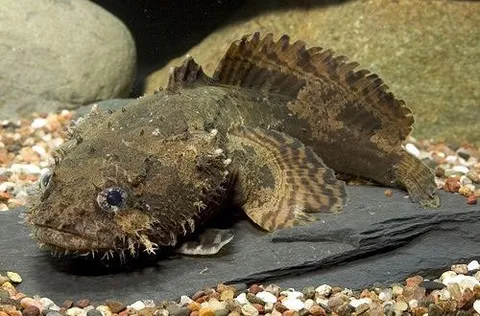
Batrachomoeus trispinosus
The Three-spined Toadfish (scientific name Batrachomoeus trispinosus), belonging to the family Batrachoididae, presents a rather unusual sight. Its appearance, characterized by a massive head and unconventional growths,…
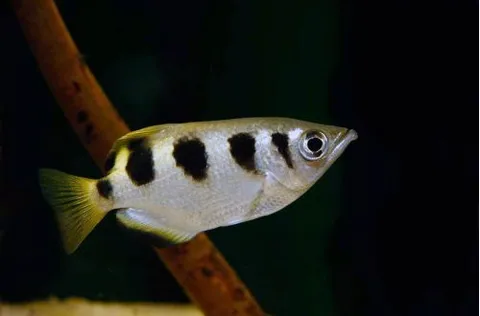
Toxotes jaculatrix
Toxotes jaculatrix, known as the Banded Archerfish, Largescale Archerfish, or simply Archerfish, is a member of the Toxotidae family. This fish is famous for its unique hunting method: it knocks insects off foliage…
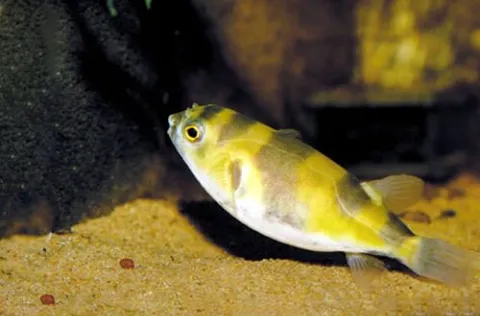
Colomesus psittacus
The Zebra Pufferfish, also known as the Parrot Pufferfish (scientific name Colomesus psittacus), belongs to the family Tetraodontidae. A distinctive feature of this fish is its ability to inflate itself when danger…
Gobioides broussonnetii
This fish, known by several names such as "Purple Goby," Peruvian Goby, or Dragon Goby, has the scientific name Gobioides broussonnetii and belongs to the family Gobiidae. Its appearance is quite bizarre, resembling the…